
Free Tool
Home Generator Sizing Calculator: Find the Right Size in 60 Seconds
Stop guessing. Our free, NEC-aware calculator helps you accurately size a standby generator for your home or project.
Get instant results and a free professional report.
Trusted by project contractors in 80+ countries since 1999
99.7%
Sizing Accuracy
60s
Time to Result
15k+
Monthly Users
Did you know that an undersized generator can damage your appliances, while an oversized unit wastes fuel and money? Whether you are protecting a family home or specifying backup power for a remote project, sizing your generator correctly is the single most important step before you invest.
Trusted by project contractors in 80+ countries since 1999
Home Generator Sizing Calculator
Find the exact kW and kVA required to power your home safely and reliably.
Home Profile
Typically 1 ton per 500-600 sq ft.
Estimated Recommendation
Recommended Generator Range
0
to
0
Kilowatts (kW)
How this is estimated:
1. Build Load Profile
| Appliance | Running Watts | Starting Surge | Qty | Total Run (W) | Action |
|---|---|---|---|---|---|
| Add appliances to build your detailed load profile. | |||||
Reduces base running load to reflect real-world habits. Does NOT reduce surge.
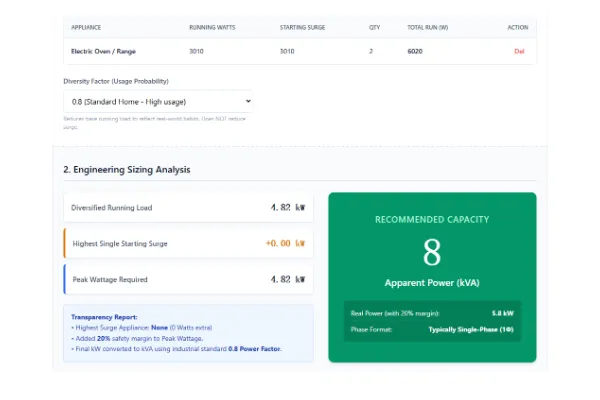
2. Engineering Sizing Analysis
Diversified Running Load
0.0 kW
Highest Single Starting Surge
+0.0 kW
Peak Wattage Required
0.0 kW
Transparency Report:
• Highest Surge Appliance: None (0 Watts extra)
• Added 20% safety margin to Peak Wattage.
• Final kW converted to kVA using industrial standard 0.8 Power Factor.
• Highest Surge Appliance: None (0 Watts extra)
• Added 20% safety margin to Peak Wattage.
• Final kW converted to kVA using industrial standard 0.8 Power Factor.
Recommended Capacity
0
Apparent Power (kVA)
Real Power (with 20% margin):
0.0 kW
Phase Format:
Typically Single-Phase (1Φ)
The Challenge
The Cost of Getting Generator Sizing Wrong
Selecting a generator set based on rough estimates is one of the most expensive mistakes you can make. An undersized genset will struggle to handle motor-starting surges from air conditioners, well pumps, and refrigerators. This leads to voltage drops that can damage sensitive electronics, trip breakers repeatedly, and ultimately shorten the life of the generator itself.
On the other hand, significantly oversizing a unit may seem safe, but it creates its own problems. Diesel and natural gas generators operate most efficiently at 70-80% of their rated load. When consistently underloaded, engines suffer from carbon buildup, incomplete combustion, and poor fuel economy. Over a five-year ownership period, the wasted fuel and maintenance costs can add thousands of dollars to your total cost of ownership.
At Shandong ZC Power, we have spent over two decades manufacturing standby and prime power solutions for hospitals, mines, data centers, and residential developments. We built this calculator because we have seen too many projects start with the wrong specification. Our goal is to give you a precise, code-compliant starting point before you speak with our engineering team or your local installer.
Case Study
A project contractor in Nigeria recently installed a standby generator that was 30% too small for a rural medical clinic. Within three weeks, voltage drops during air-conditioner startup damaged two critical pieces of medical equipment. The total replacement and re-installation cost exceeded the price of the original generator set.
Ready to size your generator with confidence?
Start My Free CalculationHow Our Home Generator Sizing Calculator Works
Unlike generic online calculators that simply add up running watts, our tool follows the same methodology our 80+ engineers use when sizing units for international projects. We account for the real-world factors that determine whether a generator will perform reliably under load.
Two Calculation Modes for Every User
For homeowners who need a fast answer, the Quick Estimate mode asks just three questions: your home’s square footage, your central air conditioner size, and whether you want to power the whole house or just essential circuits. In under a minute, you receive a recommended kW range suitable for your needs.
For contractors, distributors, and facility managers, the Detailed Calculation mode lets you build a complete load profile. You can add individual appliances, enter custom running and starting wattages, and apply a diversity factor based on actual usage patterns. The calculator automatically applies a 20% safety margin and converts your results between kW and kVA using a standard 0.8 power factor.
Every calculation is transparent. You can see exactly how the total was derived, which appliance created the highest surge demand, and why the recommended size was selected.
Benefits
Why Engineers and Homeowners Trust ZC Power
NEC-Compliant Methodology
Our calculator follows National Electrical Code Article 220 standards, the same guidelines professional electricians use for load calculations.
Instant Results + Free PDF Report
Get your size recommendation immediately. Contractors can download a professional report for permit applications and client proposals.
Mobile-First Design
Works perfectly on phones, tablets, and desktops. Use it on the job site, in the office, or during client meetings.
No Email Required for Basic Results
See your recommendation instantly without entering an email address. We do not gate information you need right now.
Backed by 80+ Technical Engineers
Have a complex project? Our engineering team is available to review your calculation and recommend a tailored genset configuration.
Get your accurate generator size in under a minute.
Calculate NowStarting Watts vs. Running Watts: What Most Calculators Miss
If you have ever used a basic generator calculator, you probably noticed it only asks for the wattage listed on your appliance label. That number is the running wattage, the continuous power an appliance draws during normal operation. But for anything with a motor, refrigerator compressor, or air-conditioning unit, the real challenge is the starting wattage.
When a motor first starts, it can draw anywhere from three to six times its running wattage for a brief surge. A standard refrigerator might run on 700 watts, but it needs 2,200 watts to start. A 3-ton central air conditioner might run on 3,500 watts but require 7,000 watts or more at startup.
This is where many online calculators fail. They add up running watts and suggest a generator size that looks fine on paper but collapses the moment your air conditioner tries to cycle on. Our calculator captures both values. We identify the single largest starting surge in your load profile and add it to your total running load. This ensures the genset we recommend can handle the real-world peak demand, not just the steady-state average.
For contractors, this level of accuracy protects your reputation. For homeowners, it means your backup power system works flawlessly when you need it most.
Features
Built for Precision
Dual-Track Calculation Mode
Choose the Quick Estimate for a fast homeowner recommendation, or switch to Detailed Calculation for project-level load analysis with full appliance control.
Serves both residential buyers and professional contractors without forcing complexity on simple jobs.
Starting Watts Analysis
The calculator automatically factors motor-starting surges for air conditioners, well pumps, refrigerators, and freezers.
Prevents the most common generator sizing mistake that leads to voltage drop and equipment damage.
20% Safety Margin
Every result includes a built-in buffer to account for future power needs, equipment degradation, and minor load growth.
Ensures your generator remains adequate even if you add appliances or face higher-than-expected loads.
kW to kVA Conversion
Results display in both kilowatts and kilovolt-amperes using a standard 0.8 power factor.
Makes it easy to match your calculation to manufacturer spec sheets and international procurement requirements.
Visual Load Builder
See a dynamic summary of which appliances your recommended generator will power and which surges drive the total size.
Builds confidence in the result by showing exactly what the generator can handle.
Export-Ready Reports
Download a professionally formatted PDF that documents your load profile, methodology, and recommended generator size.
Perfect for permit submissions, client proposals, and distributor quotations.
Testimonials
What Our Customers Say
“The ZC Power sizing calculator saved us from specifying the wrong unit for a hospital backup system in Kenya. The PDF report was exactly what we needed for the permit application.”
“Finally, a calculator that accounts for starting watts correctly. We use it on every residential installation to confirm our manual calculations before ordering equipment.”
“As a distributor in the UAE, I send this tool to all my clients. It builds trust, eliminates sizing errors, and makes the sales conversation much more professional.”
99.7%
Sizing accuracy rate
60 sec
Average time to complete
15,000+
Calculations completed monthly
80+
Technical engineers on staff
Join thousands who size their generators the right way.
Get My Free Sizing Report
Why Choose Us
ZC Power vs. Other Sizing Calculators
| Feature | ZC Power Calculator | Typical Online Calculator |
|---|---|---|
| NEC Compliance | Built-in methodology | Rarely mentioned |
| Starting Watts Analysis | Included for all motor loads | Often ignored |
| PDF Report Export | Free professional report | Not available |
| Mobile UX | Optimized for all devices | Desktop-only experience |
| Email Gate | No gate for basic results | Usually required |
| Engineering Support | 80+ engineers available | No support |
Our Process
How It Works
Three simple steps to your accurate generator sizing
STEP 1
Choose Your Mode
Select Quick Estimate for a fast homeowner recommendation, or Detailed Calculation for project-level load analysis.
STEP 2
Add Your Loads
Select appliances from our database or enter custom running and starting wattages for your specific equipment.
STEP 3
Get Your Results
See your recommended kW and kVA instantly. Download a free PDF report or request a custom quote from our engineering team.
STEP 1
Choose Your Mode
Select Quick Estimate for a fast homeowner recommendation, or Detailed Calculation for project-level load analysis.
STEP 2
Add Your Loads
Select appliances from our database or enter custom running and starting wattages for your specific equipment.
STEP 3
Get Your Results
See your recommended kW and kVA instantly. Download a free PDF report or request a custom quote from our engineering team.
FAQ
Frequently Asked Questions
For a typical 2,000 square foot home with central air conditioning, a whole-house standby generator in the 20–25 kW range is usually appropriate. Smaller homes or essential-circuits-only setups may only need 8–14 kW. Our calculator gives you an exact recommendation based on your specific appliances and square footage.
Both are critical, but starting wattage often drives the final size. Your generator must be large enough to handle the single largest motor surge in your home, typically from a central air conditioner, well pump, or refrigerator compressor. Our calculator captures both values to prevent undersizing.
Yes. Significantly oversizing a generator leads to poor fuel efficiency, carbon buildup, and incomplete combustion because diesel and gas engines operate best at 70–80% of rated load. Our calculator applies a 20% safety margin, which gives you buffer without pushing into inefficient oversizing territory.
Absolutely. Many jurisdictions require load calculations to comply with the National Electrical Code (NEC) Article 220. Our calculator follows these standards, and the optional PDF report documents the methodology for permit reviewers and inspectors.
Fuel consumption depends on your generator’s efficiency curve and the actual percentage of load it is carrying. Once you know your peak load from our calculator, you can match it to the manufacturer’s fuel consumption table. As a rule of thumb, diesel generators consume roughly 0.28–0.35 liters per kWh at full load.
You have three options. First, you can download a free PDF report for your records or permit application. Second, you can browse our range of home standby and industrial gensets that match your calculated size. Third, you can contact our engineering team for a customized site assessment and factory-direct quotation.