1. Site & Safety Parameters
2. Connected Equipment Profile
| Equipment | Run Watts | Start Watts | Surge Gap | Qty | Total Run (W) | Action |
|---|---|---|---|---|---|---|
| Enter your simultaneous loads above to calculate capacity. | ||||||
Calculate the exact kVA rating for your construction site, mining operation, or critical backup power project. Built by ZC Power’s engineering team with 25+ years of factory-direct manufacturing expertise.
100+
Global Projects
8-4000
kVA Range
80
Engineers
“Oversizing a portable generator wastes fuel and capital. Undersizing it risks catastrophic downtime when critical equipment fails to start. Most online calculators were built for household appliances—not for the motor loads, altitude derating, and continuous runtime demands of industrial job sites. Our calculator was engineered specifically for commercial portable power applications.”
Industrial-grade calculation incorporating surge gaps, PF conversion, and altitude derating
| Equipment | Run Watts | Start Watts | Surge Gap | Qty | Total Run (W) | Action |
|---|---|---|---|---|---|---|
| Enter your simultaneous loads above to calculate capacity. | ||||||
For international contractors and facility managers, a portable generator is not a convenience—it is an operational lifeline. Whether you are powering a remote construction camp, a mobile medical unit, or a mining site’s dust suppression system, the wrong generator size creates a cascade of problems.
An oversized genset burns excess fuel, inflates your capital expenditure, and demands more transport capacity than necessary. An undersized unit will trip its circuit breakers when high-inrush motors start, leaving welders, compressors, and pumps dead in the water. Both scenarios cost money and delay timelines.
A hospital project in Southeast Asia originally specified a 400kW standby genset based on basic running watts. During commissioning, the central chiller compressors failed to start because the Locked Rotor Amps demanded far more starting kVA than the alternator could deliver. ZC Power’s engineering team redesigned the specification with proper motor-starting analysis, delivering a correctly sized unit that now provides seamless backup power for 450 hospital beds.
At ZC Power, we have manufactured portable and trailer-mounted generator sets from 8kVA to 4000kVA since 1999. Our national standard testing center has validated load curves for diesel engines operating at high altitude, in extreme heat, and under continuous prime power conditions.
A hospital project in Southeast Asia originally specified a 400kW standby genset based on basic running watts. During commissioning, the central chiller compressors failed to start because the Locked Rotor Amps demanded far more starting kVA than the alternator could deliver.
Our calculator follows the same methodology our 80 technical engineers use when sizing units for client projects around the world.
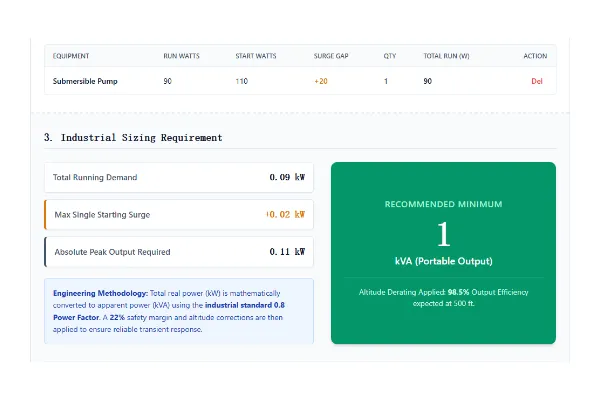
First, we total the running watts of every piece of equipment you intend to power simultaneously. Next, we identify the highest starting watts demanded by any single motor-driven load—typically compressors, submersible pumps, or arc welders. The minimum generator output equals the sum of total running watts plus that single highest starting surge.
From there, we apply a 20 to 25 percent safety margin to account for voltage fluctuations, future load additions, and temperature derating. Finally, we convert your total kilowatt requirement into kVA using a standard industrial power factor of 0.8, which is how commercial generator sets are rated globally.
If your site sits above sea level, the calculator also applies altitude derating—roughly 3 percent power loss for every 1,000 feet of elevation. This is a step most consumer calculators skip, yet it is critical for highland mining and infrastructure projects.
Based on real-world load data from our national standard testing center and 100+ successful international projects.
Automatically factors in high-altitude derating and extreme temperature impacts that consumer calculators ignore.
Delivers results in the standard industrial rating your procurement team and local electrical codes require.
Download a PDF specification sheet you can share with stakeholders or attach to RFQs.
Every calculation is backed by ZC Power’s team of 80 technical engineers.
Portable generator requirements vary dramatically across industries. A construction contractor running tower cranes and concrete vibrators needs a radically different power profile than a hospital facility manager backing up surgical suites.
Construction Sites: Trailer-mounted diesel gensets from 50kVA to 500kVA are typical. Loads include tower cranes, welding machines, batching plants, and site offices. Prime power rating is usually required because the generator runs 10 to 16 hours per day.
Mining Operations: Dust suppression fog cannons, drilling rigs, and ventilation fans demand robust starting capacity. Altitude derating is essential here—many mines operate at 3,000 meters or higher, where a generator loses 10 to 15 percent of its rated output.
Critical Backup: Hospitals and data centers require automatic mains failure (AMF) panels and rapid response times. Standby rating is appropriate here, but you must include every life-safety load in your calculation.
Pre-loaded with construction, mining, medical, and event equipment wattages.
Applies 3% power loss per 1,000 ft above sea level automatically.
Determines whether you need continuous or emergency power ratings.
Converts total kW to required generator kVA using standard 0.8 power factor.
Generate an email-ready technical report in seconds.
Calculates requirements for 50Hz and 60Hz systems worldwide.
| Capability | ZC Power Calculator | Generic Consumer Calculator |
|---|---|---|
| Load Database | Industrial equipment (cranes, pumps, welders) | Home appliances (fridges, TVs) |
| Power Output | kVA + kW (industrial standard) | Watts only |
| Altitude Adjustment | Yes, with 3% derating per 1,000 ft | No |
| Safety Margin | Engineer-recommended 20-25% buffer | None |
| Export Format | PDF technical specification report | None |
| Post-Calculation Support | 80 engineers available for review | None |
“The altitude adjustment alone saved us from ordering an undersized unit for our Andes mining project. ZC Power’s calculator gave us the exact kVA rating we needed, and their engineers verified it within 24 hours.”
“We use this calculator on every remote construction bid. Having a PDF report we can attach to our RFQs streamlines our procurement process significantly.”
100+
successful global projects
80
technical engineers
25
years manufacturing heritage
300k
sqm production facility
8-4000
kVA tailored sizing range
Four simple steps to engineering-grade power specification
Select from our industrial load library or enter custom machinery wattages.
Input altitude, temperature, and prime vs standby requirements.
Receive your minimum generator size in kVA with safety margin applied.
Get a PDF spec sheet you can share with your team or send to our engineers.
Select from our industrial load library or enter custom machinery wattages.
Input altitude, temperature, and prime vs standby requirements.
Receive your minimum generator size in kVA with safety margin applied.
Get a PDF spec sheet you can share with your team or send to our engineers.
Add the running watts of all equipment you will power simultaneously, then add the highest starting watts of any single motor. Apply a 20-25% safety margin and convert to kVA using a 0.8 power factor.
kW measures actual power consumed by your loads. kVA measures apparent power, which includes the power factor. Industrial generators are rated in kVA because they must supply both real and reactive power to motor loads.
For every 1,000 feet above sea level, a naturally aspirated diesel generator loses approximately 3% of its rated output. Turbocharged engines lose less, but derating is still required for accurate sizing.
An undersized generator will trip its circuit breaker when motor loads start, causing downtime. Repeated overloading can also overheat the alternator and damage connected equipment.
Yes, provided the generator’s surge capacity exceeds the starting wattage of the largest motor, and the total running watts of all motors do not exceed the generator’s continuous rating. Staggered starting reduces surge demand.
For permanent or semi-permanent installations, a transfer switch is mandatory for safety and code compliance. It prevents back-feeding into the grid, which protects utility workers and your equipment.