
1 Facility & Environmental Parameters
2 Professional Load Schedule
| Category | Equipment | Run (kW) | Starting Method | Peak (kVA) | Qty | Action |
|---|---|---|---|---|---|---|
| Add your loads above to build the project schedule. | ||||||
Size your facility’s backup or prime power genset with confidence. Accounts for motor starting surges, 3-phase loads, altitude derating, and NEC safety margins. No login required -engineered by ZC Power’s certified specialists.
8 kVA – 4,000 kVA
Genset range
25+
Years expertise
80
Technical engineers
Facilities managers and plant engineers waste weeks on back-and-forth sizing consultations -or worse, they rely on oversimplified calculators that ignore motor starting surges and derating factors. An undersized genset fails when it matters most. An oversized unit wastes capital and fuel. Our calculator bridges the gap between basic web tools and expensive engineering software, giving you a defensible, ISO 8528-aligned load report you can share with your procurement team or building department.
ISO 8528 compliant sizing combining load diversity, starting surges, NEC life-safety logic, and environmental derating.
| Category | Equipment | Run (kW) | Starting Method | Peak (kVA) | Qty | Action |
|---|---|---|---|---|---|---|
| Add your loads above to build the project schedule. | ||||||
Most online calculators ask for your total load in kilowatts, apply a flat safety margin, and return a generic recommendation. That approach works for a residential backup unit powering a refrigerator and a few lights. It fails completely in an industrial environment.
Industrial facilities face challenges that basic calculators ignore:
Mistakes are expensive. Undersizing risks catastrophic load failure. Oversizing leads to wet stacking, carbon buildup, and fuel waste. The industrial sweet spot is typically 70 to 80 percent of rated capacity under normal operating conditions -but reaching that figure requires more than a spreadsheet formula.
A plant engineer in Nigeria recently contacted our team after a 750 kVA standby unit failed to start a 200 HP chiller during a grid outage. The calculator he had used online ignored locked-rotor current entirely. After running our industrial sizing tool, he discovered his true requirement was closer to 1,250 kVA when motor starting sequences were factored in. ZC Power delivered a right-sized, containerized genset within three weeks -and his facility has not experienced a single startup failure since.
Avoid a costly sizing mistake. Run the calculator now.
Calculate My Generator SizeOur calculator was built by the same engineering team that designs ZC Power’s 8 kVA to 4,000 kVA genset range. It combines ISO 8528 methodology with real-world field data from over 100 successful industrial projects across Africa, the Middle East, and Southeast Asia.
Rather than asking for a single total load figure, the tool breaks your facility into logical load categories:
Once your loads are entered, the calculator applies:
The output is not just a number. You receive a professional load schedule showing running kW, starting kVA, power factor, and recommended generator range -formatted for sharing with your electrical contractor, building department, or procurement team.
Engineered to ISO 8528 standards with transparent formulas, not black-box estimates.
Calculates locked-rotor impact so your genset starts your largest motor without voltage sag.
Real-time adjustment for elevation and ambient heat -critical for high-altitude mines and desert installations.
Download a PDF schedule formatted for permit submission, contractor bids, or internal capex approval.
Instantly see available ZC Power gensets in your calculated range with factory-direct pricing.
Residential calculators focus on running watts for household appliances -refrigerators, air conditioners, and sump pumps. The math is straightforward because surge loads are modest and single-phase.
Industrial sizing is an entirely different discipline. A manufacturing plant may have:
Our calculator is designed for these complexities. It does not dumb down the problem. It guides you through each variable with plain-language explanations alongside the technical inputs -so facilities managers can collaborate with electrical engineers without getting lost in jargon.
Ready to size your facility’s power system?
Start the CalculatorEnter loads per phase and receive a balance score. Unbalanced systems cause excessive neutral current and premature alternator heating.
Input your site’s elevation and maximum ambient temperature. The calculator applies standard derating curves per ISO 3046 to ensure rated output at your actual conditions.
Fire pump loads have unique requirements under NFPA 20 and NEC Article 695. Our calculator sizes these independently and flags when your standby unit must carry them alongside normal facility loads.
After sizing, select diesel, natural gas, or dual-fuel operation and estimate fuel consumption at 25%, 50%, 75%, and 100% load. Runtime estimates help size day tanks and fuel delivery contracts.
Export a formatted load schedule showing running kW, starting kVA, power factor, diversity factor, derating adjustments, and recommended generator range with ZC Power model numbers.
Once your size is calculated, see live availability and factory-direct pricing for matching ZC Power gensets -from open-frame industrial units to containerized, sound-attenuated packages.
Industrial buyers often confuse kilowatts (kW) with kilovolt-amperes (kVA). The difference is not academic -it determines whether your generator can actually carry your load.
kW is real power -the actual work your motors and heaters perform.
kVA is apparent power -the total power the generator must supply, including reactive power for magnetic fields in motors and transformers.
The relationship is governed by power factor (PF):
kVA = kW / PF
Most industrial facilities operate at a power factor between 0.75 and 0.85 due to inductive motor loads. At 0.8 PF, a 500 kW load requires 625 kVA of generator capacity. A calculator that only sums kW and ignores power factor will undersize your unit by 20 to 25 percent.
Our calculator defaults to 0.8 PF but allows you to adjust based on your facility’s actual power factor -measured with a power quality analyzer or taken from your utility bill. For sites with heavy motor loads or poor power factor, we also flag whether power factor correction capacitors should be considered before finalizing the generator size.
“We were quoted a 2,000 kVA unit by a local distributor for our cement plant. ZC Power’s calculator showed our true steady-state load was closer to 1,250 kVA with proper diversity factoring. We saved over $80,000 on the genset alone, plus reduced our fuel storage requirements.”
“The load report export was exactly what our building department needed for the standby generator permit. The motor starting analysis alone justified the 1,500 kVA specification we submitted. No rework, no delays.”
“Our mine operates at 1,800 meters altitude. Every other calculator gave us a sea-level number. ZC Power’s tool applied altitude derating automatically and recommended a 1,000 kVA unit where others said 750 kVA would suffice. That difference prevented a startup failure during our first grid outage.”
Get a sizing report that accounts for your real operating environment.
Calculate My Generator Size| Capability | ZC Power Calculator | Basic Online Calculators |
|---|---|---|
| Motor Starting Surge Analysis | Locked-rotor kVA by HP and starting method | Flat safety margin only |
| 3-Phase Load Balancing | Per-phase entry with balance scoring | Single total load input |
| Altitude Derating | Auto-adjusted by elevation | Not included |
| Temperature Derating | Ambient temp input with ISO curves | Not included |
| Power Factor Input | Adjustable 0.7 to 1.0 | Fixed 0.8 or ignored |
| NEC Fire Pump Logic | NFPA 20 / Article 695 compliant | Not included |
| Professional PDF Export | Permit-ready load schedule | No export |
| Direct Equipment Matching | Live ZC Power inventory + pricing | Generic affiliate links |
From site conditions to professional report in minutes
Input system voltage, phase configuration, altitude, and maximum ambient temperature. These factors determine your derating multiplier before any load is calculated.
Enter HVAC, motors, general facility loads, and life-safety equipment. The calculator pre-fills typical industrial values you can adjust to match your actual equipment.
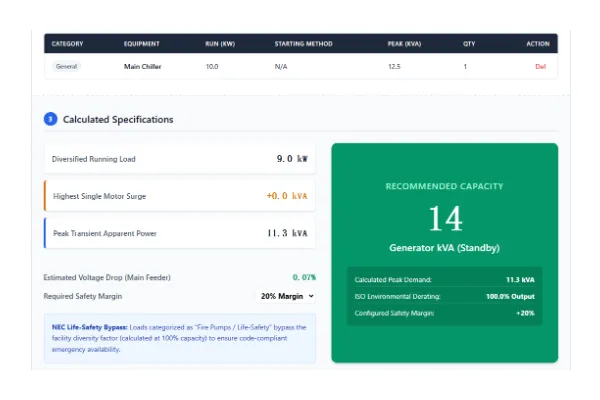
Inspect running kW, starting kVA, power factor, and diversity-adjusted total. Toggle safety margins and motor starting methods to optimize your specification.
Export a PDF load schedule for your contractor or building department -or request a factory-direct quote for matching ZC Power gensets with delivery timeline.
Input system voltage, phase configuration, altitude, and maximum ambient temperature. These factors determine your derating multiplier before any load is calculated.
Enter HVAC, motors, general facility loads, and life-safety equipment. The calculator pre-fills typical industrial values you can adjust to match your actual equipment.
Inspect running kW, starting kVA, power factor, and diversity-adjusted total. Toggle safety margins and motor starting methods to optimize your specification.
Export a PDF load schedule for your contractor or building department -or request a factory-direct quote for matching ZC Power gensets with delivery timeline.
Start by listing every load the generator must power, including running watts and starting watts for motor-driven equipment. Add all running loads together, then add the single highest starting surge. Apply a 20 to 30 percent safety margin for future expansion and derating. Our calculator automates this entire process and accounts for motor starting methods, altitude, and temperature.
kW measures real power -the actual work performed by your equipment. kVA measures apparent power -the total capacity the generator must supply, including reactive power for magnetic fields. The ratio between them is power factor, typically 0.8 in industrial settings. A 500 kW load at 0.8 PF requires a 625 kVA generator.
Motor-driven equipment like compressors and chillers can draw 3x to 6x their running current at startup. If the generator cannot supply this locked-rotor current while maintaining voltage within plus-or-minus 10 percent, the motor will fail to accelerate and may trip protection devices across your facility. Our calculator analyzes this surge requirement and recommends soft starters or VFDs if needed.
Standby-rated generators are designed for emergency use with variable load and no overload capability. Prime-rated units handle continuous variable load with a 10 percent overload allowance for one hour in twelve. If your facility needs backup power only during grid outages, standby rating is sufficient. For off-grid or unreliable grid operation, choose prime power.
Industry best practice is a 20 to 25 percent safety margin above your calculated peak load. Some critical facilities add up to 30 percent. However, oversizing beyond this range causes chronic underloading, leading to wet stacking and poor fuel efficiency. Our calculator lets you adjust the safety margin and warns if your result falls outside the optimal 70 to 80 percent utilization range.
Yes. Thinner air at high altitude reduces both engine combustion efficiency and alternator cooling. Standard derating is approximately 3 to 4 percent per 300 meters above sea level. A 1,000 kW genset at sea level may only deliver 750 to 800 kW at 2,000 meters elevation. Our calculator applies this derating automatically based on your site’s altitude.
Online calculators are an excellent starting point for estimation and budget planning. However, for complex industrial facilities with multiple large motors, non-linear loads, or strict regulatory requirements, we recommend validating the calculator output with a licensed electrical engineer before finalizing procurement. Our PDF load report is formatted specifically to streamline that professional review.
Diesel remains the dominant choice for heavy-duty industrial applications due to its high energy density, reliability, and widespread fuel availability. Natural gas is cleaner and works well where pipeline access exists. Dual-fuel units offer flexibility. Our calculator includes fuel consumption estimates for diesel, natural gas, and dual-fuel operation to help you compare operating costs.