
Calculate Generator Fuel Costs in Seconds — Engineered for Real-World Accuracy
Estimate diesel, gasoline, propane, and natural gas consumption for any generator size. Built on 25+ years of manufacturer testing data from ZC Power.
25+
Years Testing Data
Multi
Fuel Types
80+
Engineers
Planning a remote construction project or sizing backup power for a hospital? Fuel costs typically represent 60-80% of a generator’s total operating expense over its lifetime. Yet most online calculators rely on generic estimates that ignore engine brand efficiency, altitude derating, and load curves — leading to budget overruns, inadequate tank sizing, and costly operational surprises.
ZC Power Fuel Consumption Calculator
Professional ISO 3046 sizing tool for fuel burn analysis, operating cost estimates, and tank sizing.
Why Generic Fuel Calculators Fall Short on Real Projects
Most online generator fuel consumption calculators provide a single, flat estimate based on kilowatt rating alone. In practice, this approach misses critical variables that determine actual fuel burn on your job site.
A 500kW generator running at 25% load does not consume fuel proportionally. In fact, diesel engines operating below 30% load suffer from incomplete combustion, a condition known as wet stacking, which wastes fuel and accelerates wear. Conversely, pushing a unit to 100% continuous load without accounting for ambient temperature or altitude can inflate consumption by 10-15% above nameplate ratings.
Generic calculators also fail to distinguish between engine brands. A 500kW genset powered by a Cummins QSK19 Series engine delivers measurably different specific fuel consumption (SFC) than a generic or uncertified engine sourced from an assembly shop. At ZC Power, every generator undergoes rigorous full-load testing in our national standard testing center, where we record actual fuel curves across 25%, 50%, 75%, and 100% loads — not theoretical estimates.
The result? Project contractors who rely on simplified calculators often discover, mid-project, that their fuel budget is off by 20-30%. For a 1,000-hour deployment in Africa or the Middle East, that miscalculation can translate to thousands of dollars in unplanned fuel delivery costs and operational delays.
A mining contractor in North Africa discovered their 500kW genset was consuming 30% more diesel than budgeted due to altitude derating ignored by generic calculators. ZC Power’s engineering team recalibrated estimates with proper load curves and environmental factors, saving the project $12,000 in unplanned fuel costs over three months.
Need accurate fuel estimates for your project budget?
Talk to a ZC Power EngineerHow the ZC Power Fuel Calculator Works
Our calculator is built on the same formulas our 80+ engineers use when designing gensets for real-world deployments. It goes beyond simple kilowatt multiplication to deliver estimates you can trust.
1. Load-Adjusted Calculation
Enter your generator’s rated kW or kVA and your expected operating load percentage. The calculator applies a load-efficiency curve derived from actual Cummins, Perkins, Yuchai, and Weichai engine test data, not generic assumptions. This captures the reality that fuel consumption per kWh improves as load increases from 25% toward the 70-85% optimal range.
2. Multi-Fuel Support
Select diesel, gasoline, propane (LPG), or natural gas. Each fuel type carries a distinct specific fuel consumption rate and energy density. The calculator automatically adjusts for these differences, giving you consumption in liters per hour, gallons per hour, or cost per kWh in your local currency.
3. Climate and Altitude Adjustments
Operating above 1,500 meters? In a desert climate above 40 degrees Celsius? The calculator applies derating factors based on ISO 3046 standards, adjusting fuel estimates for reduced air density and engine cooling efficiency — a critical feature for projects in Africa, the Middle East, and high-altitude mining operations where ZC Power equipment is commonly deployed.
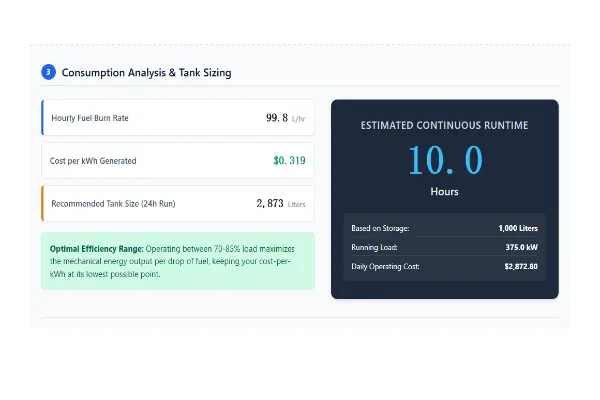
4. Tank Sizing and Runtime
Beyond hourly fuel burn, the calculator estimates total runtime based on your tank or fuel storage capacity. It includes a recommended 20% safety buffer to account for unforeseen load spikes and temperature variations, helping you size on-site fuel storage correctly from day one.
Why Procurement Managers Trust This Calculator
Engineering-Grade Accuracy
Built on test data from our national standard testing center, not generic internet formulas.
Multi-Fuel Comparison
Compare diesel, gasoline, propane, and natural gas consumption side by side for informed fuel strategy.
Climate & Altitude Intelligence
Automatic derating adjustments for high-altitude and extreme-temperature project sites.
Direct Link to Genset Models
See matching ZC Power generator sets calibrated to your calculated load and runtime requirements.
Instant Cost Estimates
Enter your local fuel price to see hourly, daily, and total project fuel costs in seconds.
See how accurate fuel estimates protect your project margin.
Request Factory-Direct PricingTypical Fuel Consumption by Generator Type (500kW at 75% Load)
| Fuel Type | Consumption (L/hr) | Cost per kWh (USD) |
|---|---|---|
| Diesel (Industrial Grade) | 94-105 L/hr | $0.12 – $0.18 |
| Natural Gas (Pipeline) | 140-160 m³/hr | $0.08 – $0.12 |
| Gasoline (Portable) | Not recommended | $0.25+ |
| Propane (LPG) | 120-135 L/hr | $0.15 – $0.22 |
Diesel vs. Natural Gas vs. Propane: Choosing the Right Fuel
Diesel remains the dominant choice for industrial and prime power applications between 100kW and 4,000kW. It offers the highest energy density per liter, widespread global availability, and excellent load-response characteristics. For remote construction sites, mining operations, and hospital standby systems, diesel gensets provide the reliability and fuel accessibility that project managers depend on.
Natural gas generators are increasingly popular for stationary installations with pipeline access, such as data centers and commercial buildings. While natural gas has lower energy density than diesel, the per-kWh fuel cost is often 20-30% lower where pipeline infrastructure exists. ZC Power offers dual-fuel and gas-powered configurations for clients with consistent gas supply.
Propane (LPG) fills a niche for environments where emissions regulations are strict or diesel storage is impractical. Propane burns cleaner and stores indefinitely without degradation, making it suitable for emergency standby systems in urban or environmentally sensitive locations. However, propane’s higher cost per kWh and lower energy density typically limit its use to smaller installations or specific regulatory environments.
Gasoline is generally not recommended for continuous or heavy-duty industrial use due to higher fuel consumption, shorter engine life, and safety concerns with fuel storage at scale. ZC Power focuses on diesel and gas solutions for all commercial and industrial applications.
The ZC Power Fuel Efficiency Advantage
Fuel consumption is not just about the engine brand — it is about how the entire generator set is engineered, cooled, and controlled. At ZC Power’s 300,000-square-meter manufacturing facility in Jining, Shandong, every genset is optimized for real-world efficiency before it leaves the factory floor.
Optimized Engine Cooling
Our water-cooled diesel generators feature radiator and fan systems sized for continuous operation in ambient temperatures up to 50 degrees Celsius. Efficient cooling maintains optimal combustion temperatures, preventing the fuel waste that occurs when engines overheat or run too cool.
Authentic Component Integration
We pair world-leading diesel engines — Cummins, Perkins, Yuchai, and Weichai — with Stamford or Leroy-Somer alternators and Deep Sea Electronics (DSE) digital controllers. This ensures that the engine operates within its peak efficiency map, rather than compensating for mismatched or substandard alternator loads that increase fuel burn.
Smart Load Management
Our DSE and SmartGen control panels include advanced AMF (Auto Mains Failure) and load-demand management features. In multi-unit parallel configurations, the controller automatically starts and stops gensets based on real-time load, ensuring each running unit operates in its most efficient load band rather than idling at partial capacity.
Verified by Testing, Not Marketing
Before any generator ships, it undergoes a full load-bank test at our national standard testing center. Engineers record actual fuel consumption at 25%, 50%, 75%, and 100% rated load. These are the same figures that feed our calculator — not estimates from a brochure.
The result? ZC Power gensets consistently deliver fuel consumption figures that meet or exceed the engine manufacturer’s published SFC curves, giving project contractors confidence that their operating budgets are built on verified data.
Ready to size fuel storage and budget with confidence?
Get a Custom Quote Based on Your CalculationFrequently Asked Questions About Generator Fuel Consumption
The standard formula is: Hourly Fuel (L) = Actual Load (kW) x Specific Fuel Consumption (L/kWh). For most industrial diesel engines, SFC ranges from 0.20 to 0.28 L/kWh depending on engine efficiency and load. At ZC Power, our calculator uses SFC curves derived from actual Cummins, Perkins, and Yuchai engine test data rather than generic averages, giving you a more accurate estimate for project planning.
At 75% load, a quality 100kW diesel generator typically consumes approximately 18-22 liters per hour. At 100% load, expect 24-28 L/hr. At 50% load, consumption drops to roughly 12-15 L/hr, though efficiency per kWh is slightly lower. Propane and natural gas units will show different rates due to lower energy density. Our calculator provides precise estimates based on your specific load and fuel type.
For continuous industrial use between 100kW and 4,000kW, diesel generators are generally the most fuel-efficient in terms of energy output per liter. However, where pipeline natural gas is available, gas gensets can offer lower per-kWh operating costs despite slightly lower thermal efficiency. The most efficient setup often involves running units in their optimal load band of 70-85% rated capacity.
Fuel consumption increases with load, but not linearly. Diesel engines typically achieve their best fuel efficiency (lowest L/kWh) between 70% and 85% rated load. Below 30%, engines suffer from wet stacking — incomplete combustion that wastes fuel and damages the engine. Above 90% continuous load, fuel consumption per kWh rises again due to thermal stress. Our calculator accounts for these real-world efficiency curves.
Multiply your hourly fuel consumption by your local fuel price per liter, then multiply by total operating hours. Example: A 500kW genset at 75% load consuming 100 L/hr, running 10 hours per day for 30 days, at $0.90 per liter diesel = 100 x 0.90 x 300 = $27,000 in fuel costs. Remember to add a 15-20% buffer for load spikes, temperature variations, and fuel degradation during storage.
Specific Fuel Consumption (SFC) measures how much fuel an engine burns to produce one kilowatt-hour of electrical output, expressed in liters per kWh (L/kWh) or grams per kWh (g/kWh). Modern industrial diesel engines typically achieve 0.20-0.24 L/kWh at optimal load. Lower SFC means better efficiency. ZC Power publishes verified SFC figures from our national testing center for each generator model.
A 500kW industrial diesel generator at 75% load (375kW actual output) typically consumes 94-105 liters per hour when equipped with a high-efficiency Cummins or Perkins engine. At 100% load, expect 120-135 L/hr. At 50% load, consumption drops to roughly 65-75 L/hr. Exact figures depend on engine brand, alternator efficiency, ambient temperature, and altitude.
Divide your tank capacity (in liters) by hourly fuel consumption. Example: A 500kW genset burning 100 L/hr with a 1,000-liter base tank will run approximately 10 hours at 75% load. For critical applications, ZC Power recommends sizing fuel storage for at least 24-72 hours of continuous runtime, plus a 20% safety margin to account for load fluctuations and supply delays.
Yes. For every 300 meters above sea level, diesel engine power output drops approximately 3-4% due to reduced air density, and fuel consumption per kWh increases correspondingly. At 2,000 meters, a generator may consume 10-15% more fuel per kWh than at sea level. Our calculator includes altitude derating factors based on ISO 3046 standards for accurate high-elevation project estimates.
Where pipeline natural gas is available, the per-kWh fuel cost is typically 20-30% lower than diesel. However, natural gas has lower energy density, so gas generators require larger engines for the same kW output. For remote sites without pipeline access, diesel remains more practical due to easier fuel transport and storage. ZC Power offers both diesel and gas configurations to match your site infrastructure.
