Voltage Drop Calculator
Calculate Voltage Drop, Wire Size, and Generator kVA in One Tool
Get NEC, IEC, and AS/NZS-compliant voltage drop and conductor sizing in seconds. Then connect with our factory engineers to specify the right generator set for the cable run and load. Trusted by project contractors across 50+ countries.
25+
Years Experience
80+
Engineers
50+
Countries
Voltage Drop Calculator
NEC, IEC & AS/NZS Wire Sizing with Generator Bridge
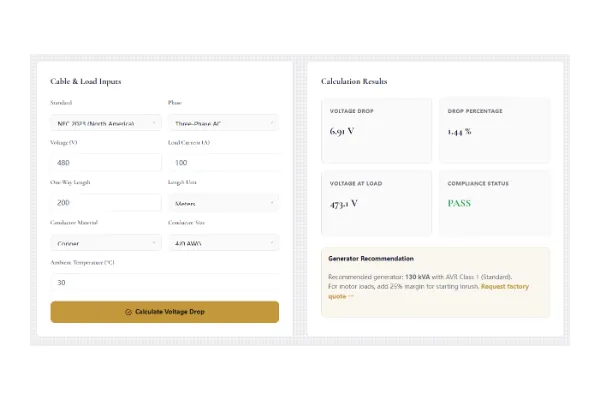
Input your cable and load parameters. Get voltage drop, conductor pass/fail, and recommended generator kVA in seconds.
Cable & Load Inputs
Calculation Results
Voltage Drop
— V
Drop Percentage
— %
Voltage at Load
— V
Compliance Status
—
Why Voltage Drop Matters
The Hidden Cost of Underestimating Voltage Drop
An undersized cable does not just dim the lights at the end of the run—it stalls motor starts, trips protective devices, and ages your generator’s alternator prematurely. Most online voltage drop calculators give you a percentage and leave you to guess what to do with it. ZC Power’s factory-engineered calculator returns the drop, the wire size, and the matching generator kVA—reviewed by 80+ technical engineers who size power systems for projects across mining, oilfields, construction, and data centers.
On paper, a 5% voltage drop sounds harmless. In practice, it can disqualify your project from acceptance testing. A 480V three-phase feeder losing 5% on a 200-meter run delivers only 456V at the load. Motors will struggle to start, VFDs may trip on undervoltage, and any sensitive electronics behind that feeder will operate outside their rated tolerance.
The problem compounds on remote sites. Mining operations, oilfield wellheads, agricultural irrigation pumps, and modular construction yards routinely run cables 150–400 meters from the generator to the load. Standard NEC tables based on short residential runs simply do not apply—and the voltage drop is rarely the only issue. The generator’s automatic voltage regulator (AVR) must compensate, the alternator must absorb reactive load, and motor starting inrush amplifies the dip by a factor of 4 to 8.
Accurate Voltage Drop & % Calculations
Resistance and reactance values from NEC Table 8, IEC 60228, and AS/NZS 3008 reference tables.
Tri-Standard Compliance Check
Pass/fail against NEC 3%/5%, IEC 60364, and AS/NZS 3008 limits in one screen.
Motor Starting Voltage Sag Mode
Models LRA inrush so you know if your motor will start at the end of a long cable run.
Integrated Generator Sizing
Recommends generator kVA, AVR class, and alternator capacity to hold voltage at the load.
Ready to verify voltage drop and generator sizing in one step?
Get My Free Voltage Drop Report
Calculator Features
Engineering-Grade Calculation & Generator Sizing
Tri-standard compliance with integrated power system specification. One tool serves every market ZC Power exports to.
Tri-Standard Switcher
Toggle between NEC 2023, IEC 60364, and AS/NZS 3008. Each standard applies its own permissible drop, conductor ampacity tables, and ambient temperature corrections.
One tool serves every export market
Reverse-Solve Wire Sizing
Switch from ‘calculate voltage drop’ mode to ‘find minimum wire size’ or ‘find maximum distance’ mode. Iterates through standard conductor sizes until the result meets your target drop.
Cut hours of trial-and-error to one click
Motor Starting Voltage Sag Mode
Enter locked rotor amperage (LRA) and the calculator models the transient voltage at the motor terminals during DOL, soft-start, or VFD starting.
Prevents remote-site motor starting failure
Generator kVA & AVR Class Bridge
Translates the calculated drop and starting sag into a recommended generator set kVA rating and AVR class. Compares cable upsizing against generator upsizing.
Complete power system specification in one workflow
Copper vs. Aluminum Cost Optimizer
Side-by-side comparison of copper and aluminum conductors at equivalent voltage drop performance. Includes resistance, weight, and indicative cost per meter.
Pick the conductor that meets specs and budget
PDF Report Export
Generate a one-page PDF report of the calculation including inputs, results, standard reference, and ZC Power engineer review fields. Ready to attach to RFQ documents.
Documentation-ready output for procurement
Engineering Excellence
Engineering Accuracy That Protects Your Project
Shandong ZC Power CO., LTD. has manufactured industrial generator sets and power systems equipment since 1999. Our 300,000 square meter facility in Jining, Shandong operates a national standard testing center where every generator set undergoes full-load validation before shipment.
1
25+ Years
Of power systems manufacturing experience with continuous engineering improvement.
2
80+ Engineers
Technical engineers verify your calculation and confirm generator specifications.
3
300,000 m²
Production facility with national standard testing center for full-load validation.
4
50+ Countries
Export track record across Africa, the Americas, the Middle East, and Southeast Asia.
Certifications
ISO9001
CE Certified
CCC Certified
How It Works
From Calculation to Power System Delivery
Four steps from cable sizing to factory delivery.
STEP 1
Select Your Standard
Choose NEC 2023, IEC 60364, or AS/NZS 3008 based on your project market.
STEP 2
Enter Cable & Load Inputs
Input load current, one-way length, voltage, phase, conductor material, and size.
STEP 3
Review Drop, Wire Size & Generator kVA
Get voltage drop %, conductor sizing pass/fail, and recommended generator kVA + AVR class.
STEP 4
Submit for Engineer Review & Factory Quote
Forward the PDF report to receive a verified spec and a factory-direct genset quotation.
STEP 1
Select Your Standard
Choose NEC 2023, IEC 60364, or AS/NZS 3008 based on your project market.
STEP 2
Enter Cable & Load Inputs
Input load current, one-way length, voltage, phase, conductor material, and size.
STEP 3
Review Drop, Wire Size & Generator kVA
Get voltage drop %, conductor sizing pass/fail, and recommended generator kVA + AVR class.
STEP 4
Submit for Engineer Review & Factory Quote
Forward the PDF report to receive a verified spec and a factory-direct genset quotation.
Testimonials
Trusted by Power Systems Engineers Worldwide
“Most voltage drop tools stop at the percentage. ZC Power’s calculator told me my 320-meter feeder needed either a heavier copper or a higher AVR class genset—and showed me the cost trade-off. We chose the containerized 500kW unit and saved 18% on copper alone.”
“We were sizing a hospital backup feeder under IEC 60364. The calculator instantly verified compliance and flagged the motor starting sag for the chiller pumps. The factory engineering review came back the same day with a confirmed genset spec.”
“Long cable runs across our agricultural site were causing pump motors to stall on start. ZC Power’s engineers used the calculator to model the inrush, then redesigned the system with a containerized genset closer to the load. Zero start failures since.”
Trusted By
EPC Contractors
Power Consultants
Project Engineers
FAQ
Frequently Asked Questions
Common questions about voltage drop and generator sizing.
For single-phase or DC circuits, use Vd = (2 × I × L × R) / 1000. For three-phase circuits, use Vd = (√3 × I × L × R) / 1000. Here I is the current in amps, L is the one-way length in feet or meters, and R is the conductor resistance per 1000 feet or 1000 meters. Our calculator applies measured NEC Table 8, IEC 60228, or AS/NZS 3008 resistance values automatically.
NEC 210.19(A) Informational Note No. 4 recommends a maximum 3% voltage drop on branch circuits and a combined 5% drop across feeders plus branch circuits. These are recommended best practices, not mandatory code requirements, but exceeding them risks equipment underperformance and protection coordination issues.
IEC 60364-5-52 recommends a maximum 4% voltage drop from the supply origin to any point of utilization for lighting circuits, and 6% for other circuits, when supplied directly from the public network. AS/NZS 3008 typically limits drop to 5% between the point of supply and any point in the installation. Our calculator applies the correct limit automatically based on the standard you select.
Yes. The generator’s automatic voltage regulator (AVR) must compensate for cable losses, which reduces the alternator’s available headroom for load and reactive surges. On long runs, the more cost-effective answer is often a higher AVR class or a larger alternator rather than heavier copper. Our calculator surfaces both options with cost implications.
Motor starting voltage at the terminals must remain above approximately 80% of nominal to ensure the motor latches into running mode. Locked rotor inrush of 4–8x full-load current causes a transient voltage dip that can violate this threshold even when steady-state drop is within limits. Our calculator’s motor starting mode models this transient explicitly.
Copper has roughly 61% of aluminum’s resistance per unit area, so equivalent voltage drop with aluminum requires roughly two AWG sizes larger conductors. Copper is the better technical choice for long runs and motor circuits, while aluminum can reduce material cost on shorter, well-supported feeders. The calculator compares both materials side-by-side at equivalent performance.
When cable runs exceed roughly 150–200 meters and loads exceed 100kW, the capital cost of upsizing copper often exceeds the cost of placing a containerized generator set closer to the load. Distributed generation also eliminates the long-term I²R energy losses that scale with cable length. Our engineering team can model both scenarios for your specific project.
Yes. After running the calculation, export the PDF report and submit it through the engineering review form. ZC Power’s 80-engineer technical team will verify the inputs, confirm the recommended generator kVA and AVR class, and return a factory-direct quotation with delivery timeline within one to two business days.