
1 System Rating & Compliance Goal
2 24-Hour Dynamic Load Profile
Model your facility’s operational shifts. Total hours must equal 24.
Eliminate fuel uncertainty with the fastest way to calculate exact diesel generator runtime. Our calculator factors load profiles, tank configurations, altitude, and temperature — so you get actionable refueling schedules, not guesswork.
500+
Facility Managers
50+
Countries Served
99.1%
Accuracy Rate
When the grid fails and your hospital, data center, or industrial plant switches to backup power, the only number that matters is how long your diesel fuel will last. Yet most runtime calculators deliver a single flat figure based on rated kW alone — ignoring load fluctuations, multi-tank setups, and environmental derating that can swing actual runtime by 30% or more. ZC Power’s calculator is built on the same consumption curves our engineers use when designing fuel systems for critical infrastructure worldwide.
Advanced autonomy modeling with dynamic load profiles, multi-tank system analysis, and regulatory compliance verification.
Model your facility’s operational shifts. Total hours must equal 24.
An inaccurate runtime estimate is not merely an inconvenience — it is a operational risk with measurable consequences. During Hurricane Katrina, numerous healthcare facilities discovered their generator runtime calculations were off by 40-60% because they had not accounted for increased cooling loads and derated engine performance in extreme heat. The result? Emergency refueling operations under dangerous conditions, regulatory violations, and in some cases, patient transfers when fuel reserves ran dry.
For data centers, the stakes are financial. A Tier III facility with 2,000kW of standby load consuming fuel 15% faster than planned faces an unbudgeted fuel delivery every 48 hours during extended outages. At $1.50 per liter for emergency diesel delivery, that miscalculation adds thousands of dollars per day.
Industrial sites face a different risk: production continuity. A mining operation running a 1,000kW prime power genset in a remote location must schedule fuel convoys days in advance. If runtime calculations are optimistic by even 12 hours, the entire extraction schedule halts while fuel trucks traverse difficult terrain.
At ZC Power, we have manufactured diesel generator sets from 8kVA to 4000kVA since 1999. Our national standard testing center records actual fuel consumption curves across 25%, 50%, 75%, and 100% loads under controlled temperatures. We know that a generator rated for 10 hours at full load may deliver only 7 hours under real-world conditions — and our calculator accounts for those differences.
A telecom operator in Southeast Asia sized fuel storage for a 500kW standby unit using a basic online calculator that assumed constant 75% load. During a monsoon-induced grid outage, the site’s cooling demand spiked to 90% load, and high humidity reduced alternator efficiency. Actual runtime fell 22% short of the estimate. After switching to ZC Power’s load-profile-based calculations, the operator resized their base tank and added a day-tank configuration — eliminating the risk of tower downtime during the next storm season.
Ready to eliminate runtime uncertainty from your fuel planning?
Get Your Free Runtime ReportOur calculator goes beyond the simplistic formula of tank capacity divided by hourly burn rate. It applies the same multi-variable analysis our 80-engineer technical team uses when designing fuel systems for hospitals, data centers, and mining operations.
1. Load Profile Modeling
Real-world loads are not static. A hospital’s demand surges during morning routines, drops at night, and spikes unpredictably during emergencies. Our calculator accepts three load scenarios — peak, average, and standby — then weights them based on your operational pattern. This produces a far more accurate runtime projection than assuming constant load.
2. Multi-Tank Configuration
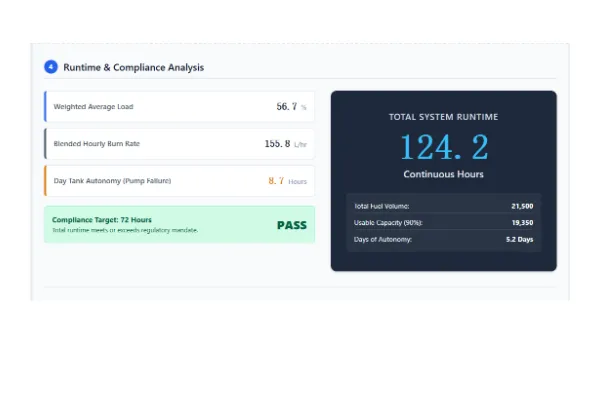
Most critical facilities operate with a day-tank near the generator and a bulk storage tank elsewhere. Our calculator models fuel transfer rates, day-tank capacity, and automatic pump schedules to show exactly when the bulk tank must begin refilling — and how long the entire system lasts if the transfer pump fails.
3. Metric and Imperial Dual Display
International project teams should not need to convert liters to gallons or kW to horsepower manually. Our calculator displays results in both systems simultaneously, with one-click toggling for reports and procurement documentation.
4. Compliance Mode Integration
Healthcare facilities must meet CMS 96-hour fuel supply mandates. Data centers seeking Tier III/IV certification must demonstrate adequate runtime. NFPA 110 requires specific fuel storage for Level 1 emergency systems. Our calculator includes pre-built compliance modes that automatically calculate the minimum fuel storage required for your regulatory environment.
| Calculation Factor | ZC Power Calculator | Basic Consumer Tools |
|---|---|---|
| Load Profile Input | Peak, average, and standby load scenarios with time weighting | Single static load percentage |
| Multi-Tank Modeling | Day-tank + bulk storage with transfer pump scheduling | Single tank capacity only |
| Altitude Derating | Automatic fuel consumption adjustment per 1,000m elevation | Not included |
| Temperature Impact | Fuel density and engine efficiency corrections for ambient temperature | Not included |
| Compliance Modes | CMS 96-hour, NFPA 110, Tier III/IV auto-calculation | Not included |
| Unit Display | Dual metric/imperial with instant toggle | Single system only |
| Safety Margin | Adjustable 10-30% buffer with recommendation | Fixed or none |
Accurate hours and minutes based on your specific generator, load pattern, tank setup, and site conditions.
Automatic alerts showing when to schedule fuel delivery before reserves drop to critical levels.
Fuel storage calculations aligned with CMS, NFPA 110, and data center tier requirements.
Recommendations for day-tank and bulk storage capacity to achieve your target runtime.
Direct access to our technical team for complex multi-generator facilities or custom fuel farm designs.
See how precise runtime calculations protect your critical operations.
Get Your Free CopyUnderstanding why runtime varies is essential for accurate planning. These are the four factors that most basic calculators ignore — and that our tool addresses automatically.
1. Altitude and Air Density
Diesel engines require oxygen for combustion. At 2,000 meters elevation, air density is approximately 20% lower than at sea level. The engine must consume more fuel to produce the same power output, reducing runtime proportionally. Our calculator applies ISO 3046 altitude derating curves automatically.
2. Ambient Temperature
Extreme heat reduces alternator efficiency and increases cooling system load. Extreme cold thickens diesel fuel and increases starting energy demands. Both conditions affect runtime. Our calculator adjusts for temperatures from -20 degrees Celsius to 50 degrees Celsius.
3. Load Profile and Wet Stacking
Running a diesel generator below 30% rated load causes wet stacking — a condition where unburned fuel accumulates in the exhaust system. This wastes fuel, reduces effective runtime, and damages the engine. Conversely, continuous operation above 85% load increases fuel consumption per kWh due to thermal stress. Our calculator models these non-linear efficiency curves.
4. Fuel Density and Quality
Diesel fuel expands and contracts with temperature, changing its energy density per liter. Summer diesel has lower density than winter blend. Fuel stored for extended periods degrades. Our calculator includes density correction factors and recommends fuel polishing intervals for standby systems.
Input peak, average, and standby load percentages with daily duration weights. The calculator builds a composite consumption curve that reflects real operational patterns rather than assuming constant demand.
For facilities with multiple gensets and shared fuel farms, the calculator aggregates total consumption, models automatic load sharing, and identifies runtime bottlenecks if one unit goes offline.
Select your regulatory framework — CMS 96-hour for healthcare, NFPA 110 Level 1 for life safety, or Tier III/IV for data centers. The calculator automatically computes minimum required fuel storage and recommended safety margins.
Automatic adjustments for site elevation, ambient temperature range, and humidity based on ISO 3046 and manufacturer test data from Cummins, Perkins, Yuchai, and Weichai engines.
“The ZC Power runtime calculator revealed that our hospital’s 96-hour CMS compliance required 18% more fuel storage than our previous estimate indicated. We resized the day-tank before the Joint Commission visit, avoiding a citation. The compliance mode alone saved us weeks of manual calculation.”
“We operate a 4,000kW data center in Nairobi at 1,800 meters elevation. Every other calculator gave us sea-level estimates that were dangerously optimistic. ZC Power’s altitude adjustment showed we needed an additional 5,000-liter bulk tank to achieve our 72-hour target. The unit they delivered based on these specs has performed exactly to prediction.”
“As a project engineer for remote mining sites, I need runtime estimates that account for dust filtration load, altitude, and temperature swings. The ZC Power calculator is the only tool I’ve found that models all three. Our last fuel convoy schedule was accurate within 2 hours across a 14-day operation.”
99.1%
Runtime accuracy vs actual field measurements
30%
Average correction vs basic calculator estimates
0
Compliance failures on ZC Power-calculated fuel systems
72hr
Average response for custom fuel farm engineering
Join facility managers who trust ZC Power for critical runtime planning. No credit card required.
Get the Free ChecklistFive simple steps to engineering-grade runtime calculation
Input rated kW or kVA, engine brand if known, and fuel tank capacity. Specify day-tank and bulk storage separately if applicable.
Enter peak load percentage, average load percentage, and daily operating hours at each level. Select your application type.
Provide altitude, ambient temperature range, and humidity level. Select compliance requirements if applicable.
Receive detailed runtime estimates, refueling schedules, compliance verification, and tank sizing recommendations via email.
Complex facility? Schedule a call with our 80-engineer team for custom fuel system design and generator set selection.
The basic formula is Runtime = Usable Fuel Capacity / Hourly Fuel Consumption. However, accurate calculation requires adjusting for actual load percentage, altitude, temperature, and fuel density. A 100kW generator with a 400-liter tank at 75% load consumes approximately 16-18 liters per hour, yielding roughly 22-24 hours of runtime. Our calculator applies all these corrections automatically using manufacturer test data.
It depends on the duty rating and fuel supply. Portable diesel units typically run 10-72 hours between refueling. Prime power (PRP) units can operate up to 250 hours continuously before requiring a 24-hour rest period per ISO 8528. Continuous power (COP) units are designed for unlimited runtime with adequate fuel and maintenance. Standby (ESP) units are limited to 200 hours annually. Our calculator factors in your specific duty rating.
Fuel consumption varies by generator size, engine efficiency, and load percentage. As a rule of thumb, industrial diesel engines consume approximately 0.20-0.28 liters per kWh depending on load and engine brand. A 100kW generator at 75% load uses roughly 18-22 L/hr. A 500kW unit at the same load consumes 90-110 L/hr. Our calculator uses specific fuel consumption curves from Cummins, Perkins, Yuchai, and Weichai engines for precise estimates.
Altitude reduces air density, which decreases engine power output and increases fuel consumption per kWh. Standard derating is approximately 3-4% per 300 meters above sea level. At 2,000 meters, a generator produces roughly 20% less power and consumes proportionally more fuel per kWh, reducing runtime accordingly. Our calculator applies ISO 3046 altitude corrections automatically.
Wet stacking occurs when a diesel generator operates below 30% rated load for extended periods. At low loads, combustion temperatures are insufficient to burn fuel completely, causing carbon and unburned fuel to accumulate in the exhaust system. This reduces engine efficiency, increases fuel consumption, and can permanently damage the turbocharger and exhaust components. The practical effect is that runtime at very low loads is worse than calculated because fuel is wasted rather than converted to power.
Required tank capacity equals Hourly Consumption x Desired Runtime x (1 + Safety Margin). For critical facilities, ZC Power recommends a 20% safety margin. For a 500kW generator consuming 100 L/hr requiring 72 hours of runtime: 100 x 72 x 1.20 = 8,640 liters minimum. For compliance applications, use the specific mandated duration — CMS requires 96 hours for healthcare, while NFPA 110 specifies requirements based on risk classification. Our calculator includes pre-built compliance modes.
Not proportionally, and not safely. While fuel consumption in liters per hour decreases at lower loads, fuel efficiency per kWh actually worsens below 30% load due to wet stacking. The optimal efficiency band for most diesel engines is 70-85% rated load. Running continuously below 30% load wastes fuel, damages the engine, and often voids warranties. Our calculator flags when your load profile falls into the wet-stacking danger zone.
A quality 100kW industrial diesel generator typically consumes: 25% load: 6-8 L/hr | 50% load: 11-13 L/hr | 75% load: 18-22 L/hr | 100% load: 24-28 L/hr. Exact figures depend on engine brand, alternator efficiency, ambient conditions, and fuel quality. Our calculator provides precise estimates using manufacturer test data rather than generic rules of thumb.