National Standard Testing Center
Industrial Power Quality & Distribution Systems: Engineered, Tested, and Verified
Stop risking sensitive equipment with unstable generator output. ZC Power delivers complete power quality and distribution solutions—every unit verified for voltage stability, low THD, and parallel-ready synchronization before it leaves our facility. Direct manufacturer since 1999.
25+
Years Manufacturing
80+
Engineers
<5%
THD Standard
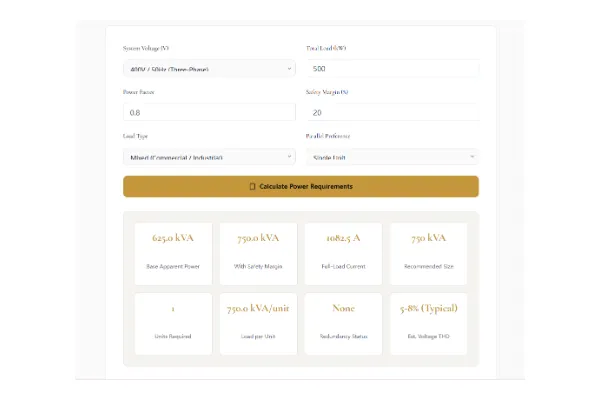
Power Distribution Calculator
Size Your Generator System & Estimate Power Quality
Enter your facility load parameters to calculate required kVA, full-load current, recommended generator size, and parallel configuration options.
625.0 kVA
Base Apparent Power
750.0 kVA
With Safety Margin
1082.5 A
Full-Load Current
800 kVA
Recommended Size
1
Units Required
750.0 kVA/unit
Load per Unit
None
Redundancy Status
5-8% (Typical)
Est. Voltage THD
The Real Cost of Poor Power Quality
Why Power Quality Is Non-Negotiable for Critical Applications
A single voltage sag or harmonic spike from a poorly regulated generator can destroy $500,000 in sensitive data center equipment. Yet most genset suppliers never verify actual power quality under load—they simply assemble components and ship. At ZC Power, every generator set undergoes rigorous full-load testing in our national standard testing center, ensuring your critical infrastructure receives clean, stable power from day one.
Power quality is not a luxury—it is a technical requirement. When generator sets produce voltage fluctuations, harmonic distortion, or frequency deviations, the consequences range from premature equipment failure to catastrophic downtime. Voltage instability causes server crashes, medical imaging errors, and manufacturing defects. High Total Harmonic Distortion (THD) overheats transformers and motor windings, shortening equipment life by 30-50%. Uneven load distribution across paralleled generators creates circulating currents that can trip breakers and damage alternator windings.
At ZC Power, we engineer every genset as a complete power quality and distribution system. From Stamford copper alternators and DeepSea digital controllers to our proprietary testing protocols, we verify that every unit delivers stable voltage (±1% regulation), clean power (<5% THD), and precise frequency control (±0.5%) before it ships.
Precision Voltage Regulation
Digital AVRs maintain terminal voltage within ±1% under steady-state conditions and recover within 0.3 seconds after a 100% load step.
Harmonic Mitigation
Oversized alternators and optional harmonic filters achieve <5% THD under linear loads and <8% under typical mixed commercial loads.
Frequency Stability
Electronic governors with 0.25% regulation ensure 50Hz or 60Hz within ±0.5% even under rapidly changing load conditions.
Verified Before Shipment
Every unit undergoes 100% full-load testing for 2+ hours. We document voltage regulation, THD spectra, and recovery times.
Verified Performance
ZC Power Quality vs. Market Standard
Unlike trading companies that simply forward manufacturer claims, we verify every specification ourselves. When we state ±1% voltage regulation and <5% THD, those numbers come from actual test data—not catalog estimates.
1
Voltage Regulation
ZC Power: ±1.0%
Market Standard: ±2.5% to ±5%
2
Voltage THD (Linear Load)
ZC Power: <5%
Market Standard: 5% to 15%
3
Frequency Regulation
ZC Power: ±0.5%
Market Standard: ±1.0% to ±2.0%
4
Load Step Recovery (100%)
ZC Power: <0.3 seconds
Market Standard: 0.5 to 2.0 seconds
Certifications & Compliance Standards
ISO9001 Certified
CE Marking
ISO 8528 Tested
IEEE 519 Compliant
Our Process
How to Get Your Power Quality & Distribution Solution
From initial load analysis through commissioning, our engineering team manages every technical detail of your power distribution project.
STEP 1
Submit Load Profile
Share your facility load list, power quality requirements, and grid standard. Our engineers analyze and respond within 24 hours.
STEP 2
Engineering Proposal
Receive detailed specifications, single-line diagrams, power quality projections, and a customized testing protocol.
STEP 3
Manufacturing & Testing
Production with full component traceability. Pre-shipment testing includes load bank verification, THD measurement, and sync commissioning.
STEP 4
Delivery & Commissioning
Global shipping with complete documentation. Remote installation guidance, commissioning support, and operator training.
STEP 1
Submit Load Profile
Share your facility load list, power quality requirements, and grid standard. Our engineers analyze and respond within 24 hours.
STEP 2
Engineering Proposal
Receive detailed specifications, single-line diagrams, power quality projections, and a customized testing protocol.
STEP 3
Manufacturing & Testing
Production with full component traceability. Pre-shipment testing includes load bank verification, THD measurement, and sync commissioning.
STEP 4
Delivery & Commissioning
Global shipping with complete documentation. Remote installation guidance, commissioning support, and operator training.
Client Validation
What Our Power Quality Clients Say
“We installed a 4x 1000kW parallel system from ZC Power for our Tier III data center in Kenya. The automatic synchronization and load sharing work flawlessly. Most importantly, their test report showed 2.8% THD at full load—critical for our server power supplies. Two years of operation, zero power quality incidents.”
“As a hospital facilities director, I cannot afford voltage fluctuations that damage MRI or ventilator equipment. ZC Power delivered a 1500kW standby system with enhanced AVR tuning. Their testing center provided complete documentation proving ±0.8% voltage regulation. That level of verification gave our medical board complete confidence.”
“We upgraded from single large gensets to a parallel 6x 500kW configuration for our copper mine in Chile. ZC Power handled the entire integration—including synchronization panels and load-dependent sequencing. Fuel consumption dropped 18% because we now run only the capacity we need. The power quality is actually better than our old single-unit setup.”
Common Questions
Frequently Asked Questions About Power Quality & Distribution
Technical answers to the most critical questions engineers ask when evaluating generator power quality and parallel distribution systems.
What is an acceptable THD level for a diesel generator?
IEEE 519 recommends voltage THD below 5% for general applications and below 3% for sensitive electronic loads such as data centers and medical equipment. ZC Power standard gensets achieve <5% THD under linear loads. For high non-linear load applications, we offer oversized alternators and harmonic filters to maintain <3% THD. Every unit’s actual THD is measured and documented during our pre-shipment load testing.
How does parallel operation improve power distribution?
Parallel operation allows multiple smaller generators to function as a single power source. This provides N+1 redundancy (if one unit fails, others continue), improves fuel efficiency by matching generation to demand, and enables maintenance without interrupting power. Our digital paralleling systems maintain active and reactive load sharing within ±5%, preventing circulating currents and ensuring stable voltage across all operating units.
What causes voltage instability in generator sets?
Common causes include: inadequate AVR response to load changes, improper governor tuning causing frequency drift, undersized alternators for the load power factor, harmonic distortion from non-linear loads, and poor grounding. ZC Power addresses these at the design stage by analyzing your load profile, specifying appropriately sized alternators with digital AVRs, and verifying stability under load step conditions during testing.
Can I parallel ZC Power generators with other brands?
Technically possible but not recommended without thorough engineering analysis. Successful paralleling requires compatible governor droop characteristics, matched AVR responses, and identical phase sequences. Differences in unit impedance and control response can cause unstable load sharing. For reliable operation, we recommend designing complete parallel systems with matched ZC Power units and integrated synchronization control.
How does Smart Cloud Monitoring detect power quality issues?
Our IoT-enabled controllers continuously log voltage, frequency, THD, power factor, and load balance to a cloud dashboard. The system generates alerts when parameters drift outside programmed thresholds—for example, if THD exceeds 5% or voltage regulation degrades beyond ±2%. This enables predictive maintenance: you address AVR tuning or filter issues before they cause equipment damage or downtime.
What certifications ensure generator power quality compliance?
ZC Power carries ISO9001 quality management certification and CE marking for European market access. Our testing follows ISO 8528 standards for reciprocating engine-driven generating sets, which define voltage and frequency response requirements. For specific markets, we can provide test documentation demonstrating compliance with IEEE 519 (harmonic limits), NFPA 110 (emergency power), and local grid code requirements.
Do you provide paralleling switchgear and ATS with your gensets?
Yes. We design and supply complete power distribution packages including automatic transfer switches, paralleling control cabinets, synchronization panels, and main distribution boards. Our engineers create single-line diagrams showing how all components integrate, eliminating the risk of incompatible equipment from multiple vendors.
How do you test for voltage regulation and frequency stability?
Every genset undergoes our national standard testing protocol: no-load verification, 25/50/75/100% load points with sustained operation, 110% overload test, and 100% load step application/removal. We record voltage regulation at each point, measure frequency deviation, capture THD spectra, and document recovery times. You receive a complete test report with these measurements before the unit ships.