How Many Amps Does an Air Fryer Use?
A 1,500 watt air fryer draws about 12.5 amps on a 120 volt circuit. Amps equal watts divided by volts, so the amperage depends on the wattage of your model and the voltage of your supply.
That equation is the whole answer, and it’s also where most people stop. The useful part is what the number means for the circuit behind the outlet.
An air fryer is one of the highest-draw appliances a typical kitchen has. It’s in the same class as a microwave or an electric kettle, and it’s usually the one that trips a breaker when it shares a circuit with the coffee maker.
At ZC Power we size generating equipment for a living, which means we spend our working days on exactly this arithmetic. The load a kitchen appliance places on a circuit and the load it places on a generator are worked out the same way, and a great deal of advice on the internet gets the second one wrong.
This guide gives you the amperage table, explains why an air fryer trips a breaker when it usually isn’t the air fryer’s fault, and covers the one case where the rules change.
Key Takeaways
- Amps equal watts divided by volts. A 1,500 W air fryer draws 12.5 A at 120 V and 6.5 A at 230 V.
- Most air fryers are 1,200 to 1,800 watts, so most draw between 10 and 15 amps on a North American circuit.
- A 15 amp circuit is rated for 1,800 watts, so a large air fryer uses nearly all of it. That’s why it trips when anything else is on the same circuit.
- Air fryers are resistive loads with a small fan, so they draw no starting surge. That makes them easy on a generator but heavy on a circuit.
- If your air fryer trips a breaker, do not simply fit a bigger breaker. A 20 amp breaker needs 12 gauge wiring and 20 amp receptacles throughout the circuit.
If your interest is what this means for a backup supply rather than a kitchen circuit, the generator load calculation guide covers the method end to end, and the section below on generators covers the part that catches people out.
How Many Amps Does an Air Fryer Use? The Short Answer
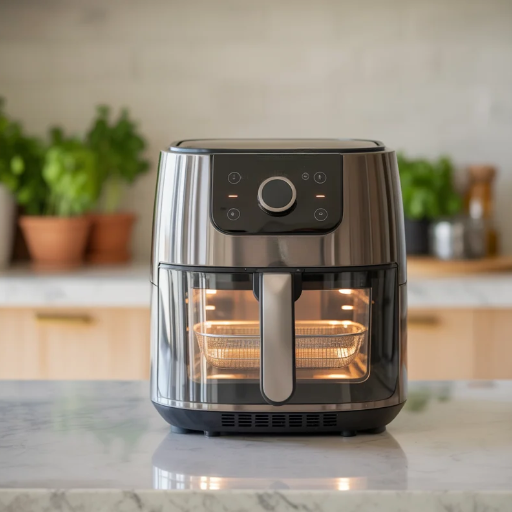
Working out how many amps an air fryer uses takes one division. Amps = watts ÷ volts. Find the wattage on the rating plate, divide by your supply voltage, and you have the current.
The Wattage to Amperage Table at 120 Volts
This covers North American household circuits. Most air fryers sold there sit between 1,200 and 1,800 watts.
| Air fryer wattage | Current draw at 120 V |
|---|---|
| 1,000 W | 8.3 A |
| 1,200 W | 10.0 A |
| 1,500 W | 12.5 A |
| 1,700 W | 14.2 A |
| 1,800 W | 15.0 A |
The Same Appliance on a 230 Volt Supply
In Europe, the United Kingdom and Australia the supply is roughly twice the voltage, so the same wattage draws roughly half the current. Air fryers sold in those markets are often higher wattage as a result.
| Air fryer wattage | Current draw at 230 V |
|---|---|
| 1,300 W | 5.7 A |
| 1,500 W | 6.5 A |
| 2,200 W | 9.6 A |
| 2,400 W | 10.4 A |
| 2,750 W | 12.0 A |
Read the two tables together and the pattern is the point. A 1,500 watt air fryer is a comfortable load on a European circuit and a marginal one on a North American circuit, and nothing about the appliance has changed.
Why the Rating Plate Beats Any Table
Wattage varies enormously between models, and manufacturers revise it between production runs. A table gives you the range. The rating plate on the underside of your own unit gives you the answer.
Divide that figure by your supply voltage and you have your air fryer’s actual draw, which is the number every other section of this article depends on.
How Many Amps Does an Air Fryer Use on a 15 Amp Circuit?
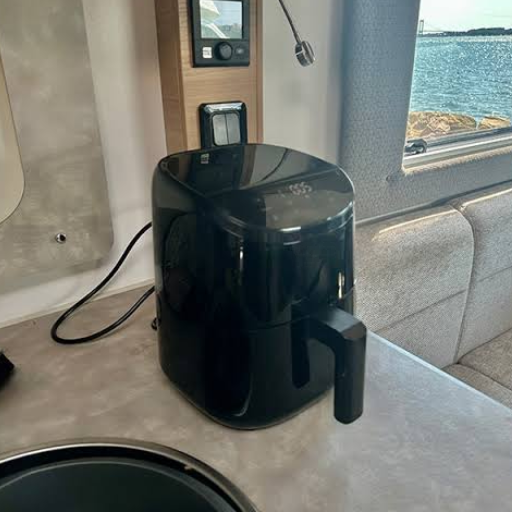
Sometimes. The important question is whether it trips on its own or because of what else is running.
What a 15 Amp Circuit Can Actually Carry
A 15 amp circuit at 120 volts is rated for 1,800 watts. A 20 amp circuit is rated for 2,400 watts.
Compare those figures with the table above. A 1,800 watt air fryer draws exactly 15 amps, which uses the whole capacity of a 15 amp circuit. A 1,500 watt model draws 12.5 amps and leaves 2.5 amps of headroom, which is not much.
A circuit’s rating applies to everything plugged into it, not to each outlet separately. The breaker cannot tell which appliance is drawing what. It only sees the total.
Why It Usually Is Not the Air Fryer’s Fault
An air fryer running alone on a 15 amp circuit is at or under the rating, so it should not trip the breaker by itself.
It trips when something else shares the circuit. A coffee maker draws 750 to 2,400 watts, a kettle around 1,500, a microwave 625 to 2,000. Add any of those to a 1,500 watt air fryer and the total passes 1,800 watts easily.
That’s the whole explanation for most air fryer tripping. It is arithmetic, not a fault.
Illustrative composite. Daniel’s air fryer tripped the kitchen breaker roughly every third time he used it, and he assumed the appliance was faulty. It wasn’t. His kitchen had one 15 amp circuit serving the counter outlets, and the kettle sat on the same run. The air fryer drew 12.5 amps, the kettle added 10, and the pair went past 1,800 watts every time they overlapped. Moving the kettle to the outlet on the other side of the room, which happened to be on a different circuit, ended the problem entirely. This scenario is illustrative, not a record of a specific customer.
When You Need a 20 Amp Circuit
Most kitchen circuits are wired for 20 amps, because the code has long required kitchen counter outlets to be served by dedicated small appliance circuits at that rating. Older homes are the exception, and a 15 amp kitchen circuit is common in them.
That’s why the same air fryer behaves differently in two houses. In a modern kitchen it runs alongside the coffee maker without complaint. In an older one it trips.
If you want a 20 amp circuit where you only have 15, the circuit has to be rewired. There is no shortcut.
Why Fitting a Bigger Breaker Is Not the Answer
This is the most dangerous advice on the subject, and it appears often enough to be worth stating plainly.
A breaker protects the wiring, not the appliance. A 15 amp breaker sits on a circuit wired with 14 gauge cable, which is rated for 15 amps. Fit a 20 amp breaker to that circuit and the breaker will happily pass 20 amps through cable designed to carry 15. The cable heats up inside the wall, and the breaker never trips to stop it.
A 20 amp breaker requires 12 gauge wiring and 20 amp receptacles throughout the circuit. If any part of the run is 14-gauge, upsizing the breaker removes the protection the circuit was built around.
Moving the air fryer to a different circuit costs nothing. Rewiring a kitchen does not. Those are the two safe options.
Running an Air Fryer Safely

Extension Cords and Power Strips
Plug the air fryer directly into a wall outlet. An air fryer should not be run from an extension cord or a power strip.
The reason is specific to high-wattage heating appliances. An air fryer pulls its full load for the whole cooking cycle, which can be twenty minutes or more without a pause. A light-duty cord carrying that current drops voltage along its length, and the lost voltage turns into heat at the plug and the socket.
Kitchen circuits also frequently sit on 20 amp receptacles with a T-shaped neutral slot, which won’t accept a standard 15 amp plug. That’s a design feature, not a fault. An air fryer drawing more than 12 amps belongs on a 20 amp outlet.
Illustrative composite. A renter in an older apartment ran her air fryer from a lightweight extension cord so it could sit on the dining table rather than the counter. After a few weeks the plug end of the cord had discoloured and the socket face felt warm to the touch. Nothing had failed, but the cord was carrying 12.5 amps through conductors sized for less. A short heavy-duty cord rated for the load, plugged into a wall outlet on its own circuit, replaced it. The appliance had never been the problem. This scenario is illustrative, not a record of a specific customer.
Sharing a Circuit With Other High-Wattage Appliances
The practical rule is one heating appliance per circuit at a time.
Count anything that makes heat as a competitor for the same capacity:
- Kettle, around 1,500 W
- Coffee maker, 750 to 2,400 W depending on whether it has a hotplate
- Microwave, 625 to 2,000 W
- Toaster or toaster oven, 800 to 1,800 W
- Electric frypan, around 1,300 W
- Hot plate, up to 2,500 W
Two of those running together will usually exceed a 15 amp circuit and sometimes a 20 amp one. If your kitchen has two counter circuits, which is the modern standard, split the appliances between them.
Can a Generator Run an Air Fryer?
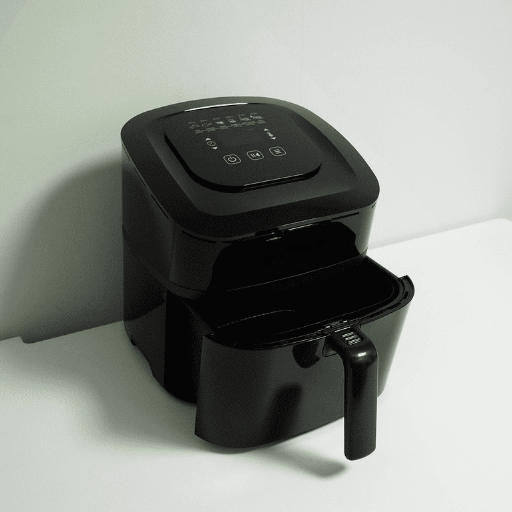
Yes, and an air fryer is one of the easier loads to put on a backup supply. The reason why is worth understanding, because it’s the opposite of what the rest of this article has been about.
Why a Resistive Load Has No Starting Surge
An air fryer is a resistive heating element with a small fan. It draws essentially the same current the instant you switch it on as it does an hour later.
That matters because most of the loads that make generator sizing difficult are motors. A refrigerator compressor, a well pump or an air conditioner draws several times its running current for a second or two at start-up. Those surge figures are what decide the size of a generating set, which is covered in our motor starting and generator sizing guide.
The air fryer has none of that. Its full load is its running load, so 1,500 watts is 1,500 watts whether it’s just been switched on or has been running for half an hour.
Two Rules Called the 80 Percent Rule
Here is where most advice goes wrong, including some of the advice about air fryers.
There are two different rules that both get called the 80 percent rule, and they govern completely different things.
| The circuit rule | The generator rule | |
|---|---|---|
| What it governs | the breaker on a branch circuit | how hard a generating set is worked |
| Where it comes from | the National Electrical Code | generator industry practice |
| What triggers it | a continuous load, meaning three hours or more at full current | Sustained running of the set |
| Does it apply to an air fryer? | No. A twenty-minute cooking cycle is not continuous | Yes, whenever the air fryer runs on a generator |
The circuit rule requires the breaker on a circuit supplying a continuous load to be sized above that load. An air fryer running for twenty minutes is not a continuous load, so the rule does not apply to it, and a 1,500-watt air fryer at 12.5 amps is within a 15-amp breaker’s rating for the length of a cooking cycle.
The generator rule is different. A generating set should not be run at more than about 80 percent of its continuous rating during sustained operation, to preserve voltage regulation and thermal headroom. That’s practice rather than code, it’s about the generator rather than the appliance, and it applies every time.
Some pages apply the circuit rule’s arithmetic to a kitchen circuit and conclude that a 1,500 watt air fryer exceeds a 15 amp circuit’s safe limit. That’s a misapplication, and following it leads to work that isn’t needed.
What That Means in Practice
On a generator, put the 80 percent figure to work. A 1,500 watt air fryer needs roughly 1,875 watts of continuous generating capacity to stay inside the band.
That’s not a large requirement. It’s about the same as a microwave, and less than a clothes dryer. Add the air fryer to a load list that already includes a fridge, a freezer and a furnace blower and it fits comfortably on a small home standby set.
The appliance’s real characteristic, as far as backup power goes, is that it’s a steady load with no surge. That makes it easy to plan around. Our guide to what uses the most electricity in a home covers where a kitchen appliance sits in the wider picture, and if you’re working out circuit capacity rather than generator capacity, wire sizing for a 30 amp circuit covers the other half of the same arithmetic.
Frequently Asked Questions
How many amps does an air fryer use on a normal household circuit?
Most air fryers draw 10 to 15 amps on a 120 volt circuit, depending on whether the model is 1,200 or 1,800 watts. A 1,500 watt air fryer, which is about the most common size, draws 12.5 amps.
Will an air fryer trip a 15 amp breaker?
Not on its own, unless it’s a high-wattage model. A 1,500 watt air fryer leaves only 2.5 amps of headroom on a 15 amp circuit, so it trips as soon as a kettle, coffee maker or microwave joins it on the same circuit. That shared total is the usual cause.
Can I put a bigger breaker in so my air fryer stops tripping?
No, not without rewiring. A 20 amp breaker requires 12-gauge wiring and 20 amp receptacles throughout the circuit. Fitting one to a circuit wired in 14-gauge means the cable can overheat before the breaker trips. Move the air fryer to another circuit instead.
What size breaker do I need for an air fryer?
A 15 amp circuit handles most models on its own. If you want to run an air fryer alongside another heating appliance, you want a 20 amp circuit, which most modern kitchens already have for the counter outlets.
Can I run an air fryer on a generator?
Yes, and it’s one of the easier loads to size for. As a resistive appliance with a small fan it has no starting surge, so 1,500 watts is 1,500 watts at all times. Allow roughly 1,875 watts of continuous generator capacity to keep it inside the 80 percent loading guideline.
If you’re building a load list for a home or a facility, the arithmetic runs the same way at every scale. Talk to the ZC Power engineering team if you want a load assessment rather than a table.
Conclusion: One Equation, Two Different Rules
How many amps does an air fryer use? Amps equal watts divided by volts, and a 1,500-watt air fryer draws 12.5 amps at 120 volts. That’s the whole calculation, and it takes about ten seconds to work out from your own rating plate.
What repays the reading is everything around it. A 15 amp circuit carries 1,800 watts in total, so a large air fryer leaves very little room for anything else. Moving the kettle is usually the fix, and fitting a bigger breaker is not. And the two rules both called the 80 percent rule govern different things entirely, which is why so much of the advice on this subject contradicts itself.
Three things are worth carrying away:
- Read the rating plate and do the division. The table gives the range, your own appliance gives the answer.
- Count the whole circuit, not the outlet. The breaker sees a total.
- Separate the circuit rule from the generator rule. One is about a three hour continuous load, and the other is about how hard a set is worked.
Get those right and the amperage stops being a guess. It becomes the first line of a calculation you can finish.