How to Size a Battery Charger for a Generator
Sizing a battery charger for a generator runs in two directions. First size the charger to the battery and the DC load it has to carry. Then size the generator to the charger’s input demand, which is not the same as its DC output rating.
Most guides stop after the first step. That is where the trouble starts, because a charger is not a resistive load. It draws its current in pulses, it presents a poor power factor, and a generator sized on the charger’s DC output will be too small to carry it properly.
At ZC Power we build generator sets from 8 kVA to 4000 kVA and run load studies on them daily. A charger is a small load, but a non-linear one, and non-linear loads are the category that most often surprises people at commissioning.
This guide works through both directions with numbers: the charger current from battery capacity and DC load, and the generator size from the charger’s real input demand. It also covers the distortion a rectifier charger puts on the generator, which is the part that decides whether the arrangement is stable or not.
Key Takeaways
- Size in two steps. Charger current comes from the recharge window and the standing DC load. Generator size comes from the charger’s input demand, not its DC rating.
- The 10 percent rule is contested. One position sets charger current at 10 percent of battery amp-hours. Charger makers recommend 20 to 25 percent for modern multistage units. Which applies depends on what the battery does.
- For a generator starting battery, the panel load governs, not the battery’s capacity, because the alternator handles the bulk recharge after a start.
- A charger’s input VA is well above its DC output. A rule of thumb puts the generator at roughly 4 × battery voltage × charger current in VA.
- Power factor changes the machine you buy. An uncorrected charger may sit at 0.6 to 0.7, against about 0.95 for a power-factor-corrected unit.
If you want the charger types and their maintenance first, our guide to the generator battery charger covers float, trickle and multistage units and how they are serviced. This article picks up at the sizing arithmetic.
Why Sizing Runs in Two Directions
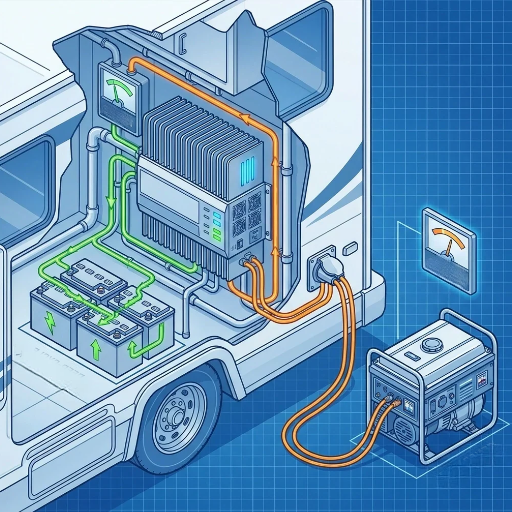
The two directions answer different questions, and they use different inputs. Confusing them is the single most common mistake on this subject.
The DC Side: Sizing the Charger
The first question is how much charging current the battery needs. That depends on the battery’s capacity, the time available to recharge it, and whatever DC load is permanently connected alongside it.
This is the side that most published guidance covers, and it is arithmetic.
The AC Side: Sizing the Generator
The second question is how much generator the charger demands. A charger’s DC output rating says nothing directly about its AC input. Conversion losses, rectifier behaviour and power factor all sit between the two.
This is the side that decides whether the installation works.
Why Skipping the Second Step Causes Problems
A charger specified from its DC rating alone will present an AC demand considerably higher than that number suggests. Size the generator on the charger’s DC output and it will be undersized, with three consequences:
- The charger may fail to complete its charge cycle and drop into fault.
- The generator’s waveform distorts under the pulsed load, which affects everything else on the set.
- The set runs at a low load factor, which is bad for a diesel engine.
This is an illustrative composite rather than a record of a specific client. An off-grid installation replaced a battery charger that would not complete its cycle, then found the replacement behaved identically. Neither charger was faulty. The generator had been specified from the chargers’ DC output ratings, and neither had enough alternator behind it to absorb the pulsed input current. The waveform distorted, the charger’s protection saw an out-of-range supply, and it dropped out partway through every cycle. The fix was a larger set, not a third charger.
How to Size a Battery Charger for a Generator: Step One
Start with the recharge requirement, then apply it to the battery.
Why the Recharge Window Comes First
Emergency power standards require an automatic charger able to restore a discharged battery, not merely maintain a full one. The recharge window is stated in hours, and it is applied as a performance requirement on the charger.
The figures commonly applied are 24 hours for Level 1 and 36 hours for Level 2. Check the edition of the standard in force, and any local amendment, before writing the requirement into a specification.
Battery Amp-Hours and the 10 Percent Rule
Given battery capacity and a recharge window, the minimum charging current is straightforward: the charger must return the battery’s capacity within the window.
For a 100 Ah battery over 24 hours, that is a little over 4 A. As a floor, charger ratings are commonly specified at least 10 percent of the battery’s amp-hour capacity, which for the same battery is 10 A. Chargers in generator service typically fall between 5 and 20 A, which reflects how small starting batteries are compared with the loads they start.
What Charger Makers Say About the 10 Percent Rule
The 10 percent figure is not settled. It appears widely, and charger manufacturers argue it is out of date.
| Position | Figure | Where it comes from |
|---|---|---|
| Conservative floor | 10 percent of amp-hours | Long-standing rule of thumb, still widely quoted |
| Modern multistage practice | 20 to 25 percent of amp-hours, higher for gel | Charger makers, on the grounds that multistage units tolerate higher rates |
Neither is a standard. The difference matters because it changes the charger you buy, and therefore the generator behind it. The rate a battery will actually accept is what governs, and that figure is published on the battery’s own data sheet. Where a rule of thumb and a data sheet disagree, the data sheet wins.
The Panel-Load Method for Starting Batteries
Here is the point that matters most for a standby generator, and it inverts the usual framing.
A starting battery is not recharged by the charger. It is discharged by a few seconds of cranking, and the engine alternator restores that energy within minutes of the set running. The charger’s real job is to cover the standing DC panel load: the transfer switch, annunciators, control panel memory and any monitoring, which draw continuously whether the set runs or not.
So for a starting battery, the governing figure is not the battery’s amp-hour capacity at all. It is the panel load plus a modest top-up. The self-discharge that makes this necessary is the same problem studied for backup generator batteries, where idle periods dominate the duty cycle (IEEE, lead-acid battery monitoring and charging for backup generators).
- Measure the standing DC load with the set idle.
- Add a margin for a top-up, typically a couple of amps.
- Select the next standard charger size above that total.
A 2 A standing load, for example, points to a 5 A charger with comfortable headroom, not to a 10 A unit sized from a 100 Ah battery’s amp-hours. The larger unit does no harm, but it is money spent on the wrong constraint.
If you are establishing the panel load, the transfer switch is usually the largest single contributor. Our guide to automatic transfer switch sizing covers how those DC loads are calculated.
A Worked Example on a 100 Ah Battery
Take a deep-cycle battery bank rather than a starting battery, so the amp-hour framing applies.
| Input | Value |
|---|---|
| Battery capacity | 100 Ah |
| Recharge window applied | 24 hours |
| Current for recharge alone | about 4.2 A |
| Standing DC load | 2 A |
| Total charger output needed | about 6.2 A |
| At the 10 percent floor | 10 A |
| At the 20 to 25 percent position | 20 to 25 A |
The spread is wide, and that is the honest answer. A 10 A unit sits at the conservative floor. A 20 A unit reflects modern practice if the battery’s data sheet permits the higher rate. Check the battery’s maximum recommended charge current before choosing, because it is the one figure that settles the argument.
How to Size a Battery Charger for a Generator: Step Two
Now to the direction that gets skipped.
Why a Charger Is Not a Resistive Load
A resistive load such as a heater draws current in a smooth wave that follows the voltage. A battery charger does not. It rectifies the incoming AC, so it draws current in short pulses while the rectifier conducts.
That pulsing is what makes charger sizing different from sizing for a resistive load of the same wattage. The pulsed current has a higher RMS value than a smooth current delivering the same power, and it carries harmonics that the generator has to absorb.
The Charger’s Input Demand, Not Its Output Rating
The practical rule is to work from the charger’s AC input figures, which are on its data sheet, rather than its DC output.
A widely used rule of thumb puts the generator’s VA rating at about 4 × battery voltage × charger current. On paper this looks generous, and it is deliberately so: the factor accounts for the difference between average and RMS current, for phase-angle behaviour, and for headroom.
Treat it as a rule of thumb rather than a standard. It is a starting point for a specification, not a substitute for the charger’s own input figures. Where a data sheet gives input current or input VA, use that.
Power Factor and Corrected Versus Uncorrected Chargers
Power factor is the ratio between real power and apparent power, and it decides how much of a generator’s rating a load can actually use.
Generators are typically rated at a power factor of 0.8, meaning the usable kW is 80 percent of the kVA figure on the nameplate. A load with a power factor below 0.8 therefore consumes more of the generator’s apparent power than its wattage suggests.
A charger’s power factor varies widely by design:
| Charger type | Typical power factor | Generator consequence |
|---|---|---|
| Uncorrected rectifier charger | 0.6 to 0.7 | Markedly higher VA demand for the same DC output |
| Power-factor-corrected (PFC) charger | about 0.95 | Substantially less generator oversizing |
This is the most actionable number in the article. Choosing a corrected charger can allow a materially smaller generator for the same DC output, and the savings on the set frequently exceed the premium on the charger. If you are specifying both, price the pair together rather than separately.
Some conservative treatments apply a squared derating to the power factor, which produces a much larger required machine. That is a cautious approach rather than a rule, and it is worth knowing that more aggressive sizing philosophies exist.
A Worked Example
Take a 24 V system with a charger delivering 20 A of DC output.
| Input | Value |
|---|---|
| Charger DC output | 20 A at 24 V |
| DC power delivered | about 480 W |
| Assumed charger efficiency | about 85% |
| Approximate AC input power | about 565 W |
| Uncorrected, power factor 0.65 | about 870 VA |
| Corrected, power factor 0.95 | about 595 VA |
| Applying the 4× rule of thumb | 4 × 24 × 20 = 1,920 VA |
| Practical selection | between the calculated figure and the rule of thumb, with margin |
The two methods bracket the answer. The power-factor calculation gives the physical minimum; the rule of thumb adds the margin that real chargers, cold days and aged batteries tend to consume. Specifying toward the upper end of that range is the safe choice, and it is what we do on our own projects.
Non-Linear Chargers and Generator Distortion
The pulsed current a charger draws has consequences beyond the sizing arithmetic.
Harmonics, Waveform Distortion and Alternator Heating
Harmonic currents do not contribute to useful output. They circulate in the alternator windings and generate heat, which is why an alternator carrying a high proportion of non-linear load has to be derated or specified with a more suitable winding.
This is the same mechanism that affects a room full of computers or a large UPS installation. A charger is a small load individually, but on a system where the charger is a large share of the total, the effect is real. Measurement work on genset-plus-battery systems has characterised exactly this, recording waveform distortion and power factor alongside efficiency for the components involved (Energy for Development Research Centre, University of Cape Town).
The engineering response is the same in each case: oversize the alternator, or reduce the non-linear share.
Rectifier Design and Why It Matters
Not all chargers distort equally. The rectifier’s design changes how much harmonic content the charger presents.
A 12-pulse rectifier produces a smoother current draw than a 6-pulse one, and therefore needs less oversizing. Where a specification allows a choice, the rectifier design is worth asking about, because it trades charger cost against generator size in the same way the power factor correction does. The behaviour of mains-powered smart chargers for diesel gensets has been the subject of patent work on the control side, for readers who want the detail.
The Resistive Load Technique
One practical technique for a charger that distorts badly: add a resistive load alongside it.
A resistive load such as a heater draws a smooth current, and adding one can stabilise the generator’s output when a distorting charger is a large part of the total load. Figures commonly quoted are in the range of 500 to 1,500 W, though the right value depends on the installation.
This is a technique rather than a rule, and it costs fuel to run. It is worth considering where a large non-linear load cannot be avoided and the alternative is a much larger set.
And do not overdo the fix in the other direction. Running a diesel set at very low load for long periods risks wet stacking, where unburnt fuel and carbon accumulate in the exhaust. Loading is discussed in our generator sizing guide, and the practical target is to keep a set working in the region it was designed for rather than idling along at a few percent.
Common Sizing Mistakes
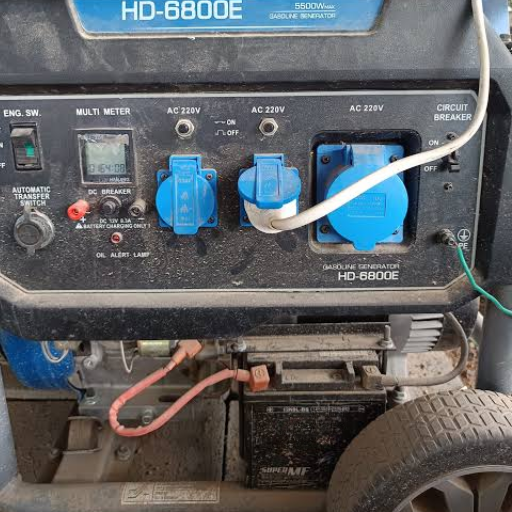
Four mistakes account for most of the problems we see.
- Sizing on the charger’s DC rating. A charger’s DC output is not its AC demand, so a set sized on the DC figure ends up undersized. Work from the charger’s input data, with margin.
- Forgetting the standing DC load. The charger has two jobs and only one is charging. Omit the panel load and the charger never reaches the state it should.
- Running the set too light. A set comfortably oversized for a small charger spends its life at low load, which is inefficient and potentially damaging on a diesel.
- Oversizing the charger to shorten the recharge. A battery only accepts current at the rate its data sheet allows, so a larger charger past that point delivers nothing and demands more from the generator.
The maintenance implications of all this are covered in our guide to heavy-duty diesel generator maintenance, and the arithmetic sits inside the wider generator load calculation method.
Frequently Asked Questions
How do I size a battery charger for a generator?
Two steps. Size the charger from the recharge window and the standing DC load, then size the generator from the charger’s AC input demand rather than its DC output. The second step is the one most often missed and the one that causes failures.
What size charger for a 100Ah battery?
It depends on the recharge window and the battery’s acceptance rate. A 24-hour window needs a little over 4 A, and the common floor is 10 percent of capacity, so 10 A. Modern practice would allow 20 to 25 A if the battery’s data sheet permits it.
What size generator do I need to run a battery charger?
Work from the charger’s AC input rather than its DC output. A common rule of thumb puts the generator at roughly 4 × battery voltage × charger current in VA. Check the charger’s data sheet for its input figures and power factor, because a corrected charger needs materially less generator than an uncorrected one.
Why does my charger fault when running on a generator?
The most likely cause is an undersized generator for the charger’s pulsed, non-linear demand. The distorted waveform can fall outside the charger’s acceptable input range, so its protection trips partway through a cycle. The charger is usually not faulty.
Does power factor matter for a battery charger on a generator?
Yes, substantially. An uncorrected charger may present a power factor of 0.6 to 0.7, while a power-factor-corrected unit sits near 0.95. Since generators are usually rated at 0.8, that difference changes how much of the set’s capacity the charger consumes, and therefore the machine you need.
Conclusion
Sizing a battery charger for a generator is two calculations, and most of the difficulty comes from doing only the first.
- Size the charger from the recharge window and the standing DC load. For a starting battery, the panel load governs, not the battery’s amp-hour capacity.
- The 10 percent rule is contested. Check the battery’s data sheet for its maximum recommended charge rate and let that settle it.
- Size the generator from the charger’s AC input, using the charger’s own data and a rule of thumb for margin.
- Power factor is the biggest lever. A corrected charger at about 0.95 against an uncorrected 0.6 to 0.7 can allow a materially smaller set.
- Expect some distortion from any rectifier charger, and size the alternator with the non-linear share in mind.
The two decisions are cheaper made together than separately. Contact our engineering team with the charger’s input data and your standing DC load, and we will quote a set built for the load it will actually see.