
Extreme Weather Containerized Generators: 2026 Spec Guide
Extreme weather containerized generators are generator sets built into an enclosure engineered for a defined site envelope, not standard ISO containers with a genset inside. The difference appears in four numbers: the ambient temperature range, the altitude, the airborne contaminant load, and the structural weather loads the package must survive.
That distinction matters because a quote can say “weatherproof” and still tell you nothing about performance at 50°C, a cold start at −25°C, or full load in a dust storm. Climate Central recorded 23 billion-dollar weather and climate disasters in the United States in 2025, with $115 billion in damages (Climate Central). For anyone specifying backup or prime power, the question is not whether extreme weather happens. It is whether the package was engineered for it.
This guide shows how to define the site envelope, derate the set, specify cold-start and contamination protection, and verify the package before shipment.
Key Takeaways
– A containerized generator is extreme-weather rated only when its rating, enclosure, and auxiliary systems are declared against a named site envelope.
– Heat and altitude cut available output. Alternators typically lose about 3% per 5°C above 40°C and about 3% per 500 m above 1,000 m; engines follow the selected engine’s curve.
– Cold starting is a system problem: fuel cloud point, battery capacity, oil viscosity, jacket heating, and insulation must work together.
– Dust, salt, and humidity need different defenses. Filtration, C5-M coating, and anti-condensation heating are not interchangeable.
– CSC and ISO 1496-1 cover transport and handling, not site wind, snow, flood, or seismic loads.
What Makes Extreme Weather Containerized Generators Different?
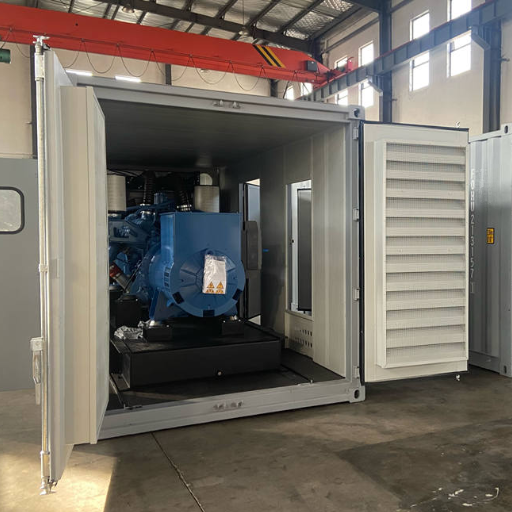
An extreme-weather containerized generator is a generator set packaged in an enclosure engineered for a stated site envelope: minimum and maximum ambient temperature, altitude, humidity, airborne dust or salt, and structural wind, snow, and flood loads. The enclosure, heating, cooling, filtration, and coating systems are specified together, and the power rating is declared at those conditions.
That definition separates an engineered package from a standard container with louvered doors. Standard sets handle rain, minor dust, and normal temperatures; they are not automatically rated for −40°C, a 55°C desert site, or coastal salt spray.
| Weather load | What it attacks first | Enclosure and system response |
|---|---|---|
| Heat | Engine cooling, alternator insulation, controls | High-ambient radiator, free-area louvers, solar control, derated rating |
| Cold | Battery cranking, oil viscosity, diesel flow | Insulation, jacket and oil heaters, fuel heating, battery warmer |
| Dust and sand | Air filters, radiator fins, bearings, seals | Multi-stage filtration, positive-pressure intake, sand-trap louvers |
| Humidity and salt | Steelwork, insulation, terminals, fasteners | C5-M coating, stainless hardware, IP-rated cabinets, anti-condensation heaters |
| Wind, flood, snow | Structure, anchorage, intake and exhaust openings | Site structural design, foundation, elevation, snow hoods |
| Altitude | Air density, turbocharger match, cooling margin | High-altitude engine rating, matched turbo, alternator margin |
A container label tells you the shipping envelope, not the operating envelope. For the procurement side of the package, including fit, transport, and service access, see the containerized heavy-duty diesel generator guide. This article focuses on the climate engineering behind the rating.
Have a site envelope but no approved drawing yet? Send the temperature, altitude, and contamination data to the ZC Power engineering team for a factory review.
Define the Site Envelope for Extreme Weather Containerized Generators
Start with the site, not the container size. A 20 ft or 40 ft box is a packaging decision. The site envelope decides whether the set can deliver its nameplate rating, start reliably, and survive its service life.
| Parameter | What to record | Why it changes the package |
|---|---|---|
| Ambient temperature | Minimum and maximum, plus duration and frequency | Sets heater sizing, coolant mix, oil grade, and derating |
| Intake temperature | Expected air temperature at the enclosure inlet | A “50°C ambient” rating may refer to outside air, not inlet air |
| Altitude | Site elevation above sea level | Reduces air density and engine output; affects turbo match |
| Relative humidity | Annual range and condensation risk | Drives anti-condensation heating, insulation, and drainage |
| Contaminants | Dust, sand, salt, ash, or chemical mist | Selects filtration stages, coating class, and hardware material |
| Wind and snow | Design wind speed, exposure, roof snow load | Anchoring, door and louver design, roof structure, intake hoods |
| Flood and seismic | Design flood elevation, seismic category | Foundation height, anchorage, isolators, flexible connections |
In a poorly ventilated metal enclosure, intake air can run roughly 10–15°C above outside ambient. A set rated at 50°C on outside air may see 60–65°C inlet air. Review the rating, airflow calculation, and louver free area together; the container ventilation review shows how those values are checked against the drawing.
Extreme Heat and Altitude: Derating the Containerized Generator
Heat and altitude both reduce the mass of air available for combustion and cooling. They often arrive together at a hot, high-altitude mine.
Two rating baselines buyers confuse
Engine ratings commonly follow ISO 8528-1 reference conditions: 25°C, 1,000 mbar, and 30% relative humidity. Alternators are often rated at 40°C and 1,000 m. If a quote lists “500 kW at prime power” without a baseline, you cannot compare it with another supplier’s 500 kW.
Derating factors that matter
For the alternator, plan on about 3% per 5°C above 40°C and about 3% per 500 m above 1,000 m. Stamford AvK’s guidance shows a factor of 1.00 at 40°C and 0.88 at 60°C (Stamford AvK AGN-012).
For the engine, use the selected engine’s curve. Planning ranges often fall near 1% per 10°C between 25°C and 40°C, with steeper losses above 40°C, and about 3–4% per 300 m above 1,000 m for turbocharged engines. Multiply the factors; do not add percentages.
A worked example
Take a 500 kW set rated at 25°C and 1,000 m, installed at 50°C and 1,500 m.
| Item | Factor | Result |
|---|---|---|
| Alternator, 50°C | 0.94 | 470 kW |
| Alternator, 1,500 m | 0.97 | 456 kW combined |
| Engine, 50°C (planning rate) | 0.8125 | 406 kW |
| Engine, 1,500 m (planning rate) | 0.942 | 383 kW combined |
| Limiting output | Lower of engine and alternator | About 383 kW |
The result is roughly 380–455 kW, or 9–24% below nameplate. The final number must come from the manufacturer’s data for the exact engine and alternator.
An illustrative composite shows why this matters. A project team specified a 500 kW set for a hot, high-altitude mine, then reduced the louver area to meet a noise target. At commissioning, the set carried about 80% load for 40 minutes before the coolant alarm tripped, with the enclosure inlet 12°C above outside ambient. Revised louvers and ducts plus a re-rating solved it; a larger generator would not have.
Airflow, solar load, and thin air
Cooling starts with air volume and pressure loss. Louver free area is not the grille’s outside dimensions; attenuators, filters, bends, and mesh all reduce flow. Hot discharge air can also recirculate into the intake.
Solar gain adds load, so use light-colored surfaces, insulation, and shaded intakes. Above roughly 2,000–3,000 m, a standard turbocharger may run outside its efficient map, and the alternator may become the limiting component. See generator cooling systems and the generator altitude derating charts for the detailed methods.
Extreme Cold: Starting a Containerized Generator Below Freezing
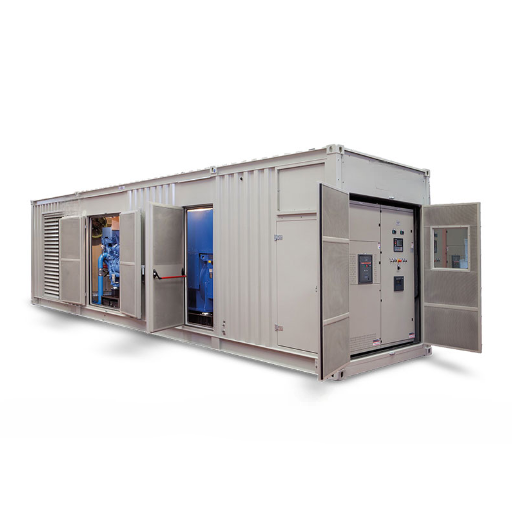
A cold container is a battery, fuel, and oil problem at the same time. The engine may be mechanically sound and still fail because the battery can’t crank it, the oil is too thick, or the fuel has waxed.
Why cold starts fail
Lead-acid battery capacity falls with temperature. A fully charged battery may deliver roughly 50% of rated cold cranking amps at −18°C and about 20–25% at −29°C. Cold oil raises cranking torque at the same time, so the starter needs more current just when the battery can supply less.
Diesel adds a second failure point. #2 diesel commonly begins to cloud near 0°C, and the cold filter plugging point is where wax blocks the filter. Winter-grade #1-D fuel can be specified to about −29°C, but the fuel in the tank may not match a sudden cold snap (Phillips & Temro).
The cold-climate package
A reliable package usually includes:
- Engine jacket-water heater to keep coolant warm during standby.
- Oil pan heater or an oil grade rated for the minimum site temperature.
- Fuel filter and line heater to prevent wax blockage.
- Battery warmer, insulation, and a charger that holds full state of charge.
- Intake air pre-heater for the first start.
- Insulated walls, roof, and doors, with sealed penetrations.
- Thermostatic louvers that close at standstill and open at load.
- Snow hoods and an anti-condensation control-cabinet heater.
Heating power is not trivial. A cold-climate package can draw several kilowatts in standby, so that load belongs in the site auxiliary supply. Heater circuits also need protection and alarms; a failed jacket heater may not be discovered until the next start.
Thermal balance and fuel
Insulation that protects the set at standstill can trap heat at full load. The enclosure needs a controlled opening schedule, separate airflow paths, and compartment temperature sensors.
Fuel needs the same care. Specify for the coldest expected temperature and keep about 10°C margin above the cloud point. Drain water from the tank, and treat with anti-gel before the filter plugs.
A second illustrative composite makes the point. A facility engineer, Tomas, put the battery charger on a timer to save power. At −22°C, the set cranked slowly and failed twice; the battery was healthy but only partly charged. Continuous charging, a battery warmer, and a jacket heater restored reliable starts.
Dust, Sand, Salt, and Humidity: Specifying the Slow Weather Loads
Heat and cold cause failures quickly. Dust, salt, and humidity cause them slowly, then all at once, and the generator may run fine for months before the damage appears.
Dust and sand
A single paper air filter isn’t a desert package. Sand and dust need staged protection: inertial or sand-trap louvers first, a cyclone or pre-cleaner for the heavy fraction, and a high-capacity primary filter for the fine fraction. A differential-pressure gauge tells maintenance when the filter is loading. Radiator fins and access panels should be arranged for cleaning, not just assembly.
Positive pressure inside the enclosure helps. If the intake moves more air than the enclosure leaks, dust travels outward through gaps instead of inward. Motorized louvers that close during a sandstorm add another layer, as does filter service based on differential pressure rather than a fixed calendar.
Salt and coastal corrosion
Salt spray attacks steelwork, fasteners, hinges, and electrical terminals. “Marine-grade paint” is not a specification. Ask for the ISO 12944 corrosivity category, the dry film thickness, and the salt-spray test evidence.
For C5-M coastal or offshore service, a typical system uses abrasive blasting, a zinc-rich primer, a high-build epoxy intermediate coat, and a polyurethane topcoat. Total dry film thickness often falls around 250–280 µm. External fasteners and hinges should be 316 stainless steel or equivalent, and penetrations should be sealed. Alternator enclosure ratings matter too: IP23 is common for standard machines, while IP55 is available for dusty or wet locations.
Humidity and condensation
Condensation forms when a surface drops below the dew point of the air around it. Sealing the enclosure doesn’t solve the problem, because moisture enters through glands, door seals, and temperature cycling. Keep internal air slightly above the external dew point and give water a path out.
An anti-condensation heater controlled by a hygrostat is the usual choice for control cabinets. A larger enclosure may need a space heater. Drain holes, breathers, and corrosion-resistant terminals complete the package. Periodic running under load also helps dry the windings in tropical sites.
Wind, Flood, Snow, and Seismic: Loads the Container Standard Doesn’t Cover
ISO 1496-1 and the CSC plate certify a container for transport and handling. They do not certify it as a building. Stacking, lifting, racking, and floor loads are transport loads. Site wind, snow, flood, and seismic loads come from the local building code and the foundation design.
That distinction has procurement consequences. A supplier may say the container is “CSC certified” and “wind resistant.” Ask for the design wind speed, exposure category, snow load, and anchorage details. On a hurricane-exposed site, the anchor design must resist uplift and lateral load, not just hold the container down under its own weight.
Foundation guidance from Cummins suggests a mass of roughly 2–10 times the generator set weight, extending at least 12 in. beyond the skid, with the base below the frost line. For flood-exposed sites, FEMA recommends mounting the generator, fuel tank, controls, and transfer switch above the expected flood level, anchoring them securely, and protecting fuel and electrical lines (FEMA information sheet).
Snow adds roof load and intake blockage. Snow hoods keep drifting snow out but must not restrict airflow. Keep the intake clear of the snow line, and include roof clearing in the maintenance plan.
Seismic design follows the local code. Isolators and flexible connections must be part of the anchorage design, not added after the foundation is poured. For transport documentation, see CSC shipping documents for containerized generators.
Specification and Factory Test Checklist for Extreme Weather Containerized Generators
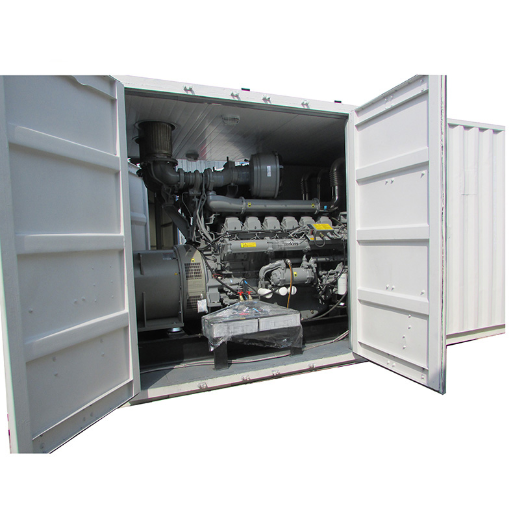
The specification should read as conditions and evidence, not a list of features. The table below is a starting point for an RFQ.
| Clause | What to require |
|---|---|
| Design envelope | Minimum and maximum ambient, inlet temperature, altitude, humidity, contaminants, wind, snow, flood, seismic |
| Rating at conditions | Prime or standby kW/kVA at the site envelope, with engine and alternator curves attached |
| Enclosure | IP rating, insulation thickness and material, door seals, drainage, lifting and anchoring points |
| Coating | ISO 12944 category, dry film thickness, salt-spray evidence, stainless grade for external hardware |
| Cooling | Radiator sizing, fan and airflow data, louver free area, discharge arrangement, recirculation check |
| Heating | Jacket, oil, fuel, battery, intake, and control-cabinet heaters with capacity, control, and alarm |
| Filtration | Stage arrangement, filter class, differential-pressure indication, service access |
| Structural | Design wind, snow, flood, and seismic loads; anchorage and foundation interface |
| Documentation | GA drawing, electrical drawing, test plan, O&M manual, spare-parts list, compliance certificates |
Factory acceptance testing should verify the systems that are hard to fix on site:
- Heater circuits energize, reach setpoint, and raise the correct alarm on failure.
- Louvers open and close fully, and the actuator responds to the controller.
- High-temperature, low-oil-pressure, over-speed, and low-coolant alarms and trips work.
- Insulation resistance and polarity are correct after enclosure wiring is complete.
- Coating dry film thickness, IP test evidence, and salt-spray reports match the specification.
- Load-bank data shows the set carrying the specified load at the specified conditions.
Ask the supplier three questions before the drawing is approved: What is the rating at my site conditions? Which components change for my climate package? What evidence will be in the FAT report? A supplier who cannot answer all three is offering a container, not a climate-rated package.
Frequently Asked Questions
Can a standard containerized generator handle extreme weather?
A standard containerized generator handles rain, normal dust, and moderate temperatures, but it is not automatically rated for extreme heat, deep cold, salt spray, or high altitude. Ask for the operating envelope and the rating at your site conditions, not just the word “weatherproof.” “Climate-rated” means the envelope, systems, and test evidence are documented.
What temperature range can a containerized generator operate in?
There’s no universal range. Manufacturers publish different envelopes for different packages; some extreme packages claim −40°C to +55°C, while standard packages are narrower. The range is meaningful only when it states the enclosure, heaters or cooling fitted, and rating at the extremes.
How much power does a generator lose in extreme heat or at altitude?
An alternator typically loses about 3% per 5°C above 40°C and about 3% per 500 m above 1,000 m. Engine losses follow the manufacturer’s curve, often around 3–4% per 300 m above 1,000 m for turbocharged engines.
Do containerized generators need heating in winter?
Yes, below freezing, reliable starting usually needs a jacket-water heater, a battery warmer and charger, fuel heating, and an insulated enclosure. The exact package depends on the minimum temperature and standby duration.
Are containerized generators waterproof?
No. They are weather-resistant or IP-rated, not submersible. An IP54, IP55, or IP56 enclosure resists dust and water under defined test conditions, but it doesn’t make the set safe to immerse. Flood protection comes from elevation, drainage, and anchorage.
Conclusion
Extreme weather containerized generators are specified, not ordered from a catalog. The site envelope decides the rating; the rating decides the engine, alternator, and cooling package; the climate loads decide the enclosure, heating, filtration, coating, and anchorage.
Five checks separate a climate-rated package from a container with a genset inside:
- The rating is stated at the site’s inlet temperature, altitude, and duty.
- Heat rejection and louver free area are calculated, not estimated from grille size.
- Cold starting is covered by fuel, battery, oil, and heating systems together.
- Dust, salt, and humidity each have a dedicated defense.
- Wind, flood, snow, and seismic loads are designed to the local code, not the CSC plate.
ZC Power builds containerized generator sets across 8 kVA–4,000 kVA, with ISO 9001, CE, and CCC certifications. The climate package is agreed on the approved drawing, so the specification and the test report describe the same machine. Send your site conditions and load schedule to the ZC Power engineering team before you commit the enclosure design.


