How Many Watts Does a TV Use? Real Figures, and Why the Label Overstates Them
A modern television draws between 30 and 150 watts while it is switched on. That range covers almost every set sold in the last decade, and the number is not the one printed on the back of your TV.
That second half of the sentence is where most people go wrong, and it’s not their fault. The label on the rear panel is a maximum rating, the largest load the set is certified to draw. It’s not consumption, and on some televisions the gap between the two figures is a factor of three.
When you search for how many watts a TV uses, you find a headline figure anywhere from 30 watts to 400 watts. The reason the range is that wide is that different sources are quoting different things.
At ZC Power we spend our working lives on load calculations, because that is what decides whether a generator carries a building or trips on the first cold morning. A television is one of the smallest loads in any home, and it is also the one people most often get wrong.
Here is the real figure by screen size and panel type, what standby actually draws, and how to read the number on your own set in about two minutes.
Key Takeaways
- A modern TV draws 30 to 150 watts in use. Screen size and panel type move the number more than viewing habits do.
- The wattage on your TV’s rating plate is a certified maximum, not consumption. Measured draw can be less than a third of it.
- Standby draw is trivial at 0.5 to 2.5 watts, but the streaming box and games console beside the TV can draw more than the TV does.
- Running a 100-watt television 24 hours a day costs roughly $155 a year at 18 cents per kilowatt-hour.
- A television has no starting surge, so it barely affects the size of a home backup generator. Motor loads decide that.
How Many Watts Does a TV Use? The Short Answer

Between 30 and 150 watts for most sets now in use. The low end is a smaller LED panel and the high end is a large OLED or an older plasma.
The spread isn’t guesswork. It tracks two variables almost entirely, and neither is how much you watch.
Screen size is the first. Panel area roughly doubles between a 43-inch and a 65-inch set, and so does the power needed to light it. Panel type is the second. An LED set uses its power to drive a backlight behind a liquid crystal layer, while an OLED lights every pixel individually and draws more when the picture is bright.
A television is a small load, and getting its figure right rarely changes an outcome. If you’re reading this because you’re sizing something larger, our guide to how to size a generator starts with the loads that do decide the answer.
Why the Number on the Back Is Not the Number You Pay For
Turn your television around and you’ll find a label with a figure in watts. That figure is a rated maximum, the ceiling the manufacturer certifies for safety testing. It assumes the set at full brightness, with every smart feature active, in the worst-case scenario the standard allows.
Lawrence Berkeley National Laboratory measured the gap directly. A 42-inch plasma set carried a rating of 335 to 477 watts and actually consumed 93 to 138 watts in normal viewing, or roughly 28 to 32 percent of the figure on its own label. On a 32-inch LCD the rated range was 38 to 130 watts against a measured draw of about 40 watts.
Two formal test methods sit behind the measured figures. The International Electrotechnical Commission publishes IEC 62087 for on-mode power, and the Consumer Technology Association publishes CEA-2037. Both measure an average across broadcast-style content rather than a worst case. That is deliberate, because a television showing a dark scene uses a fraction of what it uses showing a bright one.
So when two sources quote wildly different figures for the same television, they’re usually not disagreeing. One is a nameplate and one is a measurement.
How to Read Your Own TV’s Rating Plate in Two Minutes
Your own set is the only place the exact answer exists, and it’s free.
- Turn the TV off and look at the rear panel for a label listing voltage and frequency.
- Find the line marked power consumption or rated input. It may appear in watts or in amps.
- Treat that figure as a ceiling, not an average. For most modern sets, expect actual use to land well below it.
- If the label gives amps rather than watts, multiply amps by voltage. A set rated at 1.5 amps on a 120-volt supply has a rated input of about 180 watts.
If you want the true consumption rather than the ceiling, a plug-in power meter costs less than a takeaway meal and settles the question in an afternoon.
Illustrative composite. Priya replaced a 50-inch plasma in her living room with a 65-inch OLED and moved the plasma into the spare room, reasoning that a second television she rarely watched would cost almost nothing to run. She was half right. The old plasma drew more than twice what the new OLED drew, and it was the spare-room set that showed up on her next bill. The size of a television matters less than the technology inside it. This scenario is illustrative, not a record of a specific customer.
If you are working out whether a backup generator can carry your essentials through an outage, our guide to sizing a backup generator for your home walks through the whole load list.
How Many Watts Does a TV Use? Figures by Screen Size and Panel Type
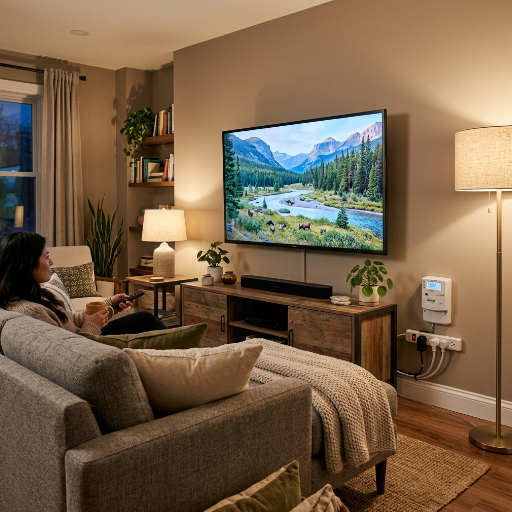
The figures below are measured on-mode draw for sets in normal home picture mode, not nameplate ratings.
| Screen size | Panel type | Typical draw | Annual cost at 4 h/day |
|---|---|---|---|
| 32 inch | LED | 30 to 50 W | 5to5to9 |
| 43 inch | LED | 45 to 70 W | 8to8to12 |
| 50 inch | LED | 60 to 100 W | 11to11to18 |
| 55 inch | LED | 60 to 100 W | 11to11to18 |
| 55 inch | OLED | 80 to 120 W | 14to14to21 |
| 65 inch | LED | 110 to 150 W | 19to19to26 |
| 65 inch | OLED, bright HDR | up to 180 W | up to $32 |
| 50 inch | Plasma | 150 to 300 W | 26to26to53 |
Costs assume four hours of viewing a day at 12 cents per kilowatt-hour, the national average. Adjust for your own rate by multiplying the wattage by your hours and dividing by 1,000.
What a 55-Inch TV Uses
A 55-inch LED typically draws 60 to 100 watts, and the same size in OLED lands at 80 to 120 watts. That’s the largest step in the table, which surprises people who expect the jump to come at 65 inches. In practice the two sizes are close, and the technology matters more than the extra ten inches of glass.
What a 65-Inch TV Uses
A 65-inch LED draws 110 to 150 watts. The same size in OLED can reach 180 watts on a bright, high dynamic range picture, because an OLED panel has to work harder to produce a bright image than a backlit panel does. This is the opposite of the usual assumption that OLED is the efficient choice. In a dark room an OLED can draw less than a comparable LED, and in a bright one it draws more.
Is OLED More Efficient Than LED?
Not reliably, and the answer depends on what is on screen. OLED panels light each pixel individually, so a dark scene draws very little. A bright scene drives every pixel hard, and consumption climbs above an equivalent LED. If your viewing skews to sports, news and bright studio content, expect an OLED to sit at the top of its band rather than the bottom.
Why Plasma TVs Draw Two to Three Times More
Plasma sets light tiny gas cells behind the screen, and every cell burns power whenever it is lit, no matter how bright the picture. There is no backlight to dim. A 50-inch plasma draws 150 to 300 watts, and peak ratings on some models ran past 400 watts.
Plasma is no longer manufactured, but the sets are still in spare rooms, which is why the figure matters. An old plasma left running is a larger load than most people assume, and it’s the one appliance in a home where replacing the unit pays for itself on the electricity bill alone.
How Many Watts Does a TV Use When It Is Switched Off?
Between 0.5 and 2.5 watts for most sets, and often below 0.5 watts. European ecodesign rules have required televisions to stay under half a watt in standby since 2013, and most manufacturers meet that comfortably.
At 1 watt, a television on standby for 20 hours a day costs about 90 cents a year. That’s the honest answer to “should I unplug it,” and it’s why most advice on this subject tells you not to bother.
Most advice is also looking at the wrong device.
The Devices Beside the TV Draw More Than the TV Does
Standby power across consumer electronics adds up to somewhere between 5 and 10 percent of residential electricity use, and a television is rarely the largest contributor in its own cabinet.
Natural Resources Canada measured standby draw across consumer equipment and found a set-top box or recorder drawing up to 31 watts while switched off, with a soundbar adding around 8 watts and a games console behaving similarly when left in its ready state. The Ohio Consumers’ Counsel puts a cable box, television, DVD player and games console together at roughly 30 watts combined in standby.
Put plainly: a streaming box in standby can outdraw the television it feeds while that television is off. The television is the smallest load on the shelf.
Illustrative composite. Marcus timed his standby devices after reading that unplugging a television saved almost nothing. He was right about the television and wrong about the cabinet. Almost the entire draw came from the set-top box and the games console in rest mode. A single switched power strip behind the unit, turned off at night, cut the figure by more than 90 percent. This scenario is illustrative, not a record of a specific customer.
How Much Does It Cost to Run a TV?
Does a TV use a lot of electricity? Compared with the appliances people usually worry about, no. Multiply the wattage by your hours, divide by 1,000 to get kilowatt-hours, then multiply by your electricity rate.
The formula: (Watts ÷ 1,000) × hours per day × 365 × your rate per kWh
A 55-inch LED at 85 watts, watched four hours a day at 12 cents per kilowatt-hour, comes to about **15ayear∗∗.Pushthesamesettoeighthoursadayanditreachesroughly15ayear∗∗.Pushthesamesettoeighthoursadayanditreachesroughly30.
Per Hour, Per Year, and Left On All Day
| Usage | 85 W set | 180 W set |
|---|---|---|
| Cost per hour | about 1 cent | about 2 cents |
| Four hours a day, one year | about $15 | about $32 |
| Eight hours a day, one year | about $30 | about $63 |
| Left on 24 hours a day, one year | about $89 | about $190 |
The last row is the one people search for, and it’s the one that justifies action. A television left on around the clock draws roughly eight times what a normal viewing household draws. At higher rates it’s not unusual for that to pass $150 a year for a single set.
Screen size is not the only lever, but it’s the one you can’t change after purchase. Going from a 50-inch to a 65-inch set costs more per year than watching the smaller one for an extra two hours a day.
Why the TV Is the Least of Your Problems in a Power Outage
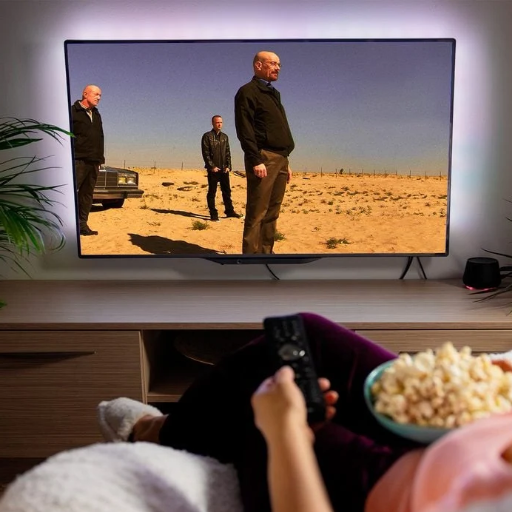
If the reason you’re counting watts is that you’re sizing a backup generator, the television is close to irrelevant. That’s worth stating plainly, because it’s the opposite of what most appliance lists imply.
A television has no motor, so it has no starting surge. It draws the same watts running as it does at the instant you switch it on. Almost every other load that matters in a house behaves differently. A refrigerator that runs on 700 watts needs around 2,200 watts to start its compressor.
A furnace blower drawing 800 watts needs roughly 1,600 to spin up. A one-horsepower well pump can demand three times its running load for a second or two.
Those surge figures, not the running totals, are what decide generator size. A load list that overstates the television by 200 watts and understates the furnace blower by the same amount will produce a generator that trips every time the heat comes on.
What Actually Determines a Home Generator Size
The method is consistent across every competent source: total the running watts of everything you want to power at once, add the single largest starting surge, then add a margin for future growth. Our whole house generator sizing guide works the arithmetic through for a typical home, and the same sequence applies whether the load list is a house or a small building.
| Load | Running watts | Starting watts |
|---|---|---|
| Refrigerator | 700 | 2,200 |
| Furnace blower | 800 | 1,600 |
| Sump pump, half horsepower | 800 | 2,000 |
| Well pump, one horsepower | 1,000 | 3,000 |
| Lights and router | 150 | 150 |
| Television | 60 to 100 | 60 to 100 |
| Central air, 3-ton | 3,500 | 7,000 |
Read the television row against the others and the point makes itself. The set that prompted the search is the smallest line in the table and the only one with no surge at all.
Our step-by-step guide to generator load calculation walks through the full method, including how to convert kilowatts to kilovolt-amperes and why the largest motor decides the outcome.
Frequently Asked Questions
How many watts does a 55-inch TV use?
A 55-inch LED draws roughly 60 to 100 watts. A 55-inch OLED draws 80 to 120 watts. Check the rating plate on the back of your own set for the certified maximum, and treat that as a ceiling rather than an average.
Do TVs use electricity when they are switched off?
Yes, but very little. Standby draw is typically 0.5 to 2.5 watts, which costs under a dollar a year for most households. The set-top box, game console and soundbar in the same cabinet are the loads worth switching off.
Is it worth unplugging a TV at night?
For the television alone, no. For the whole cabinet, yes. Putting the television and everything attached to it on one switched power strip and turning that off at night addresses the devices that actually draw.
Does a bigger TV always use more power?
At the same panel technology, yes. Across different technologies, no. A 50-inch plasma draws more than a 65-inch LED, and in a dark room a 65-inch OLED can draw less than a 55-inch LED in a bright one.
Why does my TV’s label say 300 watts if it only uses 100?
The label states the maximum setting is certified to draw in the worst case the safety standard allows, at full brightness with every feature active. Normal viewing sits below that, often far below. The measured figure is the one your electricity bill reflects.
Sizing a system to carry a house through an outage is different from reading a nameplate, and it is one our engineers routinely do. Talk to the ZC Power engineering team about a load assessment before you specify equipment.
Conclusion: The Number You Need Is on Your Own TV
The headline answer to how many watts a TV uses is simple. A modern television draws 30 to 150 watts, with screen size and panel technology doing most of the work.
The more useful lesson is about the label. The wattage printed on the back of a set is a certified maximum, and measured consumption can be less than a third of it. That gap explains why a single search returns figures from 30 watts to 400 watts for equipment that is not that different, and it is why the rating plate alone will not tell you what a device costs to run.
Three things follow:
- Read the label for the ceiling, not the running cost.
- Use a plug-in meter for the truth, and check it in the picture mode you actually watch.
- Put the whole cabinet on a switched strip, rather than chasing the television’s own standby draw.
And if the reason you started counting watts was to work out what a generator can carry, take the television off the top of the list. It has no motor, so it has no surge, and the furnace blower and the well pump will decide the answer long before a screen does.
Illustrative composite. A homeowner in the Middle East built a load list for a standby generator by counting every appliance in the house, television included, and concluded he needed a 25 kW unit. His installer recalculated without the television and with the actual motor surge figures, and a 20 kW set carried the house comfortably. The television had been the least significant line on the list and the one he had been most certain about. This scenario is illustrative, not a record of a specific customer.