Custom Voltage Industrial Generators: Factory Buyer’s Guide
A custom voltage generator is a standard generator set configured to deliver an output voltage that differs from the common 400 V or 480 V catalogue offering. Most requests are cheaper to fill than buyers expect. A smaller number are far more expensive. Knowing which is which before you request a quote is worth more than any discount you negotiate later.
Seth, a distributor in Malaysia, is an illustrative composite of a pattern that regularly reaches our engineering desk. He needed 415 V for a project. His supplier quoted an “engineering premium” plus four extra weeks of lead time for a custom alternator. Neither charge was real.
The alternator the factory was already going to fit has twelve output leads and reconnects to 415 V in an afternoon. Malaysia’s grid runs at 415 V, so the machine was always going to arrive at that voltage. Seth paid a custom price for a standard machine.
That mismatch is the subject of this guide. Voltage is cheap to change. Frequency is not, and it is where projects fail.
This article explains how output voltage is produced, what separates a reconnection from real custom engineering, and how to write an RFQ that gets an accurate number first time. The engineering team writes it at Shandong ZC Power, a source manufacturer that has built tailored generator sets from 8 kVA to 4,000 kVA since 1999.
Key Takeaways
- Voltage is a cheap variable. A twelve-lead alternator reconnects across 380 V to 480 V as standard, so most “custom voltage” requests need no custom engineering and no premium.
- Frequency is the hard constraint. It is locked to engine speed, so 50 Hz means 1,500 rpm and 60 Hz means 1,800 rpm on a four-pole machine. No setting converts one to the other.
- Voltage and frequency are coupled through the volts-per-hertz ratio. A 480 V / 60 Hz machine holds 8.00 V/Hz; run it at 50 Hz and it must drop to 400 V or the core saturates and overheats.
- Medium voltage is a different machine, not a bigger number. Above 1,000 V you add custom-wound alternators, MV switchgear, earthing design, and a load bank most contractors do not own.
- Specify voltage, frequency, phase, and switchgear rating together in one line of your RFQ. Getting three of the four right is how generators arrive correct and unusable.
What Is a Custom Voltage Generator?
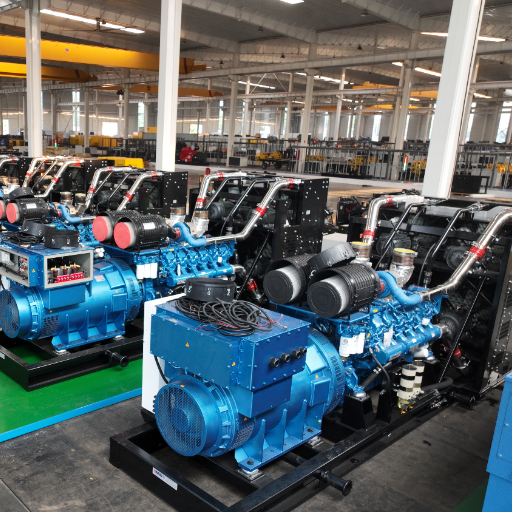
A custom voltage generator is a generator set built or configured to deliver a non-standard output voltage, such as 415 V, 690 V, 6.6 kV, or 11 kV, rather than the manufacturer’s default 400 V or 480 V. It may need only an alternator reconnection, or it may require a custom-wound alternator. In a custom voltage diesel generator, the engine is rarely what changes.
Suppliers file these under different names, from customized voltage industrial generators to medium voltage generator sets. The label tells you where the request sits in the tiers below, not that it is a different service.
The phrase covers three very different products. Buyers usually mean one of the following:
- A voltage that is not in the catalogue but is reachable from a standard alternator. Common in export projects matching a local grid. This is routine.
- A frequency that is not the local one. Often described as a voltage problem, but the real issue is hertz. This is a design decision.
- A voltage class above low voltage. Medium-voltage distribution, where the entire set changes rather than one parameter.
Before you go further, it helps to know the range you are choosing within. Our production covers open, silent, trailer, and containerized configurations from 8 kVA to 4,000 kVA, and a large share ship at a voltage that is not the default. If you are still deciding what the set has to power, start with our overview of the heavy-duty diesel generator range, since voltage only becomes meaningful once the load is known.
Custom Voltage Generators: The Three Tiers of Customization
Almost every custom voltage request falls into one of three tiers. They differ enormously in engineering effort, lead time, and cost, and suppliers rarely separate them in a quotation.
Tier 1: Reconnection, which costs nothing
Three-phase alternators are manufactured with twelve output leads as standard, precisely so they can be reconnected to different voltages. The windings group in series star, parallel star, or delta, and each grouping produces a distinct voltage band.
- Series star produces the higher band, covering roughly 380 V, 400 V, 415 V, 440 V, 460 V, and 480 V.
- Parallel star produces roughly half those values, in the 190 V to 250 V range.
- Delta arrangements cover the remaining combinations, such as the common 230 V connection.
If your target voltage sits inside those bands, the alternator you were already buying will reach it, and no reasonable supplier should charge engineering time for the change. The same principle governs three phase generator selection generally: winding configuration decides the available voltages long before anything is customised.
Two de-rates hide in this tier. Intermediate voltages can be reached by trimming the voltage regulator, but that can reduce the machine’s rating rather than moving it cleanly. And certain winding arrangements carry a defined penalty: zig-zag connections typically de-rate to about 0.866 of nominal, while specific voltage and winding pairings carry factors such as 0.93, 0.9, or 0.87. Ask for the de-rate in writing rather than assuming the nameplate figure holds.
Ready to check your voltage against a real alternator’s connection diagram? Send us your site’s grid details to a custom genset manufacturer and we will confirm the configuration that fits, before you commit to a premium you may not owe.
Tier 2: Custom winding, where lead time becomes real
When a project needs a voltage outside the reconnectable bands, the alternator must be wound to that specification. Typical reasons include a genuinely unusual distribution voltage, a legacy plant standard, or an offshore specification that cannot be renegotiated.
Custom winding is real engineering. It affects production scheduling rather than assembly, and it carries a minimum order quantity in most factories because the winding setup is the cost. It also lengthens the critical path: the alternator becomes a made-to-order component inside an otherwise standard machine.
Tier 3: Voltage class change, which is a different machine
Moving above 1,000 V does not scale Tier 1 or Tier 2. A medium voltage set changes the alternator, the switchgear, the cable, the protection scheme, and the test equipment.
What the three tiers cost
| Tier | What it covers | Engineering required | Lead time impact | Cost impact |
|---|---|---|---|---|
| 1. Reconnection | 380 V to 480 V, and the parallel-star half-voltage bands | Terminal block change and AVR setting | None | Effectively none |
| 2. Custom winding | Non-standard LV outputs outside the reconnectable bands | Custom-wound alternator to specification | Weeks, driven by the alternator | Setup and tooling, with an MOQ |
| 3. Voltage class change | Medium voltage, typically 3.3 kV to 11 kV | New alternator class, switchgear, earthing, protection | Months, and project-dependent | Substantial, extending well beyond the genset |
The practical lesson: if a supplier cannot tell you which tier your request falls into, they have not looked at an alternator datasheet. That is a free test of an engineering department.
Why Frequency Is the Hard Constraint, Not Voltage
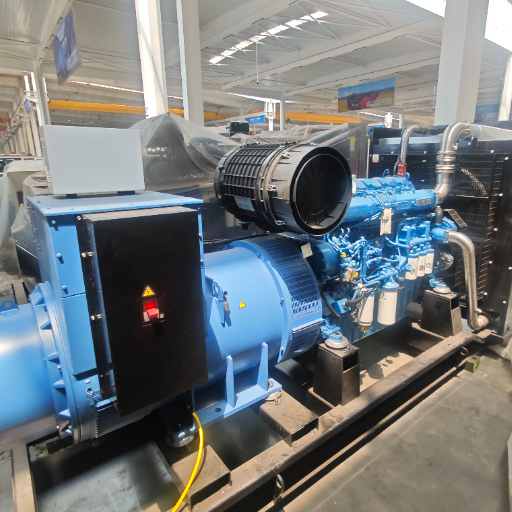
Buyers treat generator voltage and frequency as two dials on the same panel. They are not. Voltage is a winding ratio. Frequency is a physical speed, and it cannot be dialled at all.
1,500 rpm versus 1,800 rpm
The output frequency of a synchronous alternator is set by rotor speed and pole count. On a four-pole machine, the most common configuration for industrial generator sets:
- 50 Hz requires 1,500 rpm.
- 60 Hz requires 1,800 rpm.
You cannot obtain 60 Hz from a machine governed to run at 1,500 rpm. No regulator setting or reconnection produces it. A 60 Hz set is a different engine rating, with a different governor calibration, different cooling, and often a different alternator frame.
That is the most common cause of a generator arriving at the correct voltage and the wrong frequency. The order matched the voltage in the tender, and nobody checked the hertz.
The V/Hz rule: why 480 V at 60 Hz becomes 400 V at 50 Hz
A 480 V, 60 Hz generator must be re-rated to 400 V when it runs on a 50 Hz grid. The volts-per-hertz ratio sets this: 480 ÷ 60 = 8.00, and 8.00 × 50 = 400. Hold that ratio and the machine is fine. Exceed it and the core saturates.
An alternator’s magnetic core is sized for a volts-per-hertz ratio. Exceed that ratio and flux escapes the magnetic circuit. Eddy currents heat the laminations, excitation current climbs, and the winding insulation degrades.
Here is the arithmetic that catches people out:
| Step | Value |
|---|---|
| Machine nameplate | 480 V / 60 Hz |
| Its V/Hz ratio | 480 ÷ 60 = 8.00 V/Hz |
| Target frequency | 50 Hz |
| Voltage that preserves 8.00 V/Hz | 8.00 × 50 = 400 V |
| Correct output | 400 V, not 480 V |
| Synchronous speed change (four-pole) | 1,800 rpm down to 1,500 rpm |
The same generator, two grids, and two nameplate voltages that look unrelated until you divide one by the other. Manufacturers document the consequence directly: an alternator built for 60 Hz and operated at 50 Hz requires voltage and power to be reduced by around 20%, with current unchanged. The inverse holds too: a 50 Hz machine run at 60 Hz can accept roughly 20% more voltage and up to 20% more power at the same current, which is why some sets are genuinely dual-rated and most are not.
A 500 kW machine at 60 Hz, for example, lands near 415 kW when correctly re-rated to 50 Hz.
Amina, a project engineer at a food-processing plant in Lagos, is an illustrative composite too, and shows the most expensive version of this mistake. She specified a 500 kW set at 480 V because the tender’s voltage column said 480 V. Nobody wrote the frequency down. The set arrived as a 60 Hz machine for a site running at 50 Hz.
Commissioning stopped at the first load test. At 50 Hz the alternator could not hold 480 V without saturating its core, and the correct output was 400 V. The fix was a re-rate to 415 kW, not a repair.
What it costs you: power, cooling, and reactive capability
The power reduction is the headline, but it is rarely the consequence that hurts most.
- Reactive capability degrades first and worst. Real power may survive the change; reactive margin often does not, and the capability chart has to be redrawn. Sites with large motor loads feel this first. Because current stays constant while voltage falls, apparent power falls with it, which is why kVA-to-kW conversion stops being a fixed ratio on a re-rated machine.
- Cooling becomes the second limit. A slower rotor moves less air internally. Air-cooled machines see roughly 83% of their 60 Hz cooling effect at 50 Hz. That alone forces a de-rate.
- Mechanical loads rise. Holding the same power at lower speed requires roughly 20% more torque, which affects shaft and coupling selection.
- Protection must be retuned. Governor under-frequency roll-off and protection thresholds are set around the design speed, so a machine run away from its design point can nuisance-trip.
Standard Voltages by Region: What Your Site Actually Needs
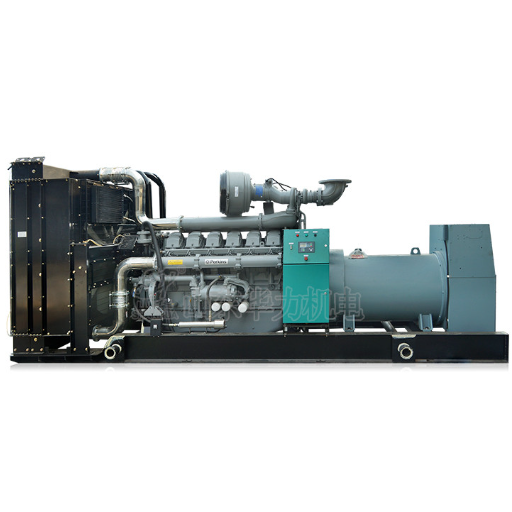
If you are sourcing from outside your market, write the grid down before you write the specification. The table below summarises the common industrial three-phase supplies. Regional variation exists within every country listed, so confirm against the utility’s own figure before ordering.
| Frequency | Typical three-phase voltage | Representative markets |
|---|---|---|
| 50 Hz | 380 V | China, Vietnam, Thailand, Indonesia, Italy, Spain, Russia, Egypt |
| 50 Hz | 400 V | Most of Europe, including Germany, France, the UK and Sweden; UAE; Pakistan; Bangladesh |
| 50 Hz | 415 V | Malaysia, Singapore, Australia, India, Kuwait, Qatar, Nigeria, Kenya, Tanzania |
| 60 Hz | 220 / 380 V | South Korea, Brazil |
| 60 Hz | 440 V | Colombia, Cuba |
| 60 Hz | 480 V | USA, Canada, Mexico, Philippines, Puerto Rico, Guam, Honduras |
Two patterns break the rule often enough to be worth memorising.
Brazil is 60 Hz. Buyers reason that South America is 50 Hz and order accordingly. Brazil is not, and neither are several of its neighbours. Typical Brazilian industrial supplies include 127/220 V and 220/380/440 V, all at 60 Hz.
Japan runs both. Eastern Japan, including Tokyo, is 50 Hz. Western Japan, including Osaka and Nagoya, is 60 Hz, split at the Fuji River. A generator ordered for the wrong half will not run correctly.
How the standards define those values
The values above come from two regional frameworks that do not agree, which is itself a source of confusion in international tenders.
IEC 60038 sets preferential nominal voltages for supply systems internationally. Its Table 3 covers three-phase systems above 1 kV and up to 35 kV, and is the origin of the commonly cited 3.3 kV, 6.6 kV, and 11 kV levels alongside 15 kV, 22 kV, and 33 kV.
ANSI/NEMA C84.1 sets nominal ratings and tolerances for 60 Hz systems above 100 V, using a different set of medium voltage values: 4.16 kV, 13.8 kV, and 34.5 kV.
That difference determines equipment availability. 3.3 kV appears in the IEC list but not the ANSI one. It is common in 50 Hz markets and thin in 60 Hz markets, so a new 60 Hz project is generally steered toward 4.16 kV. Choosing the IEC value on a 60 Hz site can add weeks to every component, including the generator. Distributors ordering for resale should factor this into their OEM diesel generator planning: a voltage class that is hard to source is hard to support locally.
One precision point: IEC 60038 does not formally define “medium voltage.” It sets a low voltage ceiling of 1,000 V AC and treats everything above it as high voltage. The intermediate category is an industry convention, generally placed between 1 kV and roughly 52 kV.
Medium Voltage Generator Sets: Above 1,000 V
Once a project’s distribution voltage climbs above 1,000 V, a high voltage diesel generator stops being a commodity and becomes a system component. A 6.6 kV set is not a 400 V set with a different label.
What changes when you leave low voltage behind
- The alternator is a different machine. Insulation systems, winding geometry, and dielectric test requirements all change with the voltage class. It is selected for the class, not reconnected into it.
- Switchgear replaces the breaker. A moulded case circuit breaker will not do this job. Medium voltage breakers, current transformers, and protection relays are separate procurements with their own lead times.
- Earthing becomes a design task. These systems generally need an earthing transformer or resistor, and the neutral arrangement has to be decided rather than inherited.
- Cable and clearance change shape. Conductors get smaller for the same power, while clearances, terminations, and cable support get larger.
- Fault levels drive protection coordination. Available short-circuit current must be calculated and coordinated across the scheme, not just at the generator terminals.
The reward is real, and it is why mining and heavy industry sites specify this way. Running the generator at the distribution voltage eliminates a step-up transformer, removing its purchase cost, losses, footprint, and maintenance.
Why you cannot load bank test an MV set with standard equipment
Here is a trap that surfaces at commissioning rather than at the quotation stage. Standard resistive load banks are low voltage devices, so a medium voltage set cannot connect directly to one.
Testing an MV machine therefore requires either an MV-rated load bank, which few commissioning contractors own, or a step-down transformer between the set and a conventional bank. If nobody planned for either, the generator cannot be proven at load before handover.
Given that every set we build is full-load tested before dispatch, this matters more for on-site verification after installation than for the factory acceptance test. Confirm the load bank testing arrangement before the equipment ships.
How to Specify Voltage and Frequency in Your RFQ
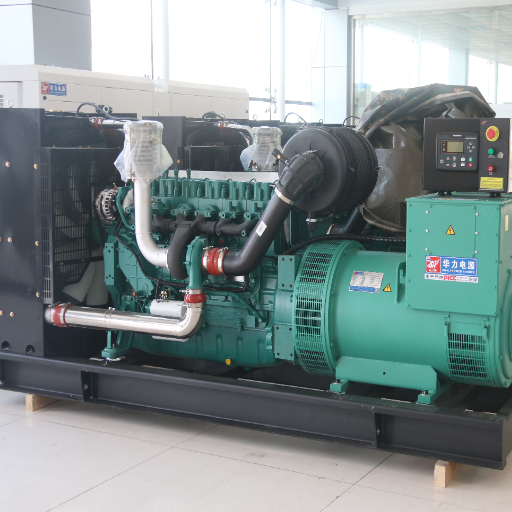
A specification that produces an accurate quote answers four questions in one line. Leave any out and the supplier will assume the catalogue default.
Include all of the following:
- Voltage, phase-to-phase, as the utility states it. Not “European standard.”
- Frequency, 50 Hz or 60 Hz, stated explicitly and separately from voltage.
- Phase configuration and wire count, three-phase four-wire being the usual industrial case.
- The switchgear or distribution voltage the set will feed. If a transformer sits between the generator and the load, say so, because it completely changes the answer.
Stating the load, not just the supply, also helps, because rating and voltage interact. A properly sized generator set has margin built around the re-rated output, not the original nameplate.
Then add the four that separate a good quote from a lucky one:
- Whether the site is the exception. Brazil, Japan, and several island markets do not follow their region’s majority standard.
- Whether the load includes large motors, since reactive capability rather than real power usually limits a re-rated machine.
- Whether you need parallel operation, which adds voltage, frequency, phase sequence, and droop matching requirements.
- Whether the set will be load tested on site, and if so, at what voltage.
Four specification mistakes that surface at commissioning
- Specifying voltage but not frequency. The most common error, and the most expensive, because it cannot be corrected on site.
- Assuming custom voltage means custom engineering. Tier 1 is a terminal block. Paying Tier 2 prices for it is avoidable.
- Forgetting the V/Hz de-rate. A re-rated set does not hold its original nameplate output, and the load calculation has to reflect that.
- Treating voltage and frequency as independent. An alternator is selected for both together. A set specified for one grid and delivered into another has no valid nameplate.
Frequently Asked Questions
Can a generator be built for any voltage I specify?
Within limits, yes, but the cost varies by orders of magnitude depending on the tier. Most industrial voltages between 380 V and 480 V are reachable by reconnecting a standard twelve-lead alternator at no engineering cost. Voltages outside those bands need a custom-wound alternator and add lead time. Voltages above 1,000 V need a medium voltage machine with its own switchgear, earthing, and protection.
Can I run a 60 Hz generator on a 50 Hz supply?
The machine will run, but not at its nameplate rating. To keep the volts-per-hertz ratio constant, a 480 V / 60 Hz machine must be re-rated to 400 V at 50 Hz, and manufacturer guidance is to reduce voltage and power by around 20%. Current stays the same. Reactive capability usually becomes limiting first, so confirm the re-rated capability chart with the factory rather than assuming a proportional reduction.
Do I need a custom voltage generator, or will a standard one work?
Compare your required voltage against the standard reconnectable bands, which cover approximately 380 V to 480 V on the series-star grouping and 190 V to 250 V on parallel star. If your requirement falls inside those, a standard alternator will reach it. If your requirement is a frequency rather than a voltage, the answer is different again: you need a set built for that frequency.
How much does a custom voltage generator cost?
For a reconnection inside the standard bands, the cost difference is effectively zero and should be quoted as such. A custom-wound low voltage alternator adds setup cost plus lead time, and usually carries a minimum order quantity. Medium voltage is a separate category: alternator, switchgear, earthing, protection, and testing all change, and the genset is often the smaller part of the total scope.
Conclusion: Specify the Grid, Not the Catalogue
A custom voltage generator sounds like a specialist requirement. In practice it splits into two problems that behave nothing alike. Voltage is a winding ratio, adjustable across a wide band by reconnecting an alternator that already has twelve leads, and usually free. Frequency is a physical speed, fixed by engine and pole count, and moving it means a different machine.
The volts-per-hertz ratio connects them. A 480 V / 60 Hz nameplate holds 8.00 V/Hz, which is why the same set must run at 400 V on a 50 Hz grid. Forget that, and the generator arrives correct and unusable.
So write the RFQ around the destination grid rather than the catalogue. State voltage, frequency, phase, and the distribution voltage the set will feed, and say whether the site is Brazil, Japan, or another exception. If your voltage turns out to be a reconnection, you should be told so and charged accordingly.
Shandong ZC Power has built tailored generator sets from 8 kVA to 4,000 kVA since 1999, from a 300,000 square metre facility in Jining with more than 80 engineers. Every set is full-load tested before dispatch at its specified voltage and frequency, with the test report travelling with the machine.
Send us your site’s voltage and frequency and we will tell you which tier your requirement falls into, before you commit to a specification. Contact our engineering team for a factory-direct assessment of your project.