What Uses the Most Electricity in a Home? The Ranking Depends on What You Measure
Heating and cooling together use more electricity in a typical home than anything else, and water heating sits third. Which of those three leads depends on your climate, your fuel, and how your house is built.
That answer is not what most appliance charts say, and the disagreement is not because those charts are wrong. It’s because they’re answering a different question and not telling you which one.
Search for what uses the most electricity in a home and you’ll find lists that put an electric kettle on top. You’ll find other lists that put air conditioning on top. You’ll find a third set that says heating by a wide margin. All three can be correct at the same time, because three different quantities are being measured and they rank appliances in almost opposite orders.
At ZC Power we size generating equipment for a living, which means we spend our days deciding which loads matter and which ones don’t. The same confusion that makes appliance lists disagree is the confusion that makes people buy a generator that’s too big or too small.
Here are the four ways to rank home appliances, what each one actually measures, and why the answer changes when you switch between them.
If you’re sizing equipment rather than auditing a bill, our guide to sizing a generator picks up where this ranking stops being useful.
Key Takeaways
- Heating and cooling lead home electricity use, with water heating third. The order shifts by climate and by whether your heat runs on gas or electricity.
- Appliance charts rank by watts, which measures power at an instant. Your bill is measured in kilowatt-hours, which is power multiplied by time. The two rankings barely resemble each other.
- An electric kettle tops almost every wattage chart at 1,500 watts and uses roughly 46 kilowatt-hours a year. A refrigerator averages about 50 watts and uses roughly 440.
- Standby power across your electronics is 5 to 10 percent of home electricity use and can cost about $100 a year, but it is rarely the single biggest load.
- The appliance that drains the most energy is not the one that decides your generator size. Starting surge decides that, and surge belongs to motors.
What Uses the Most Electricity in a Home: The Short Answer
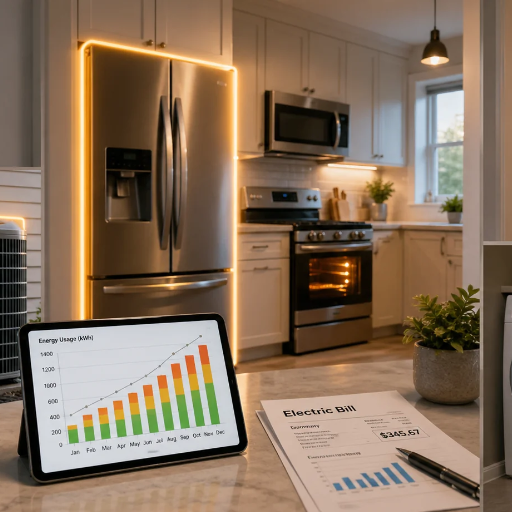
By electricity alone, air conditioning, space heating and water heating are the three largest end uses in United States homes. That’s the finding of the Energy Information Administration’s 2020 Residential Energy Consumption Survey. It put those three at the top of its electricity end-use analysis.
Notice what that sentence did not say. It did not say heating is the biggest energy use in your home, even though that’s true when you count every fuel. It did not rank appliances by how much power they draw, even though that’s what most charts do.
Three separate claims, three separate measurements. Using the wrong one is how a homeowner ends up worrying about the wrong appliance for a year.
Here’s the four-way split, and it’s the whole article in one table.
| What you measure | Units | What tops the list |
|---|---|---|
| Total household energy, all fuels | Btu or therms | Space heating, then water heating |
| Electricity only | Kilowatt-hours | Cooling, then space heating and water heating |
| Power draw while running | Watts | Resistance heat, electric range, clothes dryer |
| Energy per household that owns it | Kilowatt-hours | Water heating, EV charging, pool pumps |
Read down the right-hand column and you’ll see four different leaders. None of them is wrong. They’re just answering four questions.
One appliance that people consistently overestimate is the television, and it’s the clearest example of the problem. How many watts a TV actually uses is a smaller number than almost anyone expects.
Why the Lists Disagree: Four Questions Wearing the Same Answer
The confusion has a specific cause, and once you see it you can’t unsee it.
Total Energy Is Not Electricity
Most statements about what uses the most energy in a home are quoting a figure that counts every fuel. On that basis, space heating is the largest end use in most American homes, and water heating is second. Together they account for well over half of household energy.
Then people apply that ranking to electricity, and it falls apart. Most space heating and water heating in the United States runs on natural gas, propane or fuel oil, not on electricity. Those end uses dominate total energy while drawing comparatively little from the grid.
The result is a near inversion. On total energy, space heating wins by a wide margin. On electricity alone, cooling takes the top spot in the EIA’s own analysis. Almost all air conditioning is electric, and much heating is not.
This is the single most common error in the appliance-ranking genre: quoting a total-energy figure and then discussing your electricity bill. In practice, that mismatch explains most of the contradictory advice you will find.
Watts Are Not Kilowatt-Hours
The second confusion is the one that misleads people most, and every wattage chart on the internet contributes to it.
A watt is a rate. It tells you how fast an appliance is using energy right now. A kilowatt-hour is a quantity, and it tells you how much energy was actually used over time.
Your electricity bill charges for kilowatt-hours, not for watts.
That same distinction separates kilowatts from kilovolt-amperes in equipment ratings, and it causes just as much confusion there.
Appliance charts list watts, because watts are easy to read off a nameplate. But watts say nothing about how long the appliance runs, and duration is most of the answer.
An electric kettle draws about 1,500 watts, which puts it near the top of every chart in existence. It also runs for a few minutes at a time. A refrigerator draws far fewer watts but runs around the clock, every day, all year.
Run the arithmetic and the ranking flips completely:
| Appliance | Power while running | Time per day | Energy per year |
|---|---|---|---|
| Electric kettle | 1,500 W | 5 minutes | about 46 kWh |
| Refrigerator | about 50 W average | 24 hours | about 440 kWh |
The kettle draws roughly thirty times the power. The refrigerator uses roughly ten times the energy. If you’re deciding what to replace or what to switch off, the second column is the one that matters.
Illustrative composite. Daniel compared two appliance charts before buying a new refrigerator and found his kettle at the top of both, at 1,500 watts against the fridge at 150. He concluded the kitchen was fine and the appliance he should worry about was the one he boiled water in. A plug-in meter told a different story. The kettle accounted for about 50 kilowatt-hours over the year. The fifteen-year-old refrigerator behind it accounted for nearly 700, and replacing it cut more from his bill than every other change he made that year combined. This scenario is illustrative, not a record of a specific customer.
Intensity Is Not Impact
The third confusion is subtler, and it’s the one the EIA’s own analysis is built to correct.
The survey’s guidance is direct. The total electricity an end use consumes nationally depends on how many homes have it multiplied by how much each one uses. That’s two numbers, not one.
The EIA plots exactly that, with energy per household on one axis and the share of homes owning the device on the other. Read the chart and the highest-intensity appliances per household are water heating, electric vehicle charging, pool pumps and hot tubs.
Read the same chart for total national contribution and the picture changes. Pool pumps and hot tubs sit in a small minority of homes. Water heating and cooling reach the top of the national ranking because huge numbers of homes have them.
So a pool pump can genuinely draw more than an air conditioner in the houses that have one. It still isn’t a major contributor to national electricity use. Both statements are true. A page that reports only one of them is giving you half an answer.
Which Appliances Actually Use the Most Electricity
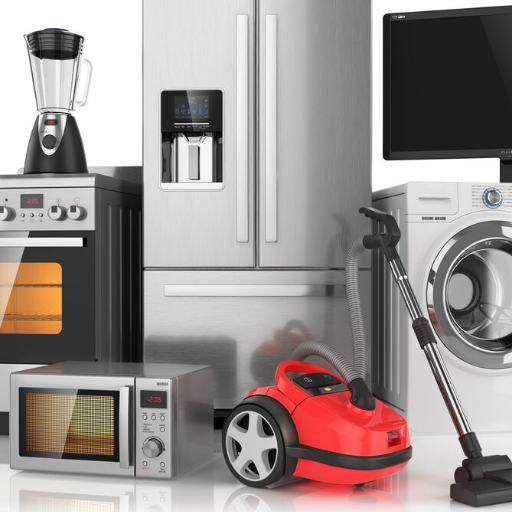
The fastest way to compare home appliance power consumption is to put power and energy in one table, with the daily duty cycle alongside.
| Appliance | Typical power | Energy a year | Cost a year |
|---|---|---|---|
| Water heater, family of four | 4,500 W | about 4,000 kWh | about $480 |
| Space heater, six hours a day | 1,500 W | about 3,285 kWh | about $394 |
| Clothes dryer, three loads a week | 5,400 W | about 850 kWh | about $102 |
| Refrigerator | 50 W average | about 440 kWh | about $53 |
| Freezer | 40 W average | about 350 kWh | about $42 |
| Television, four hours a day | 85 W | about 125 kWh | about $15 |
| Electric kettle, five minutes a day | 1,500 W | about 46 kWh | about $6 |
Costs use 12 cents per kilowatt-hour, close to the national average. Read the kettle row against the water heater row and the whole problem with wattage charts becomes visible. The kettle draws a third of the water heater’s power and uses one percent of its energy.
Electric Kettles, Space Heaters and Hair Dryers
These are the appliances that top wattage charts and use almost nothing, because they run for minutes rather than hours.
A space heater draws 1,500 watts. That’s a genuinely significant load if you run it all day, which is why it belongs in a different category from a kettle. The distinguishing question is always the same one: how long does it run?
A hair dryer at 1,800 watts for ten minutes a day is about 110 kilowatt-hours a year. A space heater at 1,500 watts for six hours a day is roughly 3,285. Same order of power, thirty times the energy.
If you want a feel for the arithmetic rather than a chart, multiply watts by hours, then divide by 1,000. That gives kilowatt-hours, and it’s the number your utility charges for.
Refrigerators and Freezers
Refrigeration is the quiet one. It draws modest power, runs continuously, and sits in almost every home. That’s why it ranks high on national electricity end-use lists despite never topping a wattage chart.
A modern refrigerator averages roughly 50 watts around the clock, which is about 440 kilowatt-hours a year. A chest freezer adds roughly 250 to 350 watts, depending on size and age. Neither figure feels dramatic, and together they can be a tenth of a household’s electricity.
Age matters more than size here. An appliance built in the 1990s can use twice what an equivalent modern unit uses, and replacement is often the highest-return change available.
Water Heaters
Water heating is the third of the big three by electricity, and for many households it’s the one they can most easily influence.
An electric water heater runs on a resistance element drawing 4,000 to 4,500 watts. It has no compressor and no motor, so there’s no surge to consider. What moves the total is how much hot water you use and how hot you keep it. Lowering the tank setting and insulating the pipes are both cheap, and both show up on the bill.
Standby and the Vampire Load
Standby power, sometimes called the vampire load, is what your devices draw while they’re switched off or idle. The Department of Energy puts it at 5 to 10 percent of residential electricity use, costing the average household as much as $100 a year.
That sounds like an obvious target, and it partly is, but it’s rarely the single biggest drain in a house. It’s a large number spread across dozens of small draws. A set-top box, a games console in rest mode, a soundbar, a printer and a charger block each contribute a little.
The usual suspects, roughly in order of how much they draw while idle:
- A set-top box or cable box
- A games console left in rest mode
- A soundbar or AV receiver
- A desktop printer
- Charger blocks and power adapters
The practical fix is one switched power strip per cluster, turned off at night. Chasing individual charger blocks is a worse use of your time.
What This Means If You Are Sizing a Generator
If you’re counting appliance energy to work out what a backup generator can carry, everything above is background. One new question takes over.
Which appliances have a starting surge? That, and not energy consumption, decides generator size.
A motor draws far more power for the first second or two than it does while running. It has to overcome inertia from a standing start.
A refrigerator that runs on 700 watts needs around 2,200 to start its compressor. A furnace blower drawing 800 watts needs roughly 1,600 to spin up. An electric water heater drawing 4,500 watts needs exactly 4,500, because a resistance element has no moving part.
That last example is the point. The appliance that uses the most energy in your home is often the one that matters least to your generator. The one that uses almost nothing can matter most. Resistance heating uses enormous energy and adds no surge at all.
The Method and the Table
The approach is consistent across every competent source. Add the running watts of everything you want to power at once. Then add the single largest starting surge, not every appliance’s surge, because motors rarely start at the same instant. Then add a margin for future growth.
| Load | Running watts | Starting watts | Assumption |
|---|---|---|---|
| Refrigerator | 700 | 2,200 | Standard frost-free, compressor start |
| Freezer | 500 to 700 | 1,500 to 2,200 | Chest versus upright |
| Sump pump, half horsepower | 800 to 1,000 | 2,000 to 3,000 | Impeller material and head |
| Well pump, one horsepower | 1,000 to 1,200 | 3,000 to 3,600 | Submersible, depth-dependent |
| Furnace blower | 600 to 800 | 1,200 to 2,000 | ECM motors at the low end |
| Central air, three ton | 3,500 | 7,000 with soft start | State whether a soft start is fitted |
| Electric water heater | 4,000 to 4,500 | Same as running | Resistive, no surge |
| Electric range or oven | 8,000 to 12,000 | Same as running | Resistive, no surge |
| Clothes dryer | 5,400 | 6,750 | Element plus drive motor |
| Television | 30 to 150 | Same as running | No motor, no surge |
Read the water heater and the television rows together. The water heater is one of the three largest energy users in the house and adds nothing to your surge requirement. The television is one of the smallest loads in the house and also adds nothing, but for the opposite reason. Neither belongs at the top of a sizing decision, and only one of them belongs near the top of an energy decision.
The full method, including how to convert kilowatts to kilovolt-amperes and why the largest motor decides the outcome, is in our step-by-step guide to generator load calculation. For the engineering behind the surge column, see motor starting and generator sizing.
Our whole house generator sizing guide works the arithmetic through for a typical home, start to finish.
If you’re comparing how loads are rated rather than how large they are, kilowatts and kilovolt-amperes covers the distinction that trips up most first calculations.
Frequently Asked Questions
What uses the most electricity in a home?
Heating and cooling together, with water heating third. Air conditioning, space heating and water heating are the three largest electricity end uses in United States homes according to the Energy Information Administration. Which of the three leads in your house depends on your climate and on whether your heat runs on gas or electricity.
What appliance uses the most electricity, if I count only one?
Usually the air conditioner in a cooling-dominated climate, and the electric water heater or electric furnace elsewhere. Each sits far ahead of anything in a kitchen or a living room. The one exception is a Level 2 electric vehicle charger, which can outdraw them all.
Do appliances use power when switched off?
Yes, and it adds up. Standby power accounts for 5 to 10 percent of residential electricity use and can cost about $100 a year. A games console in rest mode and a set-top box are usually the largest single contributors, not the television itself.
Does the biggest energy user decide my generator size?
No, and assuming it does is one of the most common sizing mistakes. Generator size is set by starting surge, which comes from motors. An electric water heater can be the largest energy user in a home and add nothing to the surge requirement. A well pump that uses a fraction of that energy can add 2,600 watts.
If you’re specifying equipment for a house, a small business or a facility, the load list matters more than the energy ranking. Talk to the ZC Power engineering team about a load assessment before you commit to a size.
Conclusion: Two Rankings, Two Different Jobs
There are two honest answers to what uses the most electricity in a home, and the right one depends on what you’re trying to decide.
If you’re trying to cut your bill, the ranking is heating and cooling first, then water heating, then refrigeration. The levers are insulation, thermostat settings, water temperature and appliance age. Those are the changes that move a monthly bill, and no amount of unplugging chargers will substitute for them.
If you’re trying to size a generator, the ranking above doesn’t apply at all. What matters is starting surge, and starting surge comes from motors. Electric resistance heat is enormous in energy terms and irrelevant in surge terms. A well pump is the reverse.
The mistake that costs people money is crossing the two. It leads to oversized equipment specified around a water heater that never surges. It also leads to undersized equipment that trips on the first cold morning, when the furnace blower and the well pump start together.
Two habits are worth keeping. Read wattage charts as power rather than cost, and multiply by hours before you compare anything. And check whether a ranking counts all fuels or electricity alone, because those two lists are nearly inverted.
Illustrative composite. A homeowner in a cold climate built a load list for a standby generator by working through every appliance in the house and adding up the energy figures. He reasoned that the biggest energy users would decide the size. His water heater and his range dominated the total and pushed him toward a much larger unit than he needed. Recalculated correctly, his surge came almost entirely from the well pump and the furnace blower, and a smaller set carried the house through a two-day outage without a trip. This scenario is illustrative, not a record of a specific customer.