
Benefits of Containerized Generator Sets: 7 Wins, 4 Costs
The benefits of containerized generator sets that actually pay are shipping and civil works. A containerized set travels as standard cargo and arrives as its own building. The rest of the list, from noise control to security, is real but secondary, and four common situations mean the premium never comes back.
Here’s the part the datasheets skip. A container is the most expensive way to buy weather protection per kW. You aren’t paying for rain cover. You’re paying for the fact that the unit ships like freight and lands on a pad instead of in a building.
We build containerized sets from 8 kVA to 4,000 kVA alongside open, silent and trailer formats, and we load test every one before dispatch. That means we see both outcomes.
Some projects the container earns its keep. Others it didn’t need to. This article prices the benefits, so you can decide in a meeting rather than on a supplier’s recommendation. If you’re comparing formats for a live project, send us the load schedule and we’ll cost both options.
Key Takeaways
- Two benefits carry the premium: shipping as standard cargo and eliminating the generator house. Price those first; the other five rarely justify it alone.
- A 40 ft general-purpose container is rated at 30,480 kg maximum gross mass. Subtract a tare of 3,640 to 4,000 kg and you have 26.5 t to 26.8 t of payload for engine, alternator, tank, enclosure and exhaust.
- Cooling is the engineering constraint, not weather sealing. Louvre and filter resistance plus heat recirculation can pull usable output below nameplate.
- The premium does not pay back in four cases: a site with an existing generator room, an indoor installation, a small set that will never move, and a project that ships the unit only once.
- “CSC certified” is not a certificate you buy. It is a Safety Approval Plate plus an examination regime, and a buyer can check both before the container leaves the port.
The Benefits of Containerized Generator Sets, Ranked
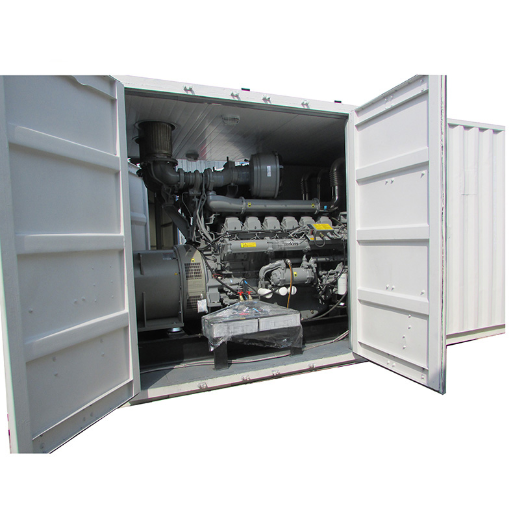
Seven benefits get quoted. Two are worth money on most projects, three are worth money on some, and two are worth having but rarely decide the purchase.
| Benefit | What it takes off the project | When it does not apply |
|---|---|---|
| Ships as standard cargo | Removes crating, a separate transport frame and rebuild on arrival | Inland projects that never leave one country |
| No generator house | Removes civil works, acoustic walls and ductwork from the programme | Sites that already have a generator room |
| Relocation value | The asset moves with the project and keeps resale value | Fixed installations with no relocation plan |
| Noise control included | Attenuation is built into the enclosure rather than added later | Sites with no noise constraint and no neighbours |
| Access control included | Lockable steel shell, which matters where cable theft is real | Fenced, staffed, monitored sites |
| Modular growth | A second container parallels to the first without redesign | Loads that will not grow |
| Factory-completed and tested | Most assembly and testing happen before dispatch, not on site | Never, but it is not unique to containers |
Read that table as a cost argument, not a feature list. The first two rows remove work from the project. The middle three remove risk. The last two remove coordination.
Shipping is a solved problem
An ISO container moves on a vessel, a flatbed or a rail car without anyone engineering a one-off shipping solution. That is the whole proposition, and it is worth more than every acoustic claim on the page.
The convention behind it is the International Convention for Safe Containers, adopted in 1972 and in force since 1977 (IMO CSC page). It works through a Safety Approval Plate fixed to the container, plus one of two examination regimes: periodic examination, or an approved continuous examination programme (ACEP). The 1983 amendments set the re-examination interval at 30 months.
That detail matters at the port. A supplier who says “CSC certified” and cannot show you the plate and the examination record is describing an intention, not a status.
The generator house you don’t build
A generator house is a building. It needs foundations, walls, a roof, acoustic treatment, ventilation openings sized to the set, fire separation and a door big enough to remove the alternator. None of that appears on a genset quotation, and all of it appears on the project programme.
A container replaces that scope with a concrete pad, an electrical connection, a fuel line and an exhaust penetration. On a remote site, the difference is not just money. It is whether the set is running this quarter or next.
This is an illustrative composite rather than a record of a specific client. An EPC contractor on a West African gold project ordered an open-frame 1,250 kVA set because the unit price was lower. The generator house was let as a separate package.
Nine weeks after the set arrived, the building was still a slab with rebar. The set sat under a tarpaulin. The mine was running on rental power at a monthly cost that exceeded the saving on the set. The container version had been quoted at roughly a fifth more for the equipment.
Acoustic and access control in one shell
Two benefits come free with the enclosure, and both are usually quoted separately on an open set.
Acoustic lining, labyrinth ventilation and an exhaust silencer turn a set into something a neighbour won’t complain about. A lockable steel shell with doors that close properly turns it into something that stays yours. Neither is unique to containers. A silent canopy does the same job outdoors.
What the container adds is that both arrive with the unit, rather than being specified later.
Where the Premium Actually Goes
A containerized set costs more than the same engine on a skid. The question worth asking is what you’re buying with the difference.
It is enclosure and integration, not the machine
The engine, alternator and controller are the same components in either format. The premium buys container modification, acoustic treatment, ventilation design, an integrated fuel tank, doors and hardware. It also buys the testing that proves the assembly works as a system.
That has a practical consequence. When you compare quotes, compare the scope. A container price that excludes the fuel tank or the exhaust silencer is not a container price. It’s an enclosure price with the contents missing.
The payload number decides whether it ships
This is the calculation nobody puts on a marketing page, and it’s the one that can stop a project.
A 40 ft general-purpose container is rated at a maximum gross mass of 30,480 kg, which is the standard figure carriers quote. Its tare weight runs from about 3,640 kg to 4,000 kg depending on builder. That leaves 26.5 t to 26.8 t of payload for the engine, alternator, base frame, fuel, enclosure and exhaust. A 20 ft unit leaves 28.1 t to 28.3 t, because its tare is lighter at 2,150 to 2,400 kg, but the floor area is half.
Some builders plate high-cube variants above 30,480 kg. Treat the higher figure as a carrier-specific allowance and confirm it against the booking, not as the container’s rating.
These dimensions and strength requirements come from ISO 1496-1:2013, the standard for series 1 general-purpose containers. The standard fixes the envelope. It does not fix the tare, which is why the same nominal container weighs different amounts depending on who built it.
This is an illustrative composite rather than a record of a specific client. A distributor ordered a 3,000 kVA set in a 40 ft container without checking the gross mass. The layout fitted the floor plan with 300 mm to spare. The completed unit came in at 31,200 kg, 720 kg over the container’s rating. The unit had to travel as breakbulk on a separate booking. The container shipped empty, and the freight cost rose by more than the container conversion had cost.
A set that fits the floor plan but exceeds the payload does not ship as a container. It ships as heavy lift.
That collapses the logistics case that justified the container. Get the gross mass from the manufacturer before you approve the layout.
Cooling is the constraint, not weather sealing
Sealing a generator into a steel box trades one problem for another. The box keeps dust and rain out. It also traps heat.
Two things limit usable output. Airflow resistance through louvres, filters and ducting reduces the volume of cooling air reaching the radiator. Hot air leaving the enclosure can also recirculate back into the intake if the discharge arrangement is wrong. That raises the intake temperature and derates the set further.
The number that matters is not nameplate output. It is the output the set will hold at your site’s ambient temperature and altitude, which is lower. Our guide to altitude and ambient derating covers the arithmetic. Ask for the site rating in writing, at the highest ambient temperature the site records, not the reference conditions the datasheet assumes.
Maintenance through the container door
A general-purpose container door opening is roughly 2.34 m wide and 2.28 m high. That sets what can leave the enclosure without cutting steel.
Routine service fits. A radiator core or a complete alternator does not always.
Ask how the alternator comes out, and how long that takes, before you sign. The answer is either a removable panel, a roof hatch, or a crane and a torch. Whichever it is, it should be documented.
The Four Cases Where the Premium Does Not Pay Back
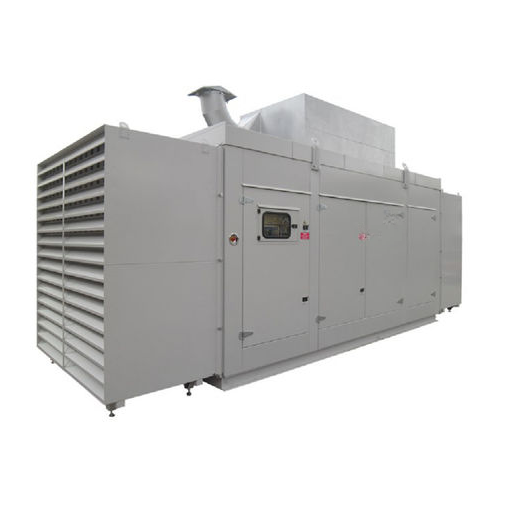
A containerized generator set wins most arguments. It does not win these.
1. A fixed site that already has a generator room
If the room exists, is sized correctly and meets the fire and ventilation requirements, the container duplicates it. You would be paying for an enclosure to replace a building you’ve already built. Spend the difference on the set itself.
2. An indoor installation
A container is an outdoor enclosure. Put one inside a plant and you’ve created a box within a box, with the ventilation problem doubled and the fire separation question unanswered. If the set goes indoors, buy an open or skid-mounted unit and ventilate the room properly. Simpler, and easier to inspect.
3. A small set on a site that will never move
The premium is roughly proportional to output but the logistics benefit is not. Below a few hundred kVA, the crating and handling cost for an open set is small in absolute terms. If the set sits in one place for twenty years, you’re paying for mobility you’ll never use. Spend that money on sizing the set correctly instead.
4. A project that ships the unit exactly once
The container’s value compounds with every move. If the set travels to site, runs for the project duration and is scrapped or sold locally, you paid for a transport advantage used once. Compare that against crating the same set and building a shelter. The gap is usually smaller than the premium.
What to Verify Before You Sign
Four checks separate a working set from a variation order.
The Safety Approval Plate and the examination record
Look for the plate on the door. Then ask for the examination regime: periodic inspection or an approved continuous examination programme, and the date of the last examination. If the programme isn’t in place, the container is a steel box with a generator in it, and some carriers will refuse it.
Site rating, not nameplate
Ask for output at your ambient temperature and altitude, with the derating basis stated. A quoted figure at reference conditions tells you what the machine does in a test cell. It doesn’t tell you what it does in July.
ISO 8528-1:2018 is the standard that defines the rating classes, from emergency standby and prime power through to continuous. Whichever class the quote names, the figure is measured at reference conditions. The site rating is the number that has to hold on your pad.
Fire, ventilation and the AHJ
Is a container used as a generator enclosure treated as a generator room? If it is, the fire separation and ventilation rules that govern rooms apply to it. That is a question for the authority having jurisdiction, and it needs asking in writing before the design freezes.
Our notes on stationary generator installation requirements cover the items an AHJ will ask for. It is not a question a vendor can answer for you, and a survey is a bad time to discover the answer.
Witnessed testing
Every set should be load tested before dispatch. The benefit of the container is that the whole package, including ventilation and cooling, can be tested as an assembly rather than as parts. Ask to witness it or receive the record, and check that the report shows load achieved at each step, not just a tick box.
Containerized vs Open Frame Generator, Without the Sales Copy
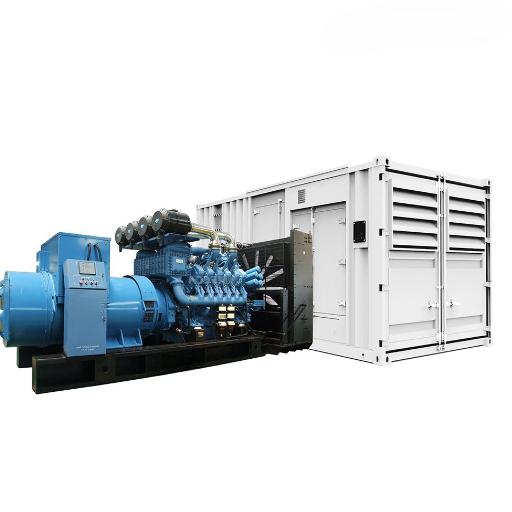
Forget the feature grid. Here are the six decisions that cover most projects.
| If your situation is | Buy this | The reason |
|---|---|---|
| Remote site, cross-border shipping, no building | Containerized | Removes civil works and crating from the programme |
| Fixed site with a compliant generator room | Open frame | The room already does the enclosure’s job |
| Indoor plant or basement | Open or skid | A container indoors doubles the ventilation problem |
| Urban site, tight noise limit, outdoor | Silent canopy | Same attenuation without the transport premium |
| Load that will grow in stages | Containerized, paralleled | Add a unit without redesigning the first |
| One-off project, small set, no relocation | Open frame | You’d be paying for mobility you won’t use |
Not sure which row you’re in? Give us the site conditions and the load, and we’ll tell you which format we’d build and why.
If you’re still narrowing the format, the containerized genset buyer’s guide covers sizing, certification and total cost in more detail than a benefits article should.
Frequently Asked Questions
Are containerized generators weatherproof?
The enclosure protects against rain, dust and salt spray when it is built for it. “Containerized” describes a format, not an ingress rating. Ask for the corrosion specification and the IP rating of the doors and louvres, because both vary by build. Our weather-resistant canopy guide explains what each rating covers.
How much more does a containerized genset cost than an open set?
It is typically quoted as a 20% to 50% premium over an open-frame set of the same rating, and the higher end is for climate-hardened builds. That range is a market convention, not a published figure. Get both quotes from the same supplier, with the same scope, and compare the total cost of ownership, civil works included.
Can any generator set be put in a container?
Almost any set can be enclosed, but not every set should be. The constraints are payload, cooling airflow and maintenance access. A set with a large radiator relative to its output may need a high-cube container or a split cooling arrangement, which changes the cost.
Do I need CSC certification?
You need a Safety Approval Plate and a valid examination regime if the container will travel internationally by sea. For a set that stays on one site in one country, the convention may not apply at all. Confirm with the carrier and your freight forwarder rather than assuming.
How do you cool a containerized generator?
Cold air enters low at one end and leaves high at the other, after passing through the radiator. Intake and discharge are separated so exhaust air does not recirculate. Louvre area, filter specification and duct geometry all reduce the airflow the radiator actually sees. That is why the site rating is lower than nameplate.
Is a containerized set a “containerized power plant”?
Not on its own. A single container is a packaged generator set. A power plant implies multiple units, paralleling gear, switchgear and usually a control room, which may itself be containerized.
Redundancy at that scale is usually described as N+1 or 2N, meaning one or two spare units beyond the load. The term is used loosely in marketing and precisely in engineering.
Conclusion
The benefits of containerized generator sets come down to two that pay and five that help. Shipping as standard cargo and eliminating the generator house do the financial work. Noise, security, modularity, relocation and factory testing are real, but they rarely carry the premium alone.
This is an illustrative composite rather than a record of a specific client. A hospital facility manager inherited a design that put a 1,000 kVA set in a 20 ft container inside a basement plant room. The room had no mechanical ventilation. On the first full-load test the intake air passed 48 °C, output fell away, and the set tripped on high coolant temperature at about 70% of nameplate. Moving the unit outdoors cost more than the container had saved, and the design had already been through two revisions.
So price the two that matter. Compare the container against an open set plus a building, with both scopes complete, including civil works and the time to first power. Then check the payload, the site rating and the examination regime before the design freezes.
Most vendor pages make a wider case. This one is narrower, and it survives the first project meeting.
Comparing formats for a live project? Send us the load schedule, the site’s ambient temperature and whether the unit will ship internationally. An engineer will cost the container and the open set on the same scope. That includes the civil works the open set needs and the container doesn’t.


