How to Specify Soundproof Containerized Power Plants
A soundproof containerized power plant is specified backwards from the boundary, not forwards from the container. Take the noise limit in your permit, subtract the distance to the nearest receptor, then divide by the number of units. What is left is the acoustic budget for each container. Almost no quotation is written this way.
Eight containers at 70 dB(A) each are not 70 dB(A) anywhere. They are 79 dB(A) at the source distance, because identical sources add as ten times the logarithm of their number. What reaches the fence depends on the distance, what stands between, and which face points at the receptor.
There is a second problem, and it is a vocabulary problem. ISO 8528-10, the standard for measuring generator noise levels, doesn’t measure anything called soundproof. It measures sound power level and emission sound pressure level. Soundproof is an adjective.
This guide converts a boundary limit into a per-unit budget you can put in a purchase order. If you have a site plan and a limit, our engineering team will run the numbers against your unit count.
The scenarios in this article are illustrative composites, not named customer cases.
Key Takeaways
– Identical units add as ten times the logarithm of their number. Eight containers is 9 dB over one, not eight times the noise.
– ISO 8528-10 measures sound power level and emission sound pressure level. Soundproof is not one of its quantities.
– A quote of 68 dB(A) at 7 m and one of 72 dB(A) at 1 m sit about 5 dB apart in sound power, and the 7 m quote belongs to the louder machine.
– The IFC guidelines set 55 dB(A) by day and 45 dB(A) by night at the nearest receptor, or a maximum 3 dB rise above background.
– Every decibel of attenuation costs airflow. Across a plant, cooling usually binds before acoustics.
Why a Soundproof Containerized Power Plant Is Not a Fence Around a Loudspeaker
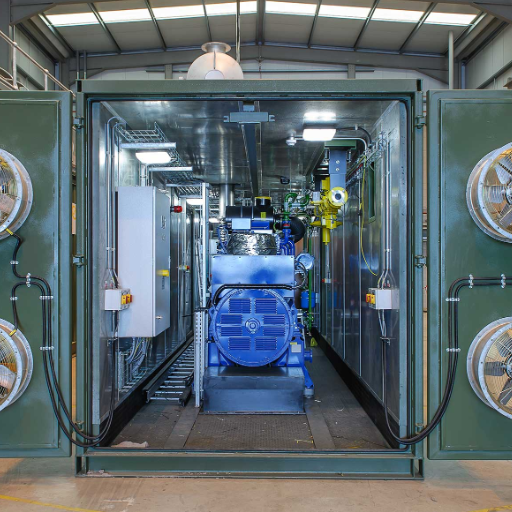
A container puts a machine inside a steel box and leaves five surfaces radiating, so treating the plant as one loud object at the middle of the site gets the arithmetic wrong.
What the standards measure, and what soundproofing does not
ISO 8528-10:2022 specifies test codes for airborne noise from reciprocating engine generator sets. It defines two quantities: the sound power level, which the standard treats as the essential noise emission value, and the emission sound pressure level at a workstation.
Neither is called soundproof, and neither is an adjective at all. Each is a number with a unit, a stated distance, a load point and a grade of accuracy.
A supplier who promises “soundproof” has promised nothing measurable. A supplier who promises 68 dB(A) at 7 m, to ISO 8528-10 grade 2 at 75% of prime rating, has promised something you can accept or reject on test. Our guide to the low-noise diesel generator 75 dB claim sets it out line by line.
What propagates and what adds is sound power, so every quotation has to be converted to it.
Sound power leaves the box; sound pressure is what a meter reads
Sound power describes how much acoustic energy a machine radiates in total. Sound pressure describes what a microphone at one point experiences. The two are linked by the measurement surface area:
LwA = LpA + 10 log₁₀(S)
with S in square meters. Take a 40 ft container measured on an enveloping box one meter out from every face. That box is roughly 14.2 m by 4.44 m by 4.59 m, so its area is about 297 m².
Ten times the logarithm of 297 is 24.7. A unit quoted at 72 dB(A) at 1 m therefore radiates about 97 dB(A) of sound power.
Five faces, five different levels
The exhaust outlet and the radiator louver are usually the loudest faces per square meter at mid and high frequency, because both carry airflow noise on top of machinery noise. The walls carry the low-frequency content, which travels furthest and is what a barrier struggles to stop. The door is the face that most often lets a design down, because its seals compress or tear first.
Multi-unit assessments model each container as an area source on every face, and the louver and exhaust assumptions decide the answer more often than the wall specification does. Construction behind those faces sits in our guide to the silent heavy duty diesel generator.
Adding Units: The Arithmetic Behind Soundproof Containerized Power Plants
Sound levels do not add the way numbers add. Two identical machines running together do not double the decibels; they raise the level by three. For identical, uncorrelated sources the combined level is L_total = L_single + 10 log₁₀(N), so each doubling of the source count adds 3 dB.
| Units running | Added over one unit |
|---|---|
| 1 | 0 dB |
| 2 | +3.0 dB |
| 4 | +6.0 dB |
| 6 | +7.8 dB |
| 8 | +9.0 dB |
| 10 | +10.0 dB |
Ten units are 10 dB louder than one. A plant of eight identical containers, each quoted at 70 dB(A) at its reference distance, comes out at 79 dB(A) at that same distance. Nobody in the procurement chain wrote 79, because each supplier quoted one unit and each unit is fine. On phased projects, add within each phase, then add the groups.
The 1 m and 7 m trap
Priya was comparing two quotations for a four-unit plant. The first quoted 72 dB(A) at 1 m to ISO 8528-10. The second quoted 68 dB(A) at 7 m to the same standard. Four decibels looked like a clear win for the second supplier.
Then her consultant put both on the same surface. Scaled out to 7 m, that enveloping box covers about 2,276 m², which adds 33.6 dB. The second unit therefore radiates about 102 dB(A) of sound power, against 97 for the first. The quote that looked four decibels quieter described a machine about 5 dB louder.
Five decibels is not a rounding difference. It is the gap between passing and needing a barrier.
Nobody played a trick. The standard’s surface sits one meter out; seven meters is a distance many suppliers quote because the figure reads lower. Priya’s fix cost one line: state the distance and the standard, and require every bidder to answer in the same terms.
From a Boundary Limit to a Per-Container Budget
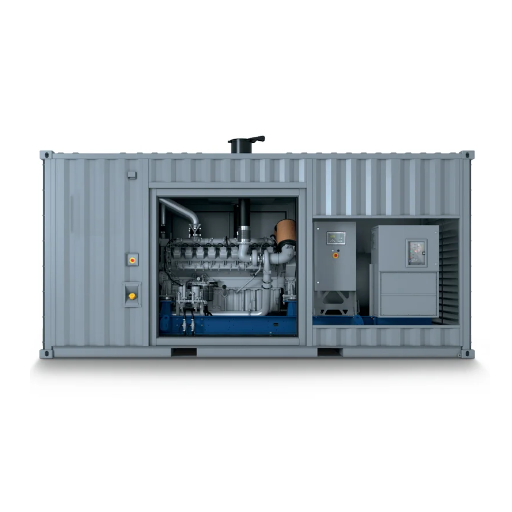
The boundary limit is the only number the permitting authority will measure. Everything upstream of it is a design assumption.
The three limits you will actually be measured against
The IFC environmental guidelines set one-hour LAeq limits at the nearest off-site receptor of 55 dB(A) by day and 45 dB(A) by night for residential, institutional and educational sites, and 70 dB(A) day and night for industrial and commercial receptors. They offer an alternative test: noise should not raise the background level by more than 3 dB. The IFC General EHS Guidelines are the reference most international lenders work to.
A national or municipal permit sets its own numbers and hours. Where a local limit exists, it governs; the IFC figure is a benchmark, not a substitute.
A rating method such as BS 4142 takes the specific sound level from your plant, applies character corrections for how it sounds, and compares the result against the measured background. It’s the method that fails plants which pass on level alone.
Distance, ground and the point-source approximation
For a source radiating over a reflecting ground, sound pressure falls approximately as LpA = LwA − 20 log₁₀(r) − 8, with r in meters. Each doubling of distance removes 6 dB, so doubling from 120 m to 240 m buys 6 dB. That’s usually cheaper than 6 dB of acoustic treatment and never appears in an equipment quotation. The approximation has a limit: a row of four 40 ft containers is more than 50 m wide, so near the array the sound does not fall away as a point source would.
The seven steps, worked end to end
Here is the arithmetic on a realistic case: eight units of 1,000 kVA in two rows of four, the boundary 120 m from the center of the array, and a night limit of 45 dB(A).
- Take the per-unit figure with its basis. The supplier confirms 72 dB(A) at 1 m, ISO 8528-10:2022, grade 2, at 75% of prime rating.
- Convert to sound power. The 297 m² enveloping surface adds 24.7 dB, so each unit radiates about 97 dB(A).
- Add the units. Eight identical sources add 10 log₁₀(8), which is 9 dB. The array radiates about 106 dB(A).
- Propagate to the boundary. At 120 m over reflecting ground: 106 − 20 log₁₀(120) − 8, or 56.4 dB(A).
- Compare against the limit. 56.4 against 45 is 11.4 dB over.
- Work back to a per-unit number. Each container would need to radiate 97 − 11.4, or 85.6 dB(A), about 61 dB(A) at 1 m.
- Read the result honestly. A 1,000 kVA container delivering 61 dB(A) at 1 m is not a catalogue item.
The seventh step is the useful one, and purchase orders skip it. The lever isn’t the specification. It’s the plant layout.
Tobias learned that on a six-unit site outside Bremen. The prediction came back at 54 dB(A) against a 45 dB(A) night limit, and his first instinct was to buy a quieter tier. The arithmetic said no tier would close nine decibels.
What closed it was a barrier built to the IFC minimum of 10 kg/m² continuous surface density with no gaps, plus a two-meter earth bund borrowed from the site’s own cut and fill. The plant passed at 44 dB(A). The barrier was a civil works item nobody had budgeted for, committed after the plinths were poured.
The Costs Nobody Quotes: Cooling, Tone and Night
Three costs sit outside the acoustic specification and decide most of the outcomes.
Attenuation is an airflow tax
A silent containerized generator has to reject heat. Of the fuel energy that goes in, about a third leaves as electrical work, about a third goes up the exhaust, and most of the rest enters the coolant and the air inside the box. That last portion leaves through the louvers, and every measure that reduces what leaves through a louver also reduces how much air leaves through it. Absorbent linings, splitter baffles and labyrinth paths all work by adding restriction and changing direction, and airflow pays for both.
Push a container into a heavily attenuated tier and the radiator starts asking for louver area it does not have. At plant scale this stops being a rounding error, because the derating applies to every unit at once on the hottest day of the year. Our containerized generator ventilation review covers that trade-off in detail.
Marta found out a season late. She specified the highest attenuation tier available for a six-unit plant outside Valencia, and it cleared the boundary with 7 dB to spare. The following August the plant derated on three consecutive days at 41 °C, because the attenuated louver could not pass the airflow the radiators needed. The acoustic margin was real.
The thermal margin had never been calculated, and the retrofit was an oversized louver with an acoustic splitter, fitted after the containers were built.
Tonality and impulsivity: the penalties that pass LAeq and fail the permit
BS 4142:2014+A1:2019 derives a rating level by adding character corrections to the specific sound level: up to +6 dB for tonality (+2 just perceptible, +4 clearly perceptible, +6 highly perceptible), up to +9 dB for impulsivity (+3, +6, +9), +3 dB for intermittency, and +3 dB for other distinctive characteristics. The BS 4142 method implementation document sets out how they are applied. The rating level is then compared with the background: about 10 dB above suggests significant adverse impact, about 5 dB above suggests adverse impact.
This is where a plant of identical units goes wrong in a way a single unit cannot. Diesel engines at steady load produce a tonal character around firing frequency and its harmonics, and eight of them is not eight times as tonal. It is tonal in a way that is harder to mask. A design predicting 48 dB(A) against a 45 dB(A) limit is a 3 dB problem until a +4 dB tonality correction makes it a 7 dB one.
Why the night limit is the one that binds
Ten decibels between the day and night IFC figures is a factor of ten in sound intensity. A standby plant that runs twice a year can negotiate an emergency condition. A prime power plant runs continuously, and the night limit is the one it lives or dies by.
What Goes Into the Plant Acoustic Specification
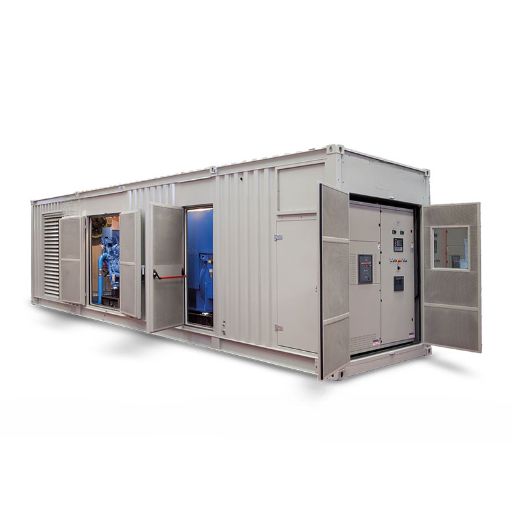
A specification for soundproof containerized power plants needs to be specific enough that a bidder can price it and a tester can accept or reject it.
| Item | What to state |
|---|---|
| Per-unit sound power | LwA per octave band from 63 Hz to 8 kHz, not only the A-weighted total |
| Measurement basis | Standard and edition, distance, load point as a percentage of prime rating, accuracy grade |
| Directivity | Which faces are loudest, and how the unit will be oriented on site |
| Array layout | Row positions, spacing, and orientation relative to the nearest receptor |
| Unit count by period | How many units run by day and how many at night |
| Cooling airflow | Required louver airflow per unit at the site design ambient, after acoustic treatment |
| Character corrections | Whether the limit is against LAeq or a rating level, and which method applies |
| Acceptance test | Who witnesses it, at what load, at what distance, and what happens if it misses |
Two of them matter most. Per-unit sound power per octave band is the number that lets a consultant model the plant at all; an A-weighted total alone will be rejected. Cooling airflow at design ambient is the number that stops an acoustic specification from creating a thermal failure six months later. The acceptance test matters too: a factory test on one unit in a supplier’s own bay is not the same measurement as eight units running at 02:00.
Four questions that separate a quotation from a specification
- What is the sound power level per octave band, not just the A-weighted total? If the answer is a single figure, the supplier has not modeled the plant and neither can you.
- At what distance, what load and what grade was that figure measured, and to which edition of the standard? A number without all four isn’t a number.
- What is the cooling airflow per unit at our design ambient, after the acoustic treatment? This is where acoustic tiers quietly fail.
- Who runs the boundary assessment, and against which limit? Supply and compliance are usually different contracts, and the gap between them is where projects fail.
For the hardware side, see our containerized heavy-duty diesel generator guide, and for the cases where the container premium does not pay back, the article on what containerized generator sets buy you.
Frequently Asked Questions
How loud is a soundproof containerized power plant?
There is no single answer, because the level depends on how many units run and where you measure. A single 40 ft container in a heavily attenuated tier might measure 65 to 75 dB(A) at 1 m; eight of those combine to roughly 9 dB above the single-unit figure.
How many dB do multiple generators add together?
Each doubling of identical, uncorrelated units adds 3 dB. Two add 3, four add 6, eight add 9, ten add 10. Ten identical generators are 10 dB louder than one, heard as roughly twice as loud, not ten times.
What noise limit applies to a containerized power plant?
Whichever limit is in your permit. The most portable international reference is the IFC guideline: 55 dB(A) by day and 45 dB(A) by night at the nearest receptor, or no more than a 3 dB rise above background.
Is a soundproof container the same as a sound-attenuated one?
Soundproof is a marketing word with no standard definition. Sound-attenuated describes a container with a measured attenuation performance, stated as a sound power level per octave band, at a stated distance and load, to a stated grade. If a supplier cannot give the measurement basis, the claim is unquantified.
Can you retrofit acoustic treatment to containers already on site?
Sometimes, and the cost depends on which face is the problem. Added lining and door seals are straightforward. Louver changes are harder, because the acoustic fix and the airflow requirement pull against each other. Retrofitting the array layout is cheapest and most often missed: rotating a container so a different face points at the receptor costs nothing.
Conclusion
Soundproof containerized power plants are sets of sources, not single products. What decides the assessment is how many run, how far the boundary is, what stands in the way, and which face points at the nearest receptor.
Three decisions carry most of the work. Convert every quotation to sound power before comparing, so a quote that reads four decibels quieter cannot turn out to be five decibels louder. Add the units before you evaluate the site, not after the plant is standing. And write the airflow figure into the same clause as the noise figure, because the two are bought together either way.
Everything else is in the layout. Halving the night-time unit count is worth 3 dB. Doubling the distance to the boundary is worth 6. Neither costs anything at the specification stage, and neither is available once the plinths are poured. Both are decided in the containerized generator GA drawing review, before fabrication begins.
Send us the site plan, the limit and the unit count, and we will tell you what the arithmetic returns. Request a factory quote and we will answer in sound power, per octave band.