
What Size Wire for a 30 Amp Breaker?
What size wire for a 30-amp breaker? Ten-gauge copper, or 8 AWG if you’re running aluminum. Those two answers cover almost everything people are actually wiring.
Here’s the part that catches people out. That 10 AWG copper is rated to carry more current than the breaker will ever allow.
In one of the code’s ampacity columns it’s good for 40 amps. Put it on a 40-amp breaker anyway and you fail inspection. The wire isn’t the limiting factor. The breaker is, and there’s a reason the rule works that way.
At ZC Power we build generator sets from 8 kVA to 4000 kVA, and every one of them connects to a building through conductors sized this way. The arithmetic is the same whether the run ends at a dryer or at a 1000 kW genset.
This guide gives you the direct answer, the three conditions that change it, and the one case where the run stops looking like a house circuit at all. If you’re wiring a generator inlet rather than a branch circuit, the gauge doesn’t change but the rules around it do, and our generator transfer switch guide covers that end of it.
Key Takeaways
- 10 AWG copper is the standard conductor for a 30 amp circuit. 8 AWG aluminum is the equivalent, because aluminum carries less current for the same size.
- 10 AWG copper is rated 30, 35 or 40 amps depending on the insulation temperature rating. A 30 amp breaker is still the maximum permitted.
- 12 AWG can’t go on a 30 amp breaker. The code caps it at 20 amps, and no amount of upsizing elsewhere changes that.
- Runs beyond roughly 100 to 150 feet at 240 volts need 8 AWG copper for voltage drop. At 120 volts the threshold arrives at about 50 to 60 feet.
- A 30 amp RV outlet is 120 volts, not 240. Wiring it like a dryer outlet damages equipment, and it’s a common and expensive mistake.
What Size Wire for a 30 Amp Breaker? The Short Answer

Ten-gauge copper, and it’s ten-gauge for the same reason every time: the conductor’s ampacity has to meet or exceed the breaker rating.
| Conductor | Size for a 30-amp circuit |
|---|---|
| Copper | 10 AWG |
| Aluminum | 8 AWG |
| Equipment grounding conductor, copper | 10 AWG |
Everything below explains when it stops being right.
Copper, Aluminum and the Grounding Conductor
Copper and aluminum aren’t interchangeable at the same size. Aluminum conducts less current for a given cross-section, so it has to be two sizes larger to carry the same load. That’s why 30 amps takes 10 AWG copper but 8 AWG aluminum.
Ten gauge aluminum is a different matter. It’s limited to 25 amps of overcurrent protection, so it can’t serve a 30-amp breaker at all. If you’ve got 10 AWG aluminum in a wall and want a 30-amp circuit, the wire has to be replaced, not repurposed.
The equipment grounding conductor follows its own table rather than the ampacity table, and for a 30-amp circuit it’s 10 AWG copper.
Why the Temperature Rating Decides the Number
Conductor ampacity depends on how hot the insulation can safely get. The code publishes three columns, at 60, 75 and 90 degrees Celsius. Ten gauge copper appears in all three.
| Insulation temperature rating | 10 AWG copper ampacity |
|---|---|
| 60 C | 30 A |
| 75 C | 35 A |
| 90 C | 40 A |
You don’t get to pick the highest number. The ampacity you use can’t exceed the lowest temperature rating anywhere in the circuit, including the terminals of the breaker, the receptacle and every splice.
Most residential cable of the non-metallic type is limited to the 60 C column regardless of what the copper inside it could take. That single fact is why the working answer for a house circuit is 30 amps, and why the same copper in a different jacket reads as a 40 amp conductor on a spec sheet. Always check the terminal markings, and when they’re unmarked, assume 60 C.
Why 10 AWG Can’t Go Higher
Even where the 75 C or 90 C column applies, a separate rule blocks the obvious move.
The code’s small conductor rule sets an absolute ceiling on the overcurrent device for the smaller wire sizes, whatever the ampacity tables say. Fourteen gauge is capped at 15 amps, twelve at 20, and ten gauge copper at 30 amps.
That cap exists because small conductors are the ones most likely to be installed by people who aren’t electricians, in the places least likely to be inspected.
So ten-gauge copper with 90 C insulation has a 40 amp ampacity and still can’t sit behind a 40 amp breaker. Upsizing the wire never lets you upsize the breaker. The two decisions are separate.
Illustrative composite. Marcus was finishing a workshop subpanel with a part reel of 10 AWG THHN left over. He read the 90 C column, saw 40 amps, and installed a 40 amp breaker to match. The inspection failed on the first visit. His wire was fine for 40 amps of current and still illegal on a 40 amp breaker, because the small conductor rule caps ten gauge at 30. The inspector’s note was one line: replace the breaker. This scenario is illustrative, not a record of a specific customer.
What Size Wire for a 30 Amp Breaker? When the Answer Changes

Ten gauge copper is the default. Three conditions override it.
Long Runs and Voltage Drop
Ampacity tables say nothing about distance. A conductor can be perfectly sized for current and still deliver a voltage at the far end that’s too low to run the equipment.
The code recommends a 3 percent drop on the branch circuit and no more than 5 percent total across the feeder and the branch together. Those figures sit in informational notes rather than enforceable text, so a design that meets the ampacity tables passes inspection even if it exceeds them. Many plan reviewers treat them as mandatory anyway, and some local authorities adopt them outright.
In practice, for a 30-amp circuit:
- At 240 volts, 10 AWG copper is generally adequate to about 100 to 150 feet.
- At 120 volts, upsize to 8 AWG beyond roughly 50 to 60 feet.
The gap between those two numbers surprises people. Voltage drop is proportional to current times distance divided by conductor size, and at half the voltage the same loss is twice the percentage.
Upsizing for voltage drop doesn’t license a larger breaker. Run 8 AWG to beat the drop on a long 30 amp circuit and the breaker stays at 30 amps.
120 Volts Versus 240 Volts
The voltage doesn’t change the wire size at 30 amps, but it changes almost everything else about the installation.
A 240 volt circuit uses two ungrounded conductors and a two-pole breaker, so both legs disconnect together. A 120 volt circuit uses one ungrounded conductor and a single-pole breaker. Both are 30-amp circuits, and they aren’t interchangeable.
Motor and HVAC Circuits
Motors are the one place the rules loosen, and it’s because a motor needs more current to start than to run.
The code permits a larger overcurrent device on a motor circuit than the conductor ampacity would normally allow, provided the motor has its own overload protection sized to the actual running current. The overload device protects the conductor. The breaker protects against short circuit.
That’s why you’ll occasionally see a 30-amp breaker on conductors that wouldn’t normally sit behind one, on an air conditioner or a pump. It isn’t a loophole for general wiring. The exception applies to the motor circuit, not to the receptacle circuit you’re adding in the same panel.
If you’re sizing supply for motor loads rather than wiring a branch circuit, motor starting and generator sizing covers the surge arithmetic that governs the answer.
Matching the Wire to the Circuit
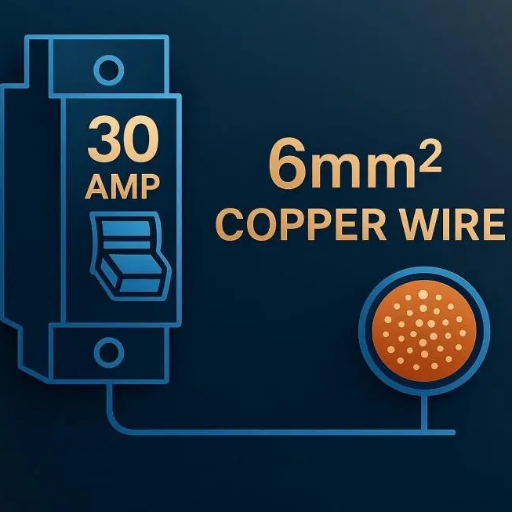
The gauge is the same across all of these. The conductor count isn’t, and that’s where the money and the mistakes are.
| Circuit | Voltage | Conductors | Breaker |
|---|---|---|---|
| Clothes dryer | 120/240 V | 10/3 with ground | Two-pole |
| RV receptacle | 120 V | 10/2 with ground | Single-pole |
| Water heater, no neutral | 240 V | 10/2 with ground | Two-pole |
| Water heater with neutral | 120/240 V | 10/3 with ground | Two-pole |
| Subpanel feeder | 120/240 V | 10/3 with ground | Two-pole |
| Generator inlet | 120/240 V | 10/3 with ground | Two-pole |
Every 120-volt circuit takes 10/2, and every 120/240 volt circuit takes 10/3 with ground.
Dryer Outlets
An electric dryer on a 30 amp circuit needs 10/3 with ground, which is three current-carrying conductors plus a grounding conductor, wired to a four-wire receptacle.
Three-wire dryer receptacles exist in older homes and the code grandfathers them, but new installations require the four-wire arrangement.
RV Outlets, and Why 30 Amp Isn’t Always 240 Volts
This is the most expensive mistake in the whole subject, so it’s worth stating plainly.
A standard 30-amp RV receptacle is 120 volts, wired on a single-pole breaker with 10/2 with ground. One ungrounded conductor, one neutral, one ground.
A 30-amp dryer receptacle is 120/240 volts, wired on a two-pole breaker with 10/3 with ground.
Both are described as 30 amp, and the plugs differ so they can’t be confused. Wire an RV outlet as though it were a dryer outlet and you send 240 volts into equipment designed for 120, which usually destroys the converter and often more. Check the receptacle type before you pull cable.
Water Heaters and Subpanels
A 240 volt water heater that uses no neutral can run on 10/2 with ground on a two-pole 30 amp breaker. If the unit needs a neutral, it needs 10/3. Follow the nameplate, because the nameplate is the authority rather than the general rule.
A 30 amp feeder to a small subpanel also needs 10 AWG copper, and a subpanel takes a four-wire feed. The neutral and the ground must stay separate at the subpanel. Most people who get this wrong do so because the main panel bonds neutral and ground together and they repeat that arrangement downstream. The bonding happens once, at the service.
What Size Wire for a 30 Amp Generator Inlet
A generator inlet is an outdoor receptacle that lets you plug a generator into your building’s wiring. The run goes from the inlet box to a transfer switch or an interlock, and from there into the panel.
For a 30 amp inlet the answer doesn’t change: 10 AWG copper, typically 10/3 with ground, feeding a two-pole 30 amp breaker. The inlet itself is usually a twist-lock configuration, and the breaker has to match the inlet rating.
That’s where the similarity to a dryer circuit ends.
Why a Transfer Switch or Interlock Is Required
You can’t simply backfeed a generator into a panel through a breaker. Doing so energizes the utility lines that the utility believes are dead, which puts line workers at risk, and it can destroy your generator when the grid comes back.
The code requires transfer equipment that makes it impossible for the utility supply and the generator supply to be connected at the same time. Either a transfer switch or a listed interlock kit for your specific panel satisfies this. A double male cord doesn’t, and it’s illegal for good reason.
The Floating Neutral Question
Portable generators sold for home backup usually have their neutral bonded to the frame. A transfer switch that switches the neutral expects the generator’s neutral to be floating instead.
Get this backwards and you create a second neutral-to-ground bond downstream of the service, which causes nuisance tripping and can energize parts of the grounding system that should sit at zero volts. Check the generator’s manual and the transfer switch instructions together, because this isn’t a detail to infer.
When to Move to 50 Amps
Thirty amps at 240 volts is 7,200 watts. That’s enough for a well pump, a furnace blower, a refrigerator and lighting at the same time.
It isn’t enough for central air conditioning plus a well pump plus a water heater. If those are the loads you want to carry, the answer is a 50-amp inlet and 6 AWG copper rather than 10.
The correct way to decide is to build the load list and add the largest single starting surge, which is the method in our generator load calculation guide. Don’t size the inlet first and discover the loads afterwards.
Illustrative composite. A homeowner in a rural area installed a 30 amp inlet and generator to cover outages, working from the inlet backwards. The first real outage lasted two days. The furnace blower ran, the well pump ran, and the air conditioning didn’t, which he hadn’t thought about. Upgrading to 50 amps meant 6 AWG copper, a new breaker, a new inlet box and a new cord. The generator was fine. The connection had been sized before the load list existed. This scenario is illustrative, not a record of a specific customer.
For site electrical requirements beyond the inlet itself, our stationary generator installation requirements cover the rough-in inspection stage at which conductor sizing is verified. If you’re working in metric or specifying equipment outside North America, converting between kilowatts and kilovolt-amperes covers the rating arithmetic that sits upstream of any conductor decision.
Aluminum Wire and the Connection Problem
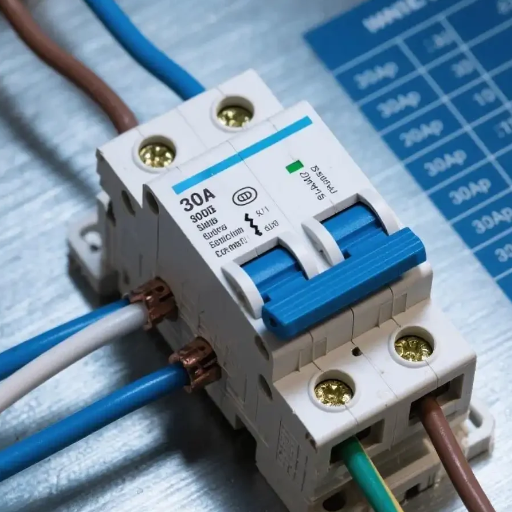
Aluminum is legal, and 8 AWG aluminum on a 30 amp circuit is a compliant installation. The problem isn’t the conductor. It’s what happens where it terminates.
Why Aluminum Terminations Fail
Builders installed solid aluminum branch circuit wiring widely in the United States between roughly 1965 and 1973, when copper prices spiked. The connections at outlets, switches and breakers deteriorate over time. They heat, they oxidize, and they can arc inside a wall.
The Consumer Product Safety Commission has published on this for decades, and its guidance places the failure at the connection rather than in the conductor.
The warning signs are worth knowing if you live in a home from that period: faceplates that feel warm, lights that flicker, a smell of hot plastic, or breakers that trip repeatedly without an obvious cause. Any of those warrant an electrician.
What a Compliant Repair Involves
The recognised approach is to join a short length of copper to the aluminum at each termination, using a method the Commission has tested, so that the device connects to copper rather than to aluminum.
The specific methods the Commission accepts have changed over time, and this is a case where second-hand summaries are unreliable. Several pages on the internet assert which connector is currently approved, and they disagree with each other. Consult the current CPSC publication directly, and use a qualified electrician for the work.
What’s safe to say is that twist-on connectors alone aren’t an adequate repair, and neither is simply replacing a receptacle with one marked for aluminum. Both leave the underlying connection problem in place.
Frequently Asked Questions
What size wire do I need for a 30 amp breaker?
10 AWG copper, or 8 AWG if you’re using aluminum. The equipment grounding conductor is 10 AWG copper. That holds for any standard 30 amp branch circuit in North America.
Can I use 12 AWG wire on a 30 amp breaker?
No. Twelve-gauge copper is capped at 20 amps of overcurrent protection, and the cap applies regardless of the insulation rating or the load. A 30 amp breaker on 12 AWG is a code violation and a fire risk, and it’ll fail inspection.
Does 10 AWG wire handle 30 amps or 40 amps?
Both figures are real and they answer different questions. Ten-gauge copper has an ampacity of 30, 35 or 40 amps depending on the insulation temperature rating. The small conductor rule caps the breaker at 30 amps in any of those cases, so the practical answer for a general circuit is 30.
How far can I run 10 AWG on a 30 amp circuit?
About 100 to 150 feet at 240 volts before voltage drop becomes a concern, and closer to 50 to 60 feet at 120 volts.
If you’re sizing the equipment rather than the conductors, a load assessment will tell you which inlet rating you actually need. Talk to the ZC Power engineering team before you commit to a gauge.
Conclusion: The Gauge Is Easy, the Conditions Are the Answer
Ten gauge copper. That’s the answer to what size wire for a 30 amp breaker, and it’s worth knowing before you read anything else.
What matters in the rating is everything around it. The conductor is rated higher than the breaker allows, and the rule that caps it is why a bigger wire never buys a bigger breaker. Long runs need more copper at 120 volts than at 240.
A 30 amp RV outlet is a different animal from a 30 amp dryer outlet despite the shared number. And a 30-amp generator inlet answers to a transfer switch requirement that a dryer circuit never sees.
Three habits are worth carrying away:
- Match the breaker to the conductor, not the conductor to the breaker. The cap runs one way.
- Check the receptacle configuration before you pull cable. It tells you the voltage, and the voltage decides the conductor count.
- Build the load list before you size the connection. It’s the only order that doesn’t end in a second installation.
Get those right and the wire size stops being a guess. It becomes the last line of a calculation you’ve already done.