Three-Phase Industrial Diesel Generator: Load-Side Guide
The load defines an industrial three-phase diesel generator it carries, not its phase count. The loads on a modern factory floor are no longer just induction motors and resistive heaters. They are variable frequency drives, rectifiers, and switch-mode power supplies, and they change what the alternator has to do at the same kilowatt rating.
Here is the counterintuitive part. A perfectly balanced three-phase load can still push current through the neutral conductor. Not a small amount, and not because of a wiring error.
The harmonic currents that non-linear loads produce add together in the neutral instead of cancelling, and the resulting current can climb toward a ceiling set by the square root of three. Most buyers discover this after commissioning rather than before it.
If you specify a three-phase industrial diesel generator for a plant with modern electronic loads, this guide covers what changes: how harmonic distortion derates an alternator, what the standards set as limits, why the fix is kVA and a line reactor rather than a larger engine, and what to write into your RFQ.
Key Takeaways
- A balanced three-phase load does not mean zero neutral current. Triplen harmonics are in phase with each other and sum in the neutral, reaching a theoretical ceiling of roughly 173% of phase current.
- IEC 60034-1 conditions generator suitability on a current harmonic content factor of no more than 0.05, with negative-sequence and zero-sequence components each held under 5% of positive-sequence.
- Published derating guidance for non-linear loads runs from 15% to 40%, and the wide spread exists because the figure depends on how much of your load is non-linear and what kind. A single number without that context is not useful.
- The corrective lever is usually kVA rather than kW. Harmonic current raises RMS current and heating without adding useful output, so a set sized correctly on kW alone runs hot.
- Ask any supplier to state the excitation system and subtransient reactance. PMG excitation and low reactance are what keep an AVR stable when the terminal voltage is distorted.
What Makes a Three-Phase Set Industrial
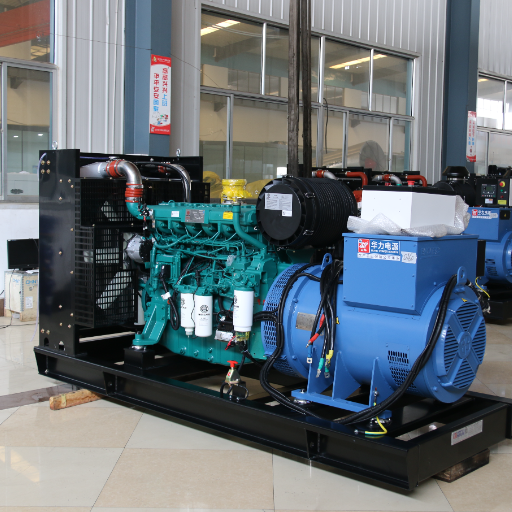
Before the load-side detail, it is worth being precise about what the word industrial is doing in this phrase. It is not a synonym for large. A 100 kVA set and a 2,000 kVA set can both be industrial or both be light commercial, and the phase count does not decide it.
Three things separate the two. The first is duty rating. An industrial set is specified on prime or continuous power, meaning it carries load as the primary source for extended periods.
A light commercial standby unit is rated for short outages and a limited number of hours per year. Confusing the two is the most common specification error we see, because the same machine carries different numbers under each rating.
The second is load profile. Industrial loads include large direct-on-line motors, high inrush, and a substantial share of non-linear electronics. Commercial loads are mostly linear and far gentler.
The third is site conditions, which derate output for altitude, ambient temperature, and dust. Those are covered in depth in our heavy duty diesel generator buying guide, along with ratings, fuel consumption, brand selection, and total cost of ownership. This article deliberately does not repeat that material. It covers the one axis that guide does not: how the load behaves electrically once the set is running.
Why a Balanced Three-Phase Load Still Pushes Current Through the Neutral
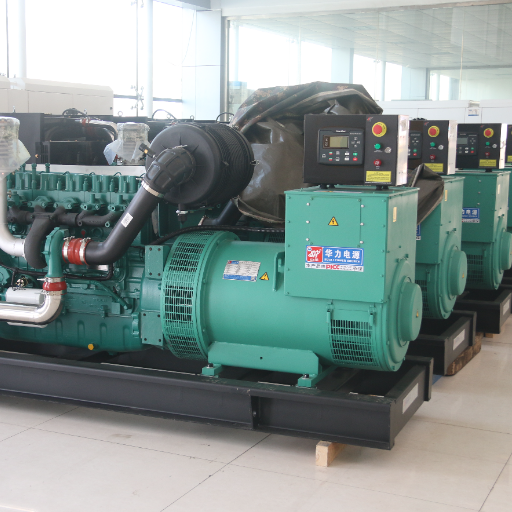
Direct answer: because triplen harmonics are zero-sequence, which means the three-phase currents are in phase with each other rather than 120 degrees apart. They cannot cancel, so they sum in the neutral even when the fundamental currents are perfectly balanced.
That single sentence explains most of the confusion around neutral sizing on modern three-phase systems. The rule that balanced loads produce no neutral current is correct for linear loads. It stops being correct the moment the load is non-linear.
Triplen harmonics add instead of cancelling
Harmonics are currents at integer multiples of the fundamental frequency. The ones that matter most on a three-phase system are the third, ninth, fifteenth, and so on, collectively called triplen harmonics because their order is a multiple of three.
Take the third harmonic. Its phase angle is displaced by three times 120 degrees, which is 360 degrees. A full rotation returns it to where it started. The practical consequence is that the third-harmonic currents on all three phases point the same direction simultaneously, so they add arithmetically in the neutral instead of subtracting.
Fifth and seventh harmonics behave differently. They are negative- and positive-sequence respectively, and cause thermal damage inside the alternator rather than in the neutral. Both matter, for different reasons.
How high the neutral current can go
If the triplen content is at its theoretical worst, the neutral current reaches the square root of three times the phase current, or roughly 173%.
Treat that figure as the arithmetic ceiling rather than a typical measurement. Real installations rarely sit at worst case, because real drives and rectifiers do not produce pure third-harmonic content. The useful point is the direction and magnitude of the effect. A neutral conductor sized on the assumption that balance means no current has no margin at all for a load that can push it past the phase current.
This is not a generator-side problem, and no alternator specification fixes it. The neutral, the panelboard, and the feeder have to be sized for it separately.
Why neutral sizing by rule of thumb fails here
Older practice often sized the neutral at a fraction of the phase conductor, on the reasoning that balanced loads make neutral current negligible. That reasoning holds for linear loads and fails for the equipment now common in industry.
Delta-connected supplies are one mitigation, because triplen current circulates in the delta loop rather than returning through the neutral. Note the trade-off: the delta then has to be derated for the current trapped inside it. Line reactors, twelve-pulse drives, and active filters reduce the harmonic current at the source, which is the cleaner answer where the budget allows it.
What this looks like on a real plant floor
Priya, an electrical engineer at a food-processing plant in Gujarat, is an illustrative composite of a pattern that regularly reaches our engineering desk. Her plant added a bank of drive-controlled conveyor motors, evenly distributed across all three phases, and the installation was textbook balanced.
Fourteen months later, a routine thermographic scan found heat damage on the neutral bar at the main panel. Every one of those drives had been injecting triplen current, and it had been summing in the neutral the entire time. Nothing was miswired and no load was unbalanced. The distribution board simply had no margin for a current nobody had expected it to carry.
How Non-Linear Loads Derate Your Three-Phase Industrial Diesel Generator
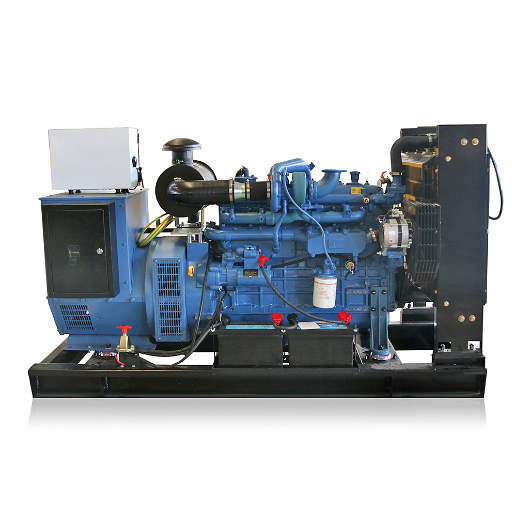
Now to the alternator itself. This is where a set that passed its factory load test can still run hot on site, and the reason is worth understanding precisely.
Harmonic current adds to the fundamental current while contributing nothing to useful power output. Alternator losses rise with the square of RMS current, so the machine gets hotter without producing more kilowatts. Skin effect and eddy currents in the laminations add further heating at higher harmonic orders. The result is an alternator operating above its intended temperature rise at a load that looks correct on a kW meter.
The limits IEC 60034-1 and ISO 8528-3 actually set
Two standards govern this, and they work together.
IEC 60034-1, which was revised in March 2026 as Edition 15.0, is the governing document for rating and performance of rotating electrical machines. It conditions the suitability of a three-phase generator for its network on the current harmonic content factor not exceeding 0.05, summed over harmonic orders up to the thirteenth, and on neither the negative-sequence nor the zero-sequence current component exceeding 5% of the positive-sequence component.
ISO 8528-3:2020 sits underneath that and addresses alternating current generators for generating sets specifically. It supplements the IEC requirements and covers special load conditions directly, including unbalanced load current, excess current capability, and total harmonic distortion.
The practical reading is that a machine is only considered suited to a distorted network inside those limits. Outside them, you are in derating territory, and the standard does not tell you how much.
Want the load-side numbers for your own site? Send us your load list and the share that is drive-fed, and our engineering team will work through the harmonic and starting picture with you. Talk to a ZC Power engineer.
THDi by load type
This is where published guidance varies widely, and the variation is informative rather than a contradiction. The derating figure depends on how much of the load is non-linear and what kind of rectifier it uses.
| Load type | Typical current THD | Practical implication |
|---|---|---|
| VFD without a line choke | 80% to 100% | Worst common case. Derate hard, or specify a choke |
| Older double-conversion UPS | 25% to 35% | Common in existing plants and often overlooked |
| LED lighting and switch-mode supplies | Variable, often high per unit | Small individually, significant in aggregate |
| Active front end or active PFC | 5% to 10% | Close to linear. Minimal derating |
| Twelve-pulse or eighteen-pulse rectifier | Lowest of the rectifier family | Specify it rather than derate for it |
Manufacturer guidance for alternators on non-linear loads commonly recommends a derating margin somewhere between 15% and 40%, with ISO 8528-3 as the reference framework. If you have seen a single figure quoted, such as 15% to 25%, treat it as a description of a particular load mix rather than a rule that transfers to yours.
A note on consistency, offered plainly. Published figures for non-linear derating genuinely disagree, including across our own technical articles. The reason is that almost none of them state the load composition the number assumes. When you compare quotes, ask each supplier what non-linear share their derating figure was calculated for. A supplier who cannot answer that has given you a number, not an engineering position.
Tomas, a project engineer at a metal fabrication plant in northern Mexico, is an illustrative composite too, and his project shows the expensive version of this mistake. His team built a careful load schedule, totalled it just under 500 kW, and ordered a 700 kVA set with a comfortable margin by their calculation.
The margin was real on paper and gone in practice. Roughly 60% of that plant’s load was rectifier-fed, and the harmonic current pushed the alternator well past its intended temperature rise at what the meter read as a normal load. The remedy was not a larger engine. It was a larger kVA rating plus line reactors on the worst drives, which cost far less than the set they had already bought.
Why the fix is kVA, not kW
Because harmonic current consumes thermal capacity without delivering power, the corrective move is to increase the kVA rating rather than the kW rating.
A set chosen against a careful kW calculation can still be undersized, because the kW total describes what the load does with the power and the kVA total describes what the alternator has to carry to deliver it. Once harmonic current is present, the gap between the two widens.
This is also where the AVR earns its place. Under a distorted terminal voltage, a poorly regulated excitation system can oscillate or struggle to hold the set point. That leads to the next specification point.
PMG excitation and subtransient reactance
Two alternator characteristics decide how gracefully a machine handles a distorted load.
Permanent magnet generator (PMG) excitation supplies the AVR from a separate permanent-magnet source rather than from the main winding. When the main winding’s voltage waveform is distorted, a PMG keeps the regulator’s reference clean. An auxiliary winding design is the common alternative and performs well when it is properly engineered.
Low subtransient reactance, written X″d, determines how much the terminal voltage distorts under a given harmonic current. Where the load’s harmonic distortion is high but the permissible voltage distortion is low, the source impedance has to be low, and that means specifying an alternator with a low reactance figure.
Manufacturer application guidance in this area also points to keeping total continuous load inside the alternator’s Class F temperature rise rating when harmonics are present, so that stator and rotor components stay within their insulation class limits. Ask for the alternator’s temperature rise class in writing.
Rafael, a distributor in Colombia, is an illustrative composite of the third pattern. He was comparing two alternator options on a set destined for a plant with a heavy drive load, and the two datasheets looked nearly identical apart from price. He chose the cheaper one.
The difference was in a line neither he nor the buyer had flagged. One option specified PMG excitation and the other did not, and that difference only becomes visible once the load is distorted and the AVR is trying to hold a set point against a waveform that keeps moving. Two datasheets agreeing on kVA, voltage, and frequency can still be different machines for the load in question.
Motor Starting on an Industrial Three-Phase Bus
Motor starting is the second load-side effect that separates an industrial specification from a commercial one, and on a three-phase bus it compounds with everything above.
A direct-on-line motor draws roughly six to eight times its full load current during starting. On a bus with large pumps, compressors, or crushers, the starting transient often sets the generator size, rather than the running load. Adding harmonic-producing drives to that same bus makes the transient harder to ride through, because the alternator has less thermal headroom available when the motor starts.
The sizing method is covered in motor starting generator sizing, and the inventory approach in generator load calculation. The point to carry forward is sequencing: start the largest motor first, so the alternator does not absorb the transient while already carrying harmonic current.
For a set that will carry both, a soft starter or a variable frequency drive on the largest motor is frequently cheaper than the next frame size up. That is a genuine engineering trade-off and worth pricing both ways.
What to Specify in Your RFQ for a Three-Phase Industrial Diesel Generator
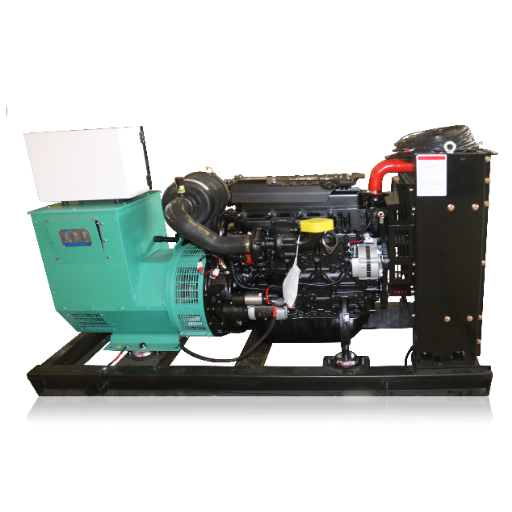
The gap between a good specification and a general one is almost entirely in the load description. Here is what to put in writing.
- Load composition. State the total connected load and, separately, the proportion that is non-linear. Drives, UPS systems, rectifiers, and switch-mode supplies go in the second bucket even though they appear in the first.
- Starting requirements. List the largest motors with their starting method, whether direct-on-line, star-delta, soft start, or drive-controlled, and whether they can be sequenced.
- Harmonic limits. Ask the supplier to confirm the alternator’s current harmonic content factor against IEC 60034-1 and to state the derating they have applied and the load mix it assumes.
- Excitation and reactance. Ask for the excitation type, PMG or auxiliary winding, and the subtransient reactance figure.
- Temperature rise class. Ask for the alternator’s insulation and temperature rise class, and whether the continuous rating assumes harmonics are present.
- Neutral and distribution. The generator neutral is only part of the picture. Confirm the neutral conductor, panelboard, and feeder sizing with the electrical designer, since that is where triplen current does its damage.
- Duty rating. State prime or standby explicitly, with expected annual hours. Never compare one supplier’s prime figure against another’s standby figure.
Two related areas sit outside this list. Voltage and frequency matching for the destination grid is covered in three-phase generator sizing and the three-phase generator primer, and translating a load list into a rating in kVA to kW conversion.
Frequently Asked Questions
Q: Does a three-phase industrial diesel generator need derating for VFD loads?
Yes, in most cases. A VFD without a line choke can draw current with total harmonic distortion between 80% and 100%, which heats the alternator without adding output. Published derating guidance for non-linear loads ranges from 15% to 40%, depending on the share and type of non-linear load. The precise figure has to be calculated against your load mix.
Q: Can a balanced three-phase load produce neutral current?
Yes. Balanced fundamental currents cancel in neutral, but triplen harmonic currents are zero-sequence, so they are in phase across all three phases and add instead of cancelling. Under worst-case triplen content the neutral current can approach 173% of phase current. Real installations sit below that ceiling, but the effect is real and the neutral must be sized for it.
Q: Why is the fix for harmonics more kVA than more kW?
Because harmonic current consumes the alternator’s thermal capacity while contributing nothing to useful power. Losses rise with the square of RMS current, so the machine runs hotter at the same kW output. Increasing the kVA rating restores the thermal margin, which increasing the kW rating alone does not.
Q: How do I know what my actual harmonic load is?
Measure it. A power quality analyzer on the main distribution board will show total harmonic distortion of both current and voltage, and the individual harmonic orders. That measurement is what turns a generic derating range into a specific figure for your site, and it is worth taking before you place an order rather than after.
Conclusion: Specify the Load, Not the Generator
The lesson that takes longest to land is that an industrial three-phase diesel generator is a load-side component before it is a supply-side one. Phase count and kilowatts describe the machine. Load composition describes whether that machine will still be inside its limits after two years of running.
Three things are worth carrying into your next specification. Balanced does not mean zero neutral current once non-linear loads are present, so neutral and distribution sizing need their own review. The derating number you are quoted is meaningless without the load mix it assumes, so treat a bare percentage with suspicion. And the corrective lever is usually kVA, excitation quality, and line reactors rather than engine size.
If you have a load list with a significant share of drive-fed equipment, the useful next step is a conversation about the numbers rather than a catalogue. Our engineering team works through load composition, harmonic exposure, starting sequence, and duty rating with you, and every set we build is full-load tested in our national standard testing center before it ships.
Send us your load list and we will come back with the harmonic and starting picture, the rating it implies, and a factory-direct quote for a three-phase industrial diesel generator matched to it.


